Cantung Mine Closure and Reclamation Project
Learn about the Cantung Mine Closure and Reclamation Project, the work that's been done and what's ahead.
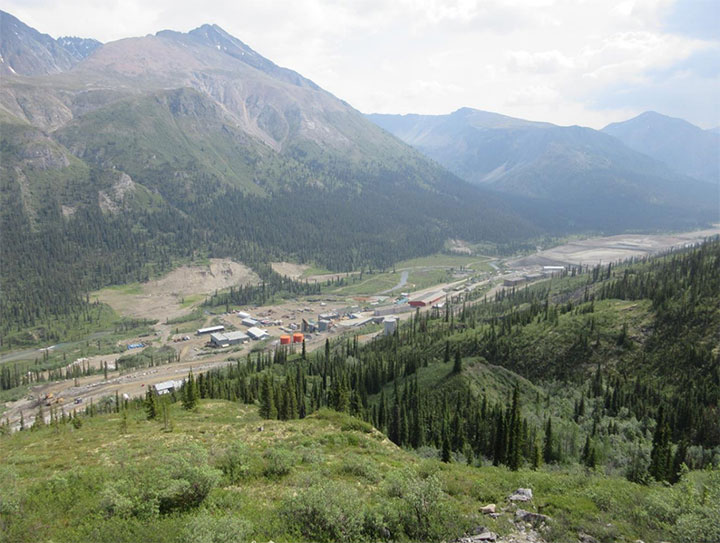
The Cantung Mine site sits nestled in the middle of a valley with a mountain range in the background and green trees and other foliage in the foreground. The mine site is made up of buildings and structures, with an access road running through the middle
On this page
Overview
Cantung Mine is a former tungsten mine located in the southwest corner of the Northwest Territories, approximately 720 kilometres west of Yellowknife and 390 kilometres from Whitehorse, Yukon. There is seasonal access to the mine by road from Watson Lake, Yukon.
Prospectors originally discovered tungsten in the area in 1954. The name Cantung is an abbreviation of the original company name, the Canada Tungsten Mining Corporation Limited. This company built the open pit mine upslope of the Flat River before continuing to mine underground. When the mine first opened, a small community called Tungsten was established for workers and their families, along with a small Tungsten (Cantung) Airport. During mine operations, the town of Tungsten was home to 650 people.
The mine was operational from 1962 to 1986. Workers, supplies and ore were transported primarily through the 300-kilometre gravel Nahanni Range Road, which extends from the mine site into the Yukon, and alternately through the gravel airstrip. Over those years, the mine saw several changes in ownership and several periods of care and maintenance.
As tungsten prices fell, the mine stopped operating and the town of Tungsten ceased permanent habitation by 1986, yet infrastructure remains.
North American Tungsten Corporation Limited purchased the mine in 1997 and the mine operated again from 2002 to 2003 and from 2005 to 2009. At one point in 2007, it was reported that Cantung Mine and the nearby Mactung deposit (also owned by North American Tungsten Corporation Limited) at the time together contained 15% of the world's known tungsten. Production was again suspended at Cantung from 2009 to 2010, and mining operations ceased when North American Tungsten Corporation Limited became insolvent in 2015. The mine site then re-entered care and maintenance for the final time.
Though the company has been under creditor protection since 2015, North American Tungsten Corporation Limited continues to own the Cantung Mine and is responsible for the site under the terms of its water licence, issued by the Mackenzie Valley Land and Water Board. A court-appointed monitor, Alvarez & Marsal Canada Inc., has been funded by the Government of Canada since November 2015 to oversee care and maintenance activities, environmental management and closure planning.
The Cantung Mine Closure and Reclamation Project (the Project) is funded through the Northern Abandoned Mine Reclamation Program.
Project goals
The Cantung mine is progressing towards permanent closure. The overarching closure goal for Cantung is to return the mine site and associated affected areas to viable and, where able, self-sustaining ecosystems that are compatible with a healthy environment and with human activities.
To support this overarching goal, 6 Project-specific sub-goals were developed. These sub-goals were informed by dialogue with and input from the Project's Indigenous partners. They are:
- The closure planning process occurs collaboratively where trust is built by acknowledging and respecting Indigenous rights, values, and priorities.
- The final landscape is guided by Traditional and cultural knowledge, understanding of pre-development conditions, historical land uses, and community and Indigenous priorities for post-closure use.
- The land and water are safe for people, wildlife, aquatic life, and plants.
- The site returns to a healthy environment that is supportive of Traditional and cultural uses and requires no long-term active care.
- The site is remediated in a manner that instills public confidence.
- The site remediation is designed to maximize opportunities for Indigenous and local socio-economic benefits.
Closure components
The mine site contains standard mining infrastructure, including:
- mill and surface plant facilities
- water management facilities
- an open pit
- underground mine workings
- waste rock storage areas
- ore stockpiles
- tailings areas
- landfills
- various site access roads
There is also the townsite (Tungsten) that contains:
- accommodations such as single-family homes and apartment complexes
- a recreational facility.
The site is currently undergoing final closure planning. The Project team is in the process of identifying closure options for the mine components with its Indigenous partners. This work will help the Project team create a final closure and reclamation plan.
Engagement approach
Remediation of federal contaminated sites in the North is conducted in collaboration with Indigenous governments and other partners. Indigenous and Northern communities must be able to meaningfully participate in and benefit from the Government of Canada's investment in cleaning up Northern contaminated sites. The Government of Canada prioritizes engagement with impacted Indigenous and Northern communities and supports their access to employment and business opportunities.
The Cantung Mine Closure and Reclamation Project actively engages and consults with Indigenous communities in the area in order to strengthen relationships between parties, exchange scientific information and Traditional Knowledge relating to the Cantung Mine area, and ensure site activities do not conflict with current and planned land uses. This is done by providing regular project updates through community and working group meetings with community leaders, representatives and members where possible. A series of closure planning workshops are ongoing with the Project team and its Indigenous partners to share information, receive input into closure plans and seek to understand Indigenous interests and priorities related to closure planning and future use of the Cantung area after the mine is closed.
Cantung is located in an area of overlapping Indigenous interests, impacts and asserted rights involving the following Indigenous partners:
- Dehcho First Nations (Northwest Territories)
- Fort Simpson Métis Nation (Northwest Territories)
- Łı́ı́dlı̨ı̨ Kų́ę́ First Nation (Northwest Territories)
- Nahʔą Dehé Dene Band (Northwest Territories)
- Acho Dene Ko First Nation (Northwest Territories)
- Liard First Nation (Yukon)
- Ross River Dena Council (Yukon)
These Indigenous partners provide recommendations to the Project team. The insight they provide is invaluable to Canada as it looks to make decisions about how to clean up the mine site and townsite areas for the safety of Northerners and the environment, and future use of the land and waters.
Work done to date
2022 to present
The Government of Canada continues to fund the North American Tungsten Corporation Limited and the court-appointed monitor through the Companies' Creditors Arrangement Act. The court-appointed monitor continues to oversee care and maintenance activities and environmental investigations on site. Site staff limit risks and maintain safe conditions, as guided by regulatory requirements.
The Cantung Mine continues to be fully licenced: its current water licence, issued by the Mackenzie Valley Land and Water Board, is valid until January 2027. North American Tungsten Corporation Limited is still legally responsible for the site under the terms and conditions of this water licence, even though the company has been under creditor protection since June 2015.
North American Tungsten Corporation Limited continues to meet its regulatory requirements throughout care and maintenance. The Project team, including third-party consultants and federal officials, are considering various closure options while assessing environmental liabilities at the mine site. This work is being done in collaboration with impacted Indigenous partners.
Studies to inform closure planning are ongoing.
2016 to 2022
The Project team conducted an assessment of the site between 2016 and 2022. A number of studies were conducted to characterize current site conditions. These studies built upon numerous existing environmental and engineering studies and investigations, many of which were conducted while the mine was operating.
In 2019, while studies continued, the Government of Canada, the Government of the Northwest Territories and the court-appointed monitor worked together on a joint sales process aimed at potentially reopening the Cantung Mine and developing the Mactung deposit. With viable tungsten and copper reserves remaining at Cantung, the Government of Canada wanted to provide a new operator the opportunity to resume mining activities before the site is remediated and closed.
A Request for Proposals for the joint sale was drafted between 2020 and 2021, circulated to Indigenous partners for consultation, and sent to a shortlist of potential buyers on March 25, 2021. Despite the potential of remaining tungsten and copper reserves, no applicants were successful and so the Government of Canada and the court-appointed monitor decided in April 2022 to plan for permanent closure of the Cantung Mine. During this process, the Government of the Northwest Territories sold the Mactung property.
2015
In June 2015, North American Tungsten Corporation Limited filed for creditor protection. Cantung Mine officially stopped mining operations in October 2015; Cantung became the first operating mine site in the Northwest Territories to become insolvent since devolution.
The Government of the Northwest Territories asserted that, under section 6.22 of the Devolution Agreement, the Government of Canada was responsible for Cantung Mine. As a result, Canada assumed responsibility for the mine in November 2015 and committed $1.8 million for care and maintenance of the Cantung Mine site until March 31, 2016. A large portion of this amount included one-time costs to decommission the mine.
2014
On April 1, 2014, the implementation of the Devolution Agreement transferred jurisdiction and decision-making over most lands and resources from the Government of Canada to the Government of the Northwest Territories. The Government of the Northwest Territories assumed responsibility for all operating mine sites in the territory, including the Cantung Mine.
What’s next
The Government of Canada is working with the court-appointed monitor to develop and engage on plans to permanently close the Cantung Mine site. Canada recognizes the importance of keeping the Cantung Mine site in a safe and stable condition during closure planning. Care and maintenance of the site will continue until the plans for permanent closure of the site are approved, at which time final closure work will take place. Canada will continue to engage with Indigenous and Northern communities as it develops permanent closure options for the site.