Great Bear Lake Remediation Project
Work underway to remediate the Great Bear Lake group of sites.
On this page
Overview
The Great Bear Lake Remediation Project includes 4 former mine sites that have been abandoned, that are now the responsibility of the Government of Canada. The properties include:
- Silver Bear Mines, consisting of the following sites:
- Terra
- Northrim
- Norex
- Graham Vein
- Smallwood sites
- Contact Lake Mine
- El Bonanza and Bonanza Mines
- Sawmill Bay
- 3 small mine portal sites
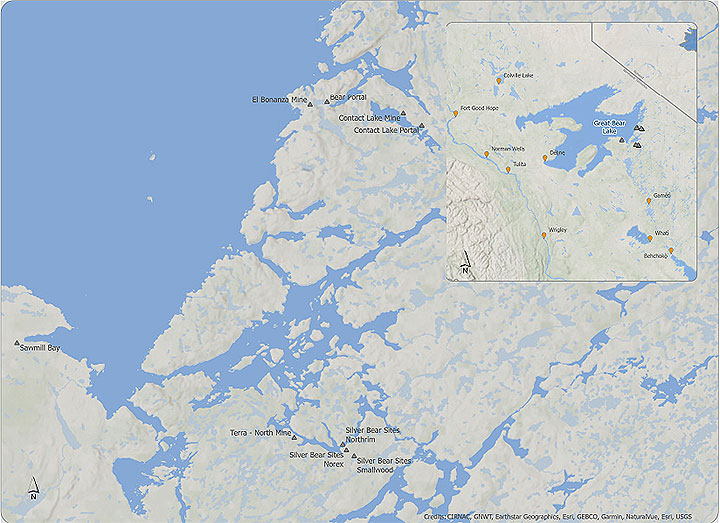
The Great Bear Lake project sites are located on the east side of Great Bear Lake and are approximately 250 kilometres east of Délı̨nę, within the Sahtu Dene and Métis Comprehensive Land Claim Agreement. The Silver Bear Mines also overlap with the Tłı̨chǫ Mǫwhì Gogha Dè Nįįłèè Boundary.
The remediation project was split into phases. In 2011, Phase roman numeral 1 was completed at Sawmill Bay, El Bonanza, Bonanza and Contact Lake Mines. Since 2011, care and maintenance and water quality monitoring has taken place at all of the sites. The remaining project tasks have been combined to form the Phase roman numeral 2 remediation project, which is now in the planning phase.
The Great Bear Lake Remediation Project is 1 of 8 abandoned mine projects in the Northwest Territories and Yukon to be funded through the Northern Abandoned Mine Reclamation Program, announced in Budget 2019, which was created to address the largest and highest-risk abandoned mines in the Northwest Territories and Yukon. Budget 2019 allocated $2.2 billion over 15 years, starting on April 1, 2020, and Budget 2023 provided additional funding of $6.9 billion over 12 years, bringing the total funding for the program to $9.1 billion over its 15-year lifespan.
The Tsá Tué Biosphere Reserve
The sites which form the Great Bear Lake Remediation Project are located within the Tsá Tué Biosphere Reserve. This internationally recognized designation by UNESCO reflects the Délı̨nę community's passion for maintaining the health of the lake, its watershed and the animals that inhabit it. Maintaining the ecological integrity of Great Bear Lake and its watershed is of utmost importance to the people of Délı̨nę.
For more information on the biosphere, consult Tsá Túé Biosphere Reserve.
Silver Bear Mines
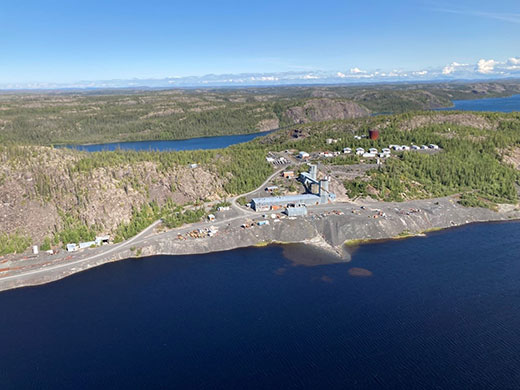
- 5 sites on the Camsell River (southeast of Great Bear Lake) mined for silver, copper and bismuth from 1969 to 1985
- mostly underground mining, with a small amount of surface mining
- Terra Mine was the largest of all the sites, with a mill, large camp and many mine openings
- Norex, Northrim, Graham Vein and Smallwood were smaller mine sites
Contact Lake Mine
- underground silver and uranium mine which operated for short periods between 1930 and 1980
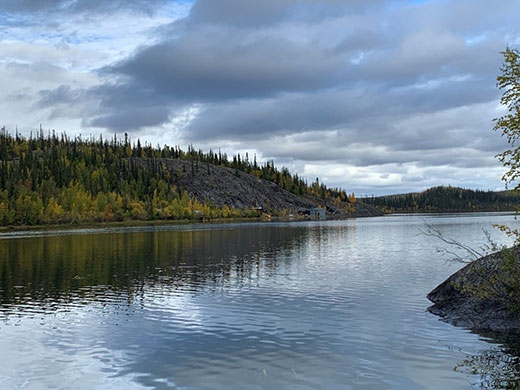
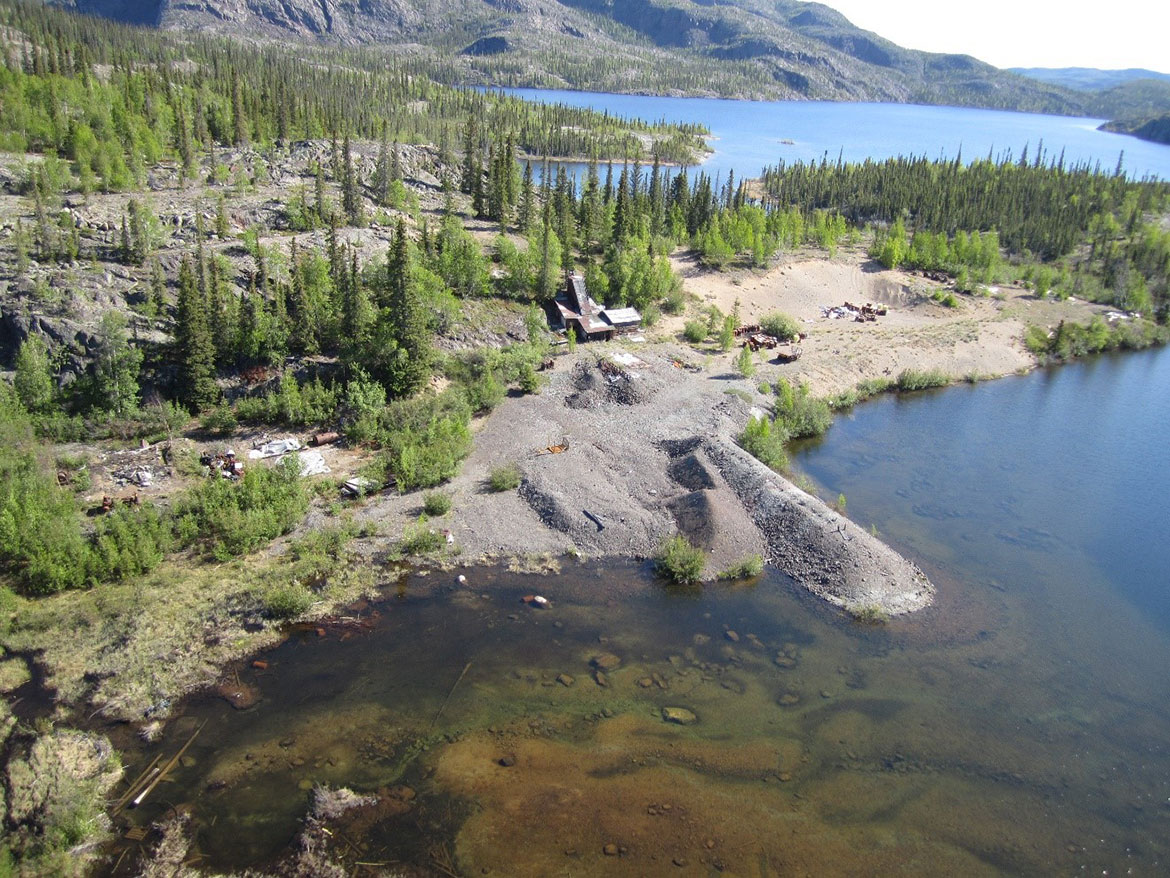
- medium-sized site with a headframe and a small number of very old camp buildings
- the former camp is on the Contact Lake shoreline, with the mine situated on the ridge above, with limited access
- the dock area is at Echo Bay, on the East Arm of Great Bear Lake
El Bonanza and Bonanza Mines
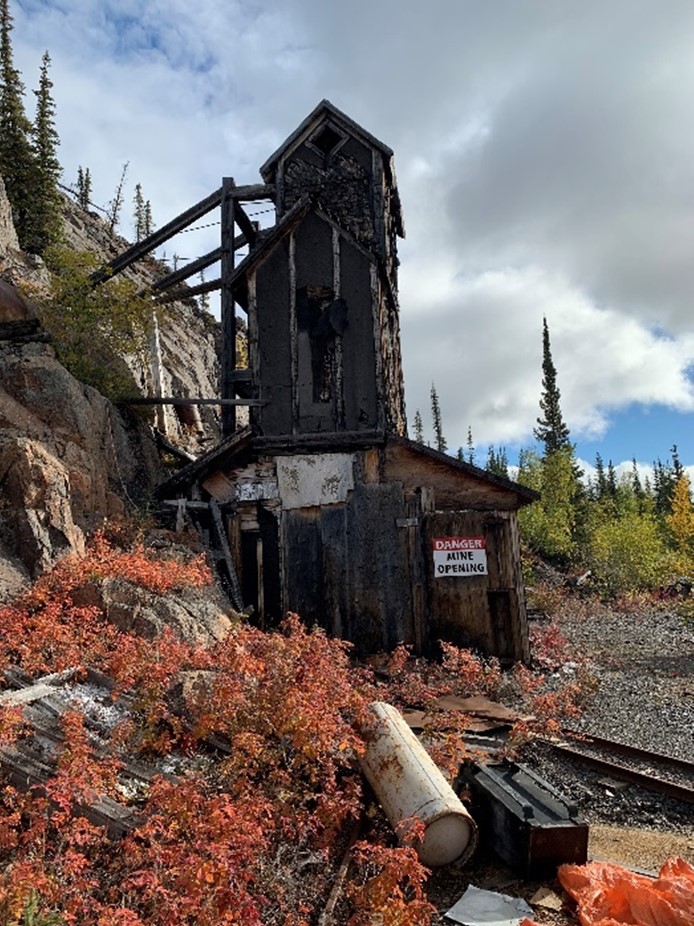
- 2 very small surface/underground silver mines, operated for short periods between 1934 and 1972
- El Bonanza Mine is on Silver Lake and Bonanza Mine is on Whale Lake
- the sites' abandoned fuel tanks and an overgrown airstrip can be found on Great Bear Lake
- overgrown roads and trails connect the sites, but access is very limited
Sawmill Bay
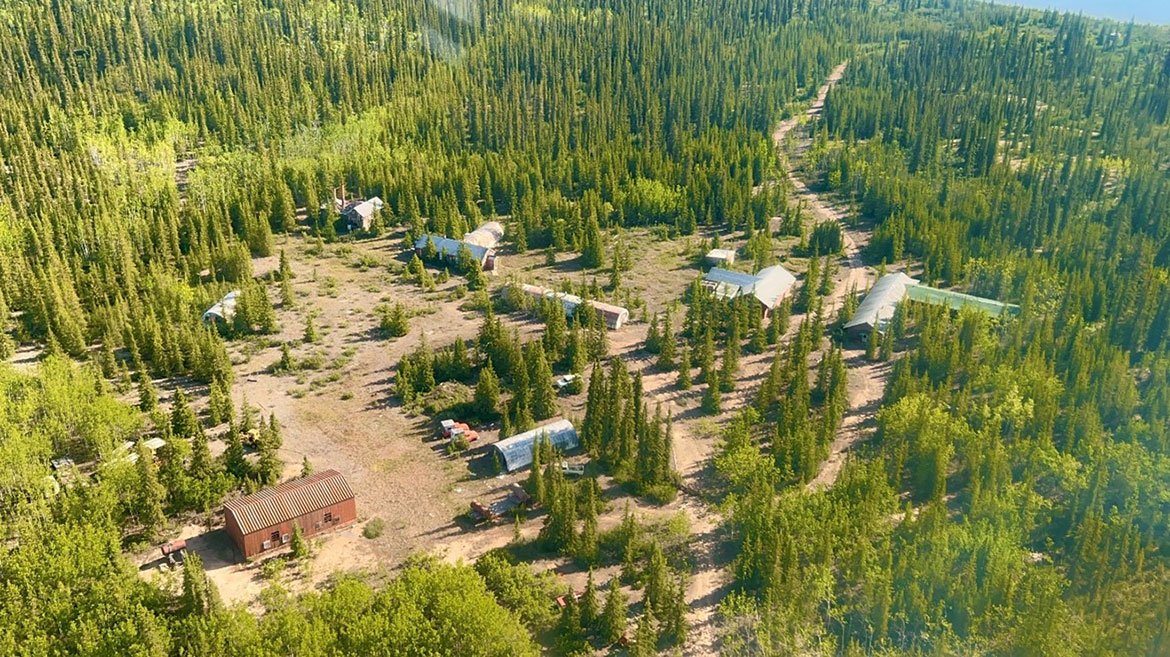
- used for multiple activities from 1930 to 1987 including:
- a sawmill for timber production to support mining at surrounding sites
- a transportation hub for air and marine transportation of supplies to support mining at Port Radium (including shipping uranium ore) and military activities
- operation of a sports fishing lodge as a tourism destination
- the site also still consists of numerous old buildings and roads along with 2 unmaintained airstrips and several former uranium ore storage areas with residual radiation concerns
Project goals
The Great Bear Lake Remediation Project goals include:
- using approaches that are cost-effective and risk-based
- restoring the land using industry best practices of:
- Traditional Knowledge
- science
- engineering
- working with Indigenous rights holders in all project stages to:
- build positive relationships and trust
- protect traditional lands and water
- planning for effective closure and monitoring, including community involvement in monitoring where warranted
Issues at the sites
Tailings: At the Silver Bear properties, ore was processed and tailings were deposited into the HoHum tailings pond. The main issue to be addressed is the high concentration of metals (that is, arsenic) in tailings and impacts to land and water. Different methods will be used to address this, depending on the area, such as:
- covering it
- improving drainage
- improving downstream wetlands that remove metals from water
Waste rock: Waste rock refers to rock that was blasted and excavated to get to the metal rich ore. There are concerns there could be potential acid generation and leachable metals or elevated gamma radiation at Contact Lake Mine. Most of the waste rock is not a concern. Different methods to address it will be used, depending on the need, including:
- diverting water around the piles
- grading it
- covering it
- using it for covers or adit plugs or leaving in place
Contaminated soils: Large fuel tanks contaminated some soil on project sites. If soils are contaminated with heavier fuels, they will be covered in place or managed on site.
Hazardous waste materials: All hazardous waste materials will be transported offsite to appropriate management facilities. The project's chemical hazards include:
- asbestos
- lead paint
- residual milling products
- waste fuel
Non-hazardous materials: These include scrap metal and general debris. While there are no chemical concerns, they may be tripping hazards. Unpainted wood will be burned on site. The project team is evaluating management options for the rest of the non-hazardous materials.
Infrastructure: This includes old buildings, mine structures and openings. Physical hazards from unmaintained buildings and chemical hazards from some building materials are present. Buildings and other infrastructure will be demolished. Unpainted wood will be burned and hazardous materials will be shipped offsite. The project team has not yet finalized management options for the non-hazardous material.
Engagement approach
The Government of Canada recognizes that Indigenous and community concerns must be appropriately understood and taken into consideration in order for remediation to be successful. Insight from Traditional Knowledge will be incorporated throughout the life of the project, from the remedial planning stages through to completion of the project and monitoring.
CIRNAC has involved the Délı̨nę Got'ı̨nę Government throughout this project by:
- carrying out leadership and public meetings during the planning stages of the project
- funding a Remediation Manager position within the Délı̨nę Got'ı̨nę Government
- hiring community members during field work and remediation activities for the project
- carrying out training activities for Délı̨nę residents
Community members and leadership continue to be engaged on this project through public meetings in Délı̨nę. At these meetings, the CIRNAC project team will continue to provide updates on the project and give the community the opportunity to highlight any concerns they may have. Délı̨nę community leadership will also be updated regularly on the project. Staff funding, training and capacity-building work will continue to take place in partnership with the Délı̨nę Got'ı̨nę Government.
The Great Bear Lake Remediation Project Governance Agreement
In February 2021, the Délı̨nę Got'ı̨nę Government and CIRNAC signed a Project Governance Agreement. This agreement allows the 2 governments to work in partnership to oversee all aspects of the Great Bear Lake Remediation Project.
Under the governance agreement:
- the Remediation Management Committee provides broad strategic direction for the remediation project; all major decisions regarding remediation will be made by consensus of the 2 governments
- the Operations Committee manages remediation implementation details as the project progresses through the planning and various design stages into full remediation and post-remediation
- the Government of Canada and Délı̨nę discuss a number of ways to ensure Délı̨nę benefits from the project on an ongoing basis
- the Government of Canada works with Délı̨nę to identify training needs within the community that are consistent with the work the project will need as well as the broader Northern Contaminated Sites Program mandate
Work done to date
- 2024
- CIRNAC renewed the land use permit and water licence required to advance pre-remediation activities. A pre-remediation program was implemented at Sawmill Bay, including asbestos and lead paint abatement (that is, removing and putting it in containers), and some minor building demolition.
- 2023
- CIRNAC conducted additional site assessment work to check on site conditions. This assessment was needed to finalize some remediation designs.
- 2022
- The Government of Canada hired K'alo-Stantec as the dedicated Environmental and Engineering firm for the Great Bear Lake Remediation Project.
- 2021
- The Délı̨nę Got'ı̨nę Government and CIRNAC signed a Project Governance Agreement, which applies a co-management approach to the Project. CIRNAC started an ice road feasibility exercise, which included ice profiling Great Bear Lake along a route from Délı̨nę to Sawmill Bay.
- 2020
- CIRNAC conducted site assessment work to verify the site conditions required to inform some remediation designs.
- 2019
- CIRNAC conducted a remediation design review to identify information gaps that are required to inform and finalize designs and plans.
- 2018
- CIRNAC conducted a drone survey of the project sites, except Sawmill Bay, which was not possible due to time constraints. The survey will be used to assist with remediation design and produce communication materials.
- 2017
- CIRNAC renewed the required land use permit and water licence to complete site remediation. During this pre-remediation stage, CIRNAC committed to annual water quality monitoring at the sites.
- 2016
- CIRNAC began removing waste fuel and drums in order to limit further contamination. Roughly 180 barrels were removed by barge. The remaining barrels were removed by airplane. The barrels were transported via winter road to Edmonton for disposal.
- 2014
- CIRNAC removed barrels from the Sawmill Bay site and moved others at Terra Mine in order to properly store them on site.
- 2013
- The Délı̨nę Renewable Resources Council, in partnership with SENES Consultants, conducted a study in 2013 for the proposed Denison Winter Road.
- 2011 to 2012
- Phase roman numeral 1 remediation was completed. CIRNAC submitted the winter road route application to the Mackenzie Valley Land and Water Board.
- 2010 to 2011
- CIRNAC completed the Phase I remediation at El Bonanza. This included:
- removing asbestos from old buildings
- removing wooden buildings
- consolidating debris for removal during Phase roman numeral 2
- CIRNAC also completed Phase roman numeral 1 remediation at Sawmill Bay. Clean-up activities included:
- cleaning and crushing roughly 12,000 barrels
- consolidating debris, to be removed during Phase roman numeral 2
- consolidating and storing hazardous materials
- CIRNAC received land use permits, and water licences were issued for remediation of the project sites. Phase I remediation began at Sawmill Bay, Contact Lake Mine and El Bonanza Mine.
- CIRNAC finalized the Sawmill Bay Remedial Action Plan and completed Traditional Knowledge studies for Contact Lake, El Bonanza and Sawmill Bay.
- CIRNAC completed the Phase I remediation at El Bonanza. This included:
- 2009 to 2010
- CIRNAC submitted the land use permit and water licence applications to the Sahtu Land and Water Board. The Délı̨nę First Nation completed a Traditional Knowledge study for Contact Lake and El Bonanza.
- 2008 to 2009
- A phased approach to addressing sites was developed during community meetings. In 2009, the Délı̨nę First Nation completed a Traditional Knowledge study for Sawmill Bay.
- 2007 to 2008
- CIRNAC completed Human Health and Ecological Risk Assessments at all the sites.
- 2004 to 2010
- CIRNAC conducted Phase roman numeral 1, roman numeral 2 and roman numeral 3 Environmental Site Assessment work and ongoing water monitoring at all of the Great Bear Lake sites.
What’s next
Starting in 2025, as project co-managers, the Délı̨nę Got'ı̨nę Government and CIRNAC will continue to finalize the remediation design and project implementation plan. Asbestos and lead paint abatement, as well as minor building demolition, will continue to advance until the start of the larger remediation works.
Site remediation is expected to begin in 2028, with active remediation occurring during the summer months until site closure in 2034. Final demobilization by the remediation contractor is planned to occur in 2035. The sites will then transfer into the Long-Term Monitoring Phase.
Long-term monitoring includes environmental monitoring to evaluate the success of the remediation project. The long-term monitoring phase typically occurs over a 25-year period, where monitoring events are more frequent during the initial years and become less frequent in later years as the site stabilizes and meets its monitoring objectives. Long-term monitoring will most likely be led by the co-management partners.