Giant Mine Remediation Project Annual Report 2021-22
Land acknowledgement
We acknowledge that the Giant Mine site is located in Chief Drygeese Territory. From time immemorial, it has been and is the traditional land of the Yellowknives Dene First Nation. The Giant Mine site is also within Mǫwhì Gogha Dè Nı̨ı̨tłèè boundary as defined in the Tłı̨chǫ Land Claim and Self Government Agreement and on the traditional homelands of the North Slave Métis Alliance. The Giant Mine Remediation Project respects the histories, languages, and cultures of First Nations, Metis, Inuit, and all First Peoples of Canada.
About this report
Welcome to the seventh Annual Report of the Giant Mine Remediation Project (the Project). The report provides an overview of the Project's key activities and performance for the 2021-22 reporting yearFootnote 1, focusing on environmental management, health and safety, and community involvement. The report's purpose is to verify that:
- defined project objectives are being met
- the Project meets the requirements of the Environmental Agreement
- interested rights holders and stakeholders, members of nearby communities, and the broader public have accurate and timely information on the Project
The report is provided to the Giant Mine Oversight Board, the independent oversight body established through the Environmental Agreement, which is then responsible for posting on their website (for additional information, see Environmental Agreement (PDF): Report Alignment (Appendix A).
The report's content is largely shaped by the Environmental Agreement signed in June 2015, as well as the Giant Mine Oversight Board's feedback on previous reports and input from the Project team. The report aligns with Project reporting obligations out of the Environmental Agreement.
For additional information on the Project, please visit Giant Mine Remediation Project.
Table of Contents
- Message from the Assistant Deputy Minister, Northern Affairs Organization
- Summary of Progress in 2021-22 and Plans for 2022-23
- 1. Project Overview
- 2. 2021-22 Year in Review
- 3. Advancement of Substantive Design and Remediation
- 4. Operational Summary
- 4.2 Inspections and Audits in 2021
- 4.3 Summary of Fiscal Year 2020-2021 expenditures
- 5. Environment
- 6. Health and Safety
- 7. Community
- 8.0 In closing
- References to all sources relied upon
- Appendices
- Appendix A: Environmental Agreement: Report Alignment
- Appendix B: List of 2021-22 Studies / Reports
- Appendix C: Project Risks and Mitigation
- Appendix D: Progress on Environmental Assessment Measures and Suggestions: Detailed Tables
- Appendix E: Additional Information on Monitoring Parameters
- Appendix F: Greenhouse Gas Emissions
- Appendix G: Plain Language Summary
Tables
- Table 1: Status of Environmental Assessment Measures and Suggestions (as of April 2022)
- Table 2: Planned Versus Actual Expenditures
- Table 3: Planned Expenditures in 2022-23
- Table 4: Annual Water Quality Monitoring 2021-22
- Table 5: Health and Safety Incidents and near misses in 2021-22
- Table 6: Summary of Urinalysis Sampling and Results between 2017-18 and 2021-22
- Table 7: Total Number of Persons and Total Person Hours and target ranges (Parsons and CIRNAC and their contractors) for 2021-22, by Category
- Table 8: Total Number of Persons and Total Person Hours and target ranges (Parsons and Parsons' contractors only) for 2021-22, by Category
- Table 9: Total Number of Persons and Total Person Hours and target ranges (CIRNAC contractors only) for 2021-22, by Category
- Table 10: Employment: total number of persons and person-hours, by Northern sub-category (Parsons and their contractors), in 2020-22
- Table 11: NWT Resident status (total number and %) (Parsons and their contractors only) in 2021-22
- Table 12: Number of employers and skill level by category in 2021-22 (Parsons and its contractors)
- Table 13: Total Number of Suppliers and Total Value of Contracts (Combined Parsons and CIRNAC and its contractors), in 2021-22, by Category
- Table 14: Total Number of Suppliers and Total Value of Contracts (Parsons and its contractors), in 2021-22, by Category
- Table 15: Total Number of Suppliers and Total Value of Contracts (CIRNAC contractors), in 2021-22, by Category
- Table 16: Major work packages awarded by Parsons in 2021-22
- Table 17: Procurement accounted for by Northern Indigenous and Northern Non-Indigenous suppliers (Total number, money spent and % of total value spent) (Parsons and CIRNAC) for 2021-22
- Table 18: Total Number of People trained and Total Person Hours of Training in 2021-22, by Category
- Table 19: Total Number of People trained and Total Person Hours of Training, by Northern sub-category (Parsons and CIRNAC), in 2021-22
- Table 20: AQMP Air Quality Criteria (SLR Consulting (Canada) Ltd, 2021)
- Table 21: Summary of Monthly Consumption for 2021 to 2022 Fiscal Year
- Table 22: GHG Emission Summary for 2021 to 2022 Fiscal Year
Figures
- Figure 1: GMRP Activities and Timeline
- Figure 2: Governance Structure of the GMRP
- Figure 3: Number of environmental spills and incidents from 2017-18 to 2021-2022
- Figure 4: H&S Incidents per 200,000 Person-hours Worked, by year (2017-18 to 2021-22)
- Figure 5: H&S Near Misses per 200,000 Person-hours Worked from 2017-2018 to 2021-2022
- Figure 6: Percentage of samples above the Action Level (35 µg/L) from 2017-18 to 2021-22
- Figure 7: Persons as % of all Employees by Category from 2017-18 to 2021-22
- Figure 8: Percentage of Person Hours by Category from 2017-18 to 2021-22
- Figure 9: Percentage of employment by Northern sub-category (Parsons and its contractors), from 2019-20 to 2021-22.
- Figure 10: Total Number of Suppliers from 2017-18 to 2021-22
- Figure 11: Percent of Total $ Value Spent from 2016-17 to 2021-22
- Figure 12: Percentage of People Trained by Employee Group from 2017-18 to 2021-22
- Figure 13: Number of Person Hours of Training per 200,000 Person-hours Worked by Employee Group from 2017-18 to 2021-22
- Figure 14: Non-normalized percentage of person-hours trained by Northern sub-category (Parsons and CIRNAC), 2018-19 to 2021-22.
- Figure 15: GMRP Risk Profile Summary
- Figure 16: Active Risks by Level
- Figure 17: Historical Risk Profile
- Figure 18: Surface Water Quality Monitoring Stations
- Figure 19: Groundwater Monitoring Wells and Well Status
Message from the Assistant Deputy Minister, Northern Affairs Organization
On behalf of the entire Giant Mine Remediation Project team, I am pleased to present the seventh Annual Progress Report to the Giant Mine Oversight Board. This report provides our stakeholders and the public with a transparent, comprehensive record of our progress over the last year as we work towards advancing the Project. We are committed to following the mandate given to us by the Government of Canada to create more economic opportunity and a higher quality of life in the North of Canada by using public investments to spur economic growth, job creation, and advancing policy and programs that support Northerners and Indigenous Peoples. We will also use this opportunity to support self-determination, improve service delivery, advance reconciliation and the renewed relationship between Canada and Indigenous Peoples based on recognition, rights, respect, co-operation, and partnership.
This seventh Annual Report builds on our prior submissions, with the benefit of input and advice from the Giant Mine Oversight Board, rights-holders and our other stakeholders. The Project reached a number of significant milestones during this year, including the formalization of the Community Benefits Agreement, which was signed in August 2021. The Project also commenced the Early Works Implementation Plan in summer 2021, and made significant progress on advancing early works during the field program.
I am pleased to report that, despite the ongoing challenges of the global COVID-19 pandemic, the Project team has continued to rise to the challenge and adapt to ensure the Project remains on-track. In this context, with the goal of protecting health and safety of all people at the Giant Mine site, the Main Construction Manager, Parsons Inc., continue to follow a robust COVID-19 Virus Response Plan and procedures. The Project also continues to follow the guidance of the Government of Northwest Territories Chief Public Health Officer.
The Project team looks forward to engaging with others throughout the Project life cycle, seeking a collaborative approach that is inclusive and innovative. We hope our work, and the lessons we learn through it, will inform the management of other complex remediation projects and will allow the Government of Canada to adapt and improve both its management and decision-making processes related to resource extraction, land use, and socio-economic development in the North.
We will continue to communicate our progress, improve our engagement with, and reporting to, the public, and welcome feedback on our planning and management of the Project. Our goal is to achieve an outcome we can all be proud of that addresses the legacy left behind by Giant Mine, and benefits Indigenous Peoples, Northerners, and all Canadians through collaboration, open and sincere dialogue, and learning from each other in order to continually improve.

Assistant Deputy Minister, Northern Affairs Organization
Summary of progress in 2021-22 and plans for 2022-23
The table below summarizes key activities planned for 2021-22 (as identified in the 2020-21 Annual Report), provides a brief description of progress made, and identifies activities planned for 2022-23. This summary enables readers to see at a high level whether the Project team achieved what it planned and, where it did not, to understand why not.
Design and Remediation
Component: Waste Disposal and Management [Section 3.1]
Plans for 2021-22
- Begin construction of the landfill.
Progress in 2021-22
In progress:
- Substantially completed construction of the first phase of the Non-Hazardous Waste Landfill as outlined in the Non-Hazardous Waste Landfill Design Plan.
Plans for 2022-23
- Finish construction of the first phase of the Non-Hazardous Waste Landfill as outlined in the Non-Hazardous Waste Landfill Design Plan.
Component: Waste Disposal and Management [Section 3.1]
Plans for 2021-22
- Submit the Contaminated Soils and Sediment Design Plan to the Mackenzie Valley Land and Water Board.
Progress in 2021-22
In progress:
- Completed the substantive design for Contaminated Soils
Plans for 2022-23
- Advance the detailed design for Contaminated Soils.
- Advance the detailed design for highly arsenic contaminated waste removal, soil washing, and Chamber 15 backfill.
Component: Freeze [Section 3.2]
Plans for 2021-22
- Continue underground stabilization work.
- Construct the first of the 4 freeze pads (AR1), including rock blasting.
Progress in 2021-22
In progress:
- Completed the blasting portion of the AR1 freeze pad construction
Plans for 2022-23
- Complete the construction of the AR1 Freeze Pad, which includes the placement of off-site borrow material for the "insulation layer" of the freeze pad
Component: Water Treatment [Section 3.3]
Plans for 2021-22
- Submit the Water Treatment Plant Design Plan to the Mackenzie Valley Land and Water Board. Finalize substantive design for the intake and outfall
Progress in 2021-22
Completed:
- Designed the freshwater intake (water supply for construction and operations & maintenance purposes)
In progress:
- Drafted a memo on action levels in support of the Design Plan
Partially completed:
- Partially designed the intake and outfall for the Water Treatment Plant to the substantive level along with the plant itself
Plans for 2022-23
- Engage the Working Group on the Water Treatment Plant design, finalize the Water Treatment Plant design (intake, plant and outfall), and submit the Water Treatment Plant Design Plan in 2022 to the Mackenzie Valley Land and Water Board
- Procure the construction contract for Water Treatment Plant (construction anticipated to start in 2023-24)
- Advance a redesign of the freshwater intake pipe
Component: Water Treatment [Section 3.3]
Plans for 2021-22
- Complete the passive treatment assessment
Progress in 2021-22
In progress:
- The Project has advanced several steps of the passive treatment assessment, but completion has been paused due to other priorities
Plans for 2022-23
- Complete the passive treatment assessment
Component: Tailing Containment Areas [Section 3.4]
Plans for 2021-22
- Submit the Tailings Design Plan and revised Tailings Monitoring and Management Plan to the Mackenzie Valley Land and Water Board
Progress in 2021-22
In progress:
- Completed the draft Tailings Monitoring and Management Plan
Plans for 2022-23
- Submit the draft Tailings Monitoring and Management Plan to the Working Group for pre-engagement prior to submittal to the Mackenzie Valley Land and Water Board
- Submit the Tailings Design Plan at a similar time with the Tailings Monitoring and Management Plan
- Conduct a South Pond Dewatering Study
Component: Open Pits Closure [Section 3.5]
Plans for 2021-22
- Submit the Open Pits Design Plan
- Conduct further field investigations for open pits and openings to surface
Progress in 2021-22
Completed:
- Completed the Open Pits Final Substantive Design Report
Deferred:
- Postponed the field investigations due to the COVID-19 pandemic
Plans for 2022-23
- Refine open pit closure design by addressing some outstanding risks
- Complete community engagement and inform on status of closure decisions
- Conduct field investigation to scope out the drilling program for Open Pits
Component: Open Pits Closure [Section 3.5]
Plans for 2021-22
- Finalize work on the closure of boreholes based on site criteria
Progress in 2021-22
Completed:
- Completed the closure of borehole field investigation memo
Component: Other Design work [Section 3.6]
Plans for 2021-22
- Complete a site access Multiple Accounts Analysis to complete bridge crossing and site access and complete bridge design
Progress in 2021-22
Completed:
- Completed the multiple accounts analysis for bridge crossings and incorporated it into the Site Services substantive design
Plans for 2022-23
- Advance Site Services Design Plans and associated documents. Complete the implementation of the Phase Power Infrastructure Plan
Operations
Component: Care and Maintenance [Section 4.1]
Plans for 2021-22
- Continue care and maintenance in accordance with contract and regulatory requirements and site conditions
Progress in 2021-22
Completed:
- Continued care and maintenance in accordance with contract, regulatory requirements, and site conditions
- Monitored air quality, conducted ongoing dust management activities, prepared for 2021 spring freshet, discharged treated effluent at Baker Pond, conducted maintenance of roads and site infrastructure, provided site security, fencing upgrades and new signage
Plans for 2022-23
- Continue care and maintenance in accordance with contract, regulatory requirements, and site conditions
- Continue to monitor air quality, conduct ongoing dust management activities, prepare for 2022 spring freshet, discharge treated effluent at Baker Pond, conduct maintenance of roads and site infrastructure, and provide site security
Component: Care and Maintenance [Section 4.1]
Plans for 2021-22
- Complete the stabilization work for engineered cap for bulkhead 36 and obtain sign-off from design consultant
- Prepare for and undertake a ground support program for safe access to the Early Works mine stabilization areas
Progress in 2021-22
In progress:
- Completed final assembly and securing of the engineered cap for bulkhead 36 to ensure stabilization, including engineering sign-off by the design consultant
- Continued to melt ice in the mine workings at the south end of the mine for future mine stabilization below A1 and A2 open pits
- Completed a ground support program to make safe access for the Early Works mine stabilization contractor
Plans for 2022-23
- Complete early works underground stabilization and close-out documentation
- Continue work to gain access to ice-filled areas of the mine below A1 and A2 pits. Initiate ground support installations to make safe access to the Remainder Works mine stabilization
- Decommission the 750-level pump station, remove hazardous material, conduct mine examination and prepare for the abandonment of the north end of the mine
Component: Care and Maintenance [Section 4.1]
Plans for 2021-22
- Continue with the regular underground care and maintenance activities
- Begin engineering works towards improved mine ventilation and mine communications
Progress in 2021-22
Completed:
- Continued with underground care and maintenance activities with sumps, pumps, ventilation, and refuge chambers
- Began engineering for an improved underground communication system and changes to the mine primary ventilation
Plans for 2022-23
- Continue with the regular underground care and maintenance activities
- Install the improved mine communication system and complete the C-Shaft ventilation system
Component: Immediate Risk Mitigation [Section 4.1.1]
Plans for 2021-22
- Conduct a thorough review of all the buildings
- Tender the Townsite decontamination and demolition project for construction in 2022
Progress in 2021-22
Completed:
- Completed the Building Assessment on all remaining buildings that are not part of the upcoming Townsite Decontamination and Demolition Contract
- Tendered the Townsite Decontamination and Demolition Project in March 2022
Plans for 2022-23
- Complete decontamination and demolition of select buildings, with remainder of Townsite buildings deferred until 2023-24
Component: Immediate Risk Mitigation [Section 4.1.1]
Plans for 2021-22
- Northwest Deep Well pump to be repaired and re-installed before freshet 2022
Progress in 2021-22
Completed:
- Re-installed the Northwest Deep Well pump, which is now working as designed
Plans for 2022-23
- No further repair work planned
Component: Immediate Risk Mitigation [Section 4.1.1]
Plans for 2021-22
- Conduct the annual geotechnical dam inspection and continue to enact recommendations put forth by the inspecting geotechnical engineers on site, as appropriate
Progress in 2021-22
Completed:
- Conducted the annual geotechnical inspections and submitted the final report to the Mackenzie Valley Land and Water Board
In Progress:
- Ongoing work by the surface care and maintenance contractor to execute work required to maintain dams
Plans for 2022-23
- Conduct the annual geotechnical inspection and submit the report to the Mackenzie Valley Land and Water Board Continue work by the surface care and maintenance contractor to maintain dams
Component: Immediate Risk Mitigation [Section 4.1.1]
Plans for 2021-22
- Conduct ongoing monthly monitoring of the high-risk dams
Progress in 2021-22
In Progress:
- Ongoing monitoring of dams, as outlined in the Operations, Maintenance and Surveillance Manual
Plans for 2022-23
- Conduct ongoing monitoring of the high-risk dams as outlined in the Operations, Maintenance and Surveillance Manual
Component: Immediate Risk Mitigation [Section 4.1.1]
Plans for 2021-22
- Include dam safety review recommendations in updates to the Operations, Maintenance and Surveillance manual
- Continue to implement dam safety review recommendations to minimize risks to dams
Progress in 2021-22
Completed:
- Implemented dam safety recommendations on site where possible to minimize risks to dams and included updates in the Operations, Maintenance and Surveillance manual
Plans for 2022-23
- Continue to implement dam safety recommendations on site where possible to minimize risks to dams and include updates in the Operations, Maintenance and Surveillance manual
Component: Immediate Risk Mitigation [Section 4.1.1]
Plans for 2021-22
- Continue to monitor Dam 1 stabilization. Determine whether a raise of the dam's crest is required for Effluent Treatment Plant operations
Progress in 2021-22
In progress:
- Conducted ongoing monitoring of Dam 1 stabilization
- Data is being used to assist in assessing what type of dam raise may be required
Plans for 2022-23
- Continue monitoring of Dam 1 stabilization and construct the dam raise if warranted
Environment
Component: Air [Section 5.2]
Plans for 2021-22
- Continue air quality monitoring, including ongoing community monitoring and site perimeter monitoring, with activity-specific monitoring conducted as applicable
Progress in 2021-22
Completed:
- Continued air quality monitoring activities in 2021-22
Plans for 2022-23
- Continue air quality monitoring, including ongoing community monitoring and site perimeter monitoring, with activity-specific monitoring conducted as applicable
Component: Air [Section 5.2]
Plans for 2021-22
- Continue to treat the tailing containment areas and road network, as needed (dust control)
Progress in 2021-22
Completed:
- Applied Soil-Tac and water for dust suppression at roads and on the tailing containment areas as needed
Plans for 2022-23
- Continue to treat the tailing containment areas and road network, as needed
Component: Water [Section 5.3]
Plans for 2021-22
- Continue monitoring treated effluent prior to and during discharge
Progress in 2021-22
Completed:
- Discharged 589,700 cubic meters of treated effluent at Baker Pond
Plans for 2022-23
- Continue monitoring treated effluent prior to and during discharge
Component: Water [Section 5.3]
Plans for 2021-22
- Continue existing water quality monitoring (Surveillance Network Program, Aquatic Effects Monitoring Program, Metal and Diamond Mining Effluent Regulations/Environmental Effects Monitoring, Operational Monitoring Program)
Progress in 2021-22
Completed:
- Conducted monitoring of minewater, surface water and groundwater to meet regulatory and operational monitoring requirements, as well as to continue to collect baseline data to support ongoing modelling efforts and site characterization
Plans for 2022-23
- Continue existing water quality monitoring (Surveillance Network Program, Aquatic Effects Monitoring Program, Metal and Diamond Mining Effluent Regulations/Environmental Effects Monitoring, Operational Monitoring Program)
Component: Water [Section 5.3]
Plans for 2021-22
- Respond to Environment and Climate Change Canada's comments
- Submit the Phase 7 Environmental Effects Monitoring Study Design to Environment and Climate Change Canada
Progress in 2021-22
Completed:
- Responded to Environment and Climate Change Canada comments
- Submitted the Phase 7 Environmental Effects Monitoring Study Design to Environment and Climate Change Canada in October 2021
Plans for 2022-23
- Carry out monitoring in accordance with the Phase 7 Environmental Effects Monitoring Study Design
Component: Water [Section 5.3]
Plans for 2021-22
- Engage on the moderate and high Aquatic Effects Monitoring Program Action Levels and submit to the Mackenzie Valley Land and Water Board for review and approval
Progress in 2021-22
Completed:
- Engaged the Giant Mine Working Group on the moderate and high Action Levels in September 2021
- Submitted a revised Aquatic Effects Monitoring Program Design Plan with moderate and high Action Levels to the Mackenzie Valley Land and Water Board
Plans for 2022-23
- Carry out monitoring in accordance with the Aquatic Effects Monitoring Program Design Plan
Component: Water [Section 5.3]
Plans for 2021-22
- Complete the large-bodied fish tissue sampling program
Progress in 2021-22
Completed:
- Completed large-bodied fish tissue sampling program in summer 2021
Plans for 2022-23
- Not applicable
Component: Water [Section 5.3]
Plans for 2021-22
- Submit Annual Reports (on a calendar year).
Progress in 2021-22
Completed:
- Submitted the 2020 Annual Water Licence Report and the 2020 Aquatic Effects Monitoring Program Annual Report to the Mackenzie Valley Land and Water Board in April 2021
Plans for 2022-23
- Submit Annual Reports (on a calendar year)
Component: Land [Section 5.4]
Plans for 2021-22
- Continue managing wastes on site
Progress in 2021-22
Completed:
- Continued to manage wastes on site in accordance with the Waste Monitoring and Management Plan
Plans for 2022-23
- Continue managing waste in accordance with the Waste Monitoring and Management Plan
Component: Land [Section 5.4]
Plans for 2021-22
- Establish Waste Disposal Operations for day-to-day operational waste to be transferred off-site
Progress in 2021-22
Completed:
- Established a Waste Transfer Station in Fall 2021 for operational waste generated on site
Plans for 2022-23
- Commission and operate the Non-Hazardous Waste Landfill. Continue operations of the Waste Transfer Station for operational waste
Component: Land [Section 5.4]
Plans for 2021-22
- Conduct an annual review of the Wildlife and Wildlife Habitat Monitoring and Management Plan and make any revisions necessary to reflect changes in Site operations
Progress in 2021-22
Completed:
- Reviewed Wildlife and Wildlife Habitat Monitoring and Management Plan (Version 2.0). No changes identified
Plans for 2022-23
- Prepare Version 3.0 of the Wildlife and Wildlife Habitat Monitoring and Management Plan with submission to the Mackenzie Valley Land and Water Board anticipated for 2022-23
Component: Land [Section 5.4]
Plans for 2021-22
- Continue to log and report wildlife sightings and interactions including the bird survey
Progress in 2021-22
Completed:
- Maintained wildlife log on site
Plans for 2022-23
- Continue to log and report wildlife sightings and interactions including the bird survey
Health and safety
Component: Occupational health and safety [Section 6.1]
Plans for 2021-22
- Continue to track and report on occupational health and safety through tracking of training and incidents
Progress in 2021-22
Completed:
- Continued to track and report on occupational health and safety incidents and training
Plans for 2022-23
- Continue to track and report on occupational health and safety through tracking of training and incidents
Component: Public health and safety [Section 6.2]
Plans for 2021-22
- Prepare for the next round of Health Effects Monitoring Program sample collection to occur in 2022-2023
Progress in 2021-22
Completed:
- Continued preparing for the next round of Health Effects Monitoring Program sample collection to occur in 2022-2023
Plans for 2022-23
- Prepare for child sampling in Spring 2023, adult/children sampling to take place again in 2027/2028
Component: Public health and safety [Section 6.2]
Plans for 2021-22
- Implement the Hoèła Weteèts'eèdeè study and engagement, led by University of Laurier's research team
Progress in 2021-22
In progress:
- Continued ongoing Advisory Committee meetings to provide updates on relevant publications, genetic analysis, and communication strategies for the revised website
- Study team received approval from the Ethics Review Board, established office space, and prepared to initiate the survey
Plans for 2022-23
- At the time of writing this report the study has been put on hold indefinitely, pending advice of the Advisory Committee
Community
Component: Engagement [Section 7.1]
Plans for 2021-22
- Continue engagement on Management Plans (2 plans remaining), the Quantitative Risk Assessment, closure criteria, Socio-Economic implementation, Hoèła Weteèts'eèdeè, the Perpetual Care Plan, and the Aquatics Advisory Committee
Progress in 2021-22
Completed:
- Held engagement sessions on Management Plans and Quantitative Risk Assessment, most Closure Criteria with the Working Group
- Engaged with the Perpetual Care Plan Task Force on the Perpetual Care Plan
- Continued the Aquatics Advisory Committee Meetings via Zoom throughout the year
- Continued engagement on socio-economic implementation
Plans for 2022-23
- Continue engagement on Management Plans (Tailings Management and Monitoring Plan) and Closure Criteria (new criteria) with the Giant Mine Working Group
- Engage the Working Group on the Water Treatment Plant Design
- Continue the development of the Perpetual Care Plan scope of work with the Perpetual Care Plan Task Force and the contracting of a consultant
- Continue Aquatics Advisory Committee engagement including a site tour and review of Fisheries Act Authorization
- Engage with Yellowknives Dene First Nation and North Slave Métis Alliance on revegetation
Component: Socio-economic (procurement, employment and training) [Section 7.2]
Plans for 2021-22
- Finalize and communicate socio-economic targets; confirm 2020-21 and 2021-22 implementation activities and advance implementation
- Track employment, procurement, and training statistics
Progress in 2021-22
Completed:
- Finalized and communicated socio-economic targets. Advanced actions within the evergreen Implementation Plan
- Continued to track suppliers, employment, and workforce training on a quarterly and annual basis
Plans for 2022-23
- Continue to track employment, procurement and training statistics
Component: Socio-economic (procurement, employment and training) [Section 7.2]
Plans for 2021-22
- Continue to incorporate focus group inputs into the evergreen Implementation Plan and advance Implementation Plan actions
Progress in 2021-22
Compeleted:
- Continued to update the Implementation Plan and engage the Socio-economic Working Group and Advisory Body on the progress, goals, and limitations of the action items
Plans for 2022-23
- Continue to work with the Socio-economic Working Group and Advisory Body to advance and adjust actions identified within the Implementation Plan
Component: Socio-economic (procurement, employment and training) [Section 7.2]
Plans for 2021-22
- Update the Socio-Economic Strategy
Progress in 2021-22
In progress:
- Initiated the update of the Socio-Economic Strategy with the support of the Socio-Economic Working Group
Plans for 2022-23
- Update the strategy to reflect new forecasts presented in the Project Implementation Plan, including financial and labour estimates, as well as the updated timeline to complete Project remediation
- Develop an online performance tracking and reporting tool
Component: Socio-economic (procurement, employment and training) [Section 7.2]
Plans for 2021-22
- Hold another Industry Day (late 2021 or early 2022)
Progress in 2021-22
Completed:
- Held (through Parsons) a virtual Industry Day between January 18 to 20, 2022
Plans for 2022-23
- Hold Industry Day on November 1 and 2, 2022
1. Project Overview
The Project addresses the long-term containment and management of the arsenic trioxide waste, the demolition and removal of all surplus buildings on the surface, and the remediation or risk management of all impacted surface areas, such as soils and tailings ponds. It also includes water management and treatment. The overall objectives of the Project are to:
- minimize public and worker health and safety risks
- minimize the release of contaminants from the site to the surrounding environment
- remediate the site in a manner that instills public confidence
- implement an approach that is cost-effective and robust over the long term
The successful remediation of the Giant Mine will yield the following outcomes:
- safeguard the health and safety of Northerners
- protection of water, soils, flora and fauna at the Giant Mine site
- reduced federal liability associated with the site by using industry best practices for remediation in a cost-effective manner
- improved relationships with local Indigenous groups
- demonstration of federal commitment, which illustrates how economic development can be carried out without adversely affecting the environment
- demonstration of federal leadership in complying with all applicable environmental acts, regulations and standards
Phases of the Project
The Project received its Water Licence in September 2020, and in July 2021 transitioned from care and maintenance activities (Phase 1) into active remediation and adaptive management (Phase 2).
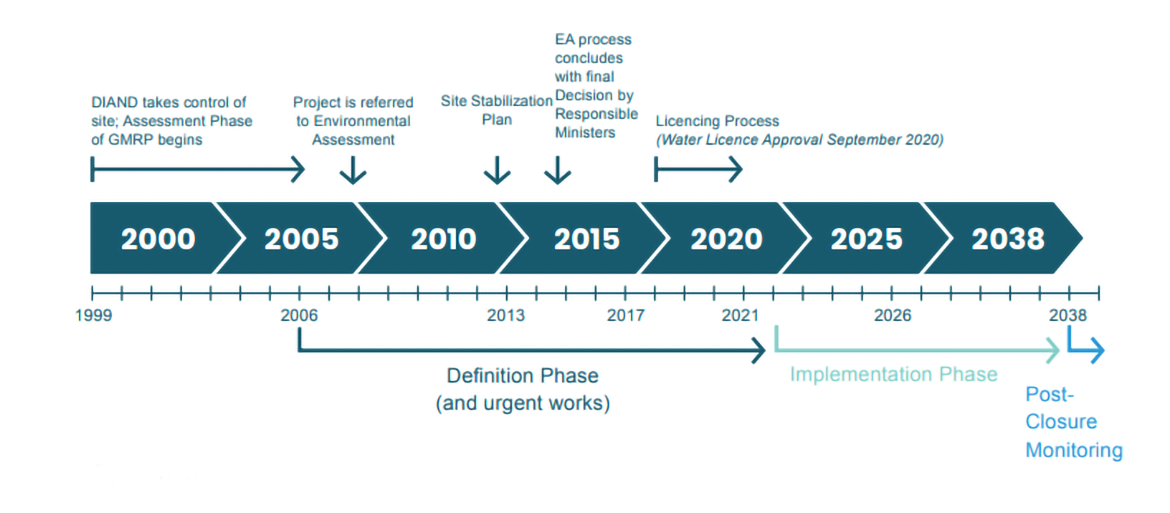
Figure 1 illustrates the past, current, and planned activities of the Project.
Text alternative for Figure 1: GMRP Activities and Timeline
A figure showing the project timelines from 1999 until 2038 and beyond. In 1999, the Department of Indian Affairs and Northern Development takes control of the site and the assessment phase of the project begins and an arrow shows this carries onward throughout the timeline. From 2006 to 2021, the definition phase and urgent works are denoted. In 2007, the project is referred to Environmental Assessment. In 2013, there is a Site Stabilization Plan. In 2014, the Environmental Assessment process concludes with a final decision by the Responsible Ministers. From 2017 to 2020, the licencing process takes place, and the Water Licence approval occurs September 2020. From 2021 to 2038, the implementation phase is denoted. From 2038 onward, post-closure monitoring is denoted.
Governance of the Project
The governments of Canada and the Northwest Territories are co-proponents of the Project. Crown-Indigenous Relations and Northern Affairs Canada (CIRNAC) is Canada's lead on the Project while Environment and Natural Resources represents the Government of Northwest Territories, with Public Service and Procurement Canada (PSPC) playing an important support role.
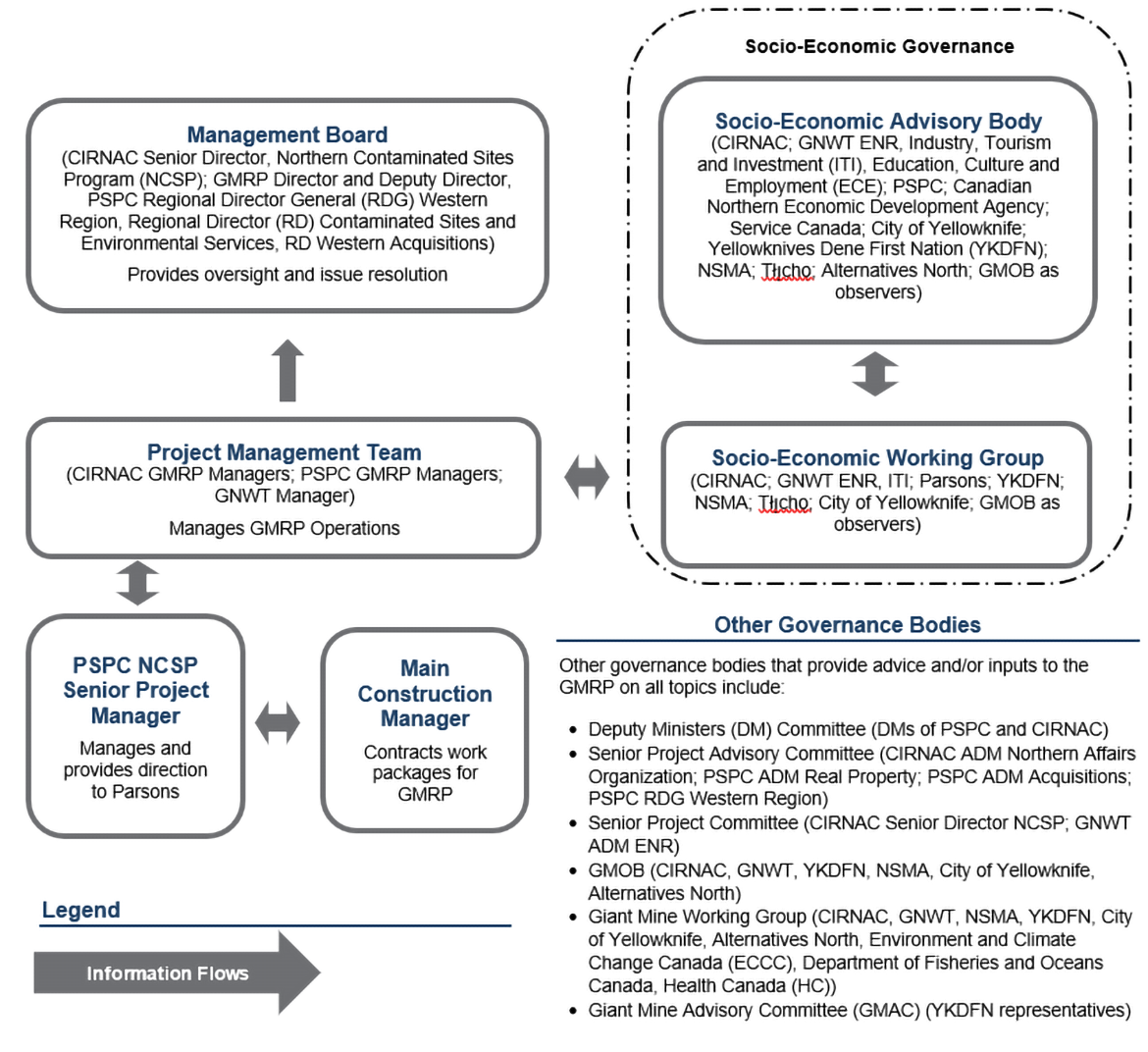
A joint CIRNAC and PSPC project governance structure has been established to provide oversight, direction and advisory services to the Project Team. The governance and management of the Project is also supported by external, independent, and technical reviews provided by multiple groups, such as the Giant Mine Oversight Board, which was formed in 2015. Figure 2 shows the governance structure of the Project.
Text alternative for Figure 2: Governance Structure of the Project
This figure shows how information flows and the project is governed.
The Main Construction Manager contracts work and packages for the project. Information flows to and from the Main Construction Manager to the PSPC Northern Contaminated Senior project manager.
The PSPC Northern Contaminated Senior Project Manager provides direction to and management of Parsons, the Main Construction Manager, with information flowing to and from the Project Management Team, and to and from the Main Construction Manager.
The Project Management Team consists of CIRNAC project managers, PSPC project managers, and the GNWT manager. The team manages project operations. Information flows to and from the team to the PSPC Senior Project Manager, and to and from the Socio-Economic Governance bodies, as well as upward to the Project Management Committee.
The Project Management Committee consists of the CIRNAC project directors, the PSPC Western Region Director General of Environmental Services. The committee provides oversight, direction and issues resolution. The committee also flows information upward to the Management Board.
The Management Board consists of the CIRNAC Director General of the Northern Contaminated Sites Program, the PSPC Regional Director General of the Western Region, the PSPC Regional Director of Environmental Services, and the PSPC Regional Director of Acquisitions. The board provides oversight and issue resolution.
The Socio-Economic Governance bodies are the Socio-Economic Working Group and the Socio-Economic Advisory Body. Information flows to and from the Project Management team to these bodies.
The Socio-Economic Working Group consists of representatives of
- CIRNAC
- the GNWT departments of
- Environment and Natural Resources
- Industry, Tourism and Investment
- Education, Culture and Employment
- Infrastructure
- CanNor
- City of Yellowknife
- Giant Mine Oversight Board, as observersC
Information flows to and from the Socio-Economic Working Group to the Socio Economic Advisory Body. The body consists of representatives of:
- CIRNAC
- GNWT departments of:
- Environment and Natural Resources
- Industry, Tourism and Investment
- PSPC
- CanNor
- Service Canada
- City of Yellowknife
- Yellowknives Dene First Nation
- North Slave Métis Alliance
- Alternatives North
Other governance bodies that provide advice and/or inputs to the project on all topics include:
- Deputy Ministers Committee (PSPC and CIRNAC)
- Senior Project Advisory Committee (CIRNAC Associate Deputy Minister of the Northern Affairs Organization, PSPC Associate Deputy Minister Real Property, PSPC Associate Deputy Minister Acquisitions, PSPC Regional Director General, Western Region)
- Senior Project Committee (CIRNAC Director General, Northern Contaminated Sites Program, GNWT Associate Deputy Minister, Environment and Natural Resources)
- Giant Mine Oversight Board (CIRNAC, GNWT, Yellowknives Dene First Nation, North Slave Métis Alliance, City of Yellowknife, Alternatives North)
- Giant Mine Working Group (CIRNAC, GNWT, Yellowknives Dene First Nation, North Slave Métis Alliance, City of Yellowknife, Alternatives North, Environment and Climate Change Canada, Department of Fisheries and Oceans Canada, Health Canada
- Giant Mine Advisory Committee (Yellowknives Dene First Nation representatives)
2. 2021-22 Year in review
2.1 Overview
The Project team focused their activities on 7 main project components over the 2021-22 year (April 1, 2021 to March 31, 2022):
- Advanced substantive designsFootnote 2 and cost estimates in support of the implementation of the Treasury Board implementation phase submission in October 2022 (Section 3)
- Ensured ongoing care and maintenance of the site (Section 4)
- Undertook immediate risk mitigation activities (Section 4)
- Initiated and advanced remediation activities including AR1 freeze pad construction, and Non-Hazardous Waste Landfill construction (Section 4)
- Undertook environmental monitoring studies and baseline assessments (Section 5 to Appendix B includes a comprehensive list of the studies conducted in 2021-22),
- Continued to advance the health monitoring studies (Section 6 to Appendix B includes a comprehensive list of the studies conducted in 2021-22)
- Advanced Socio-Economic Strategy implementation (Section 7)
Engagement is a core component of the Project and is described in more detail in Section 7.1. In addition, the Project team maintained an active risk identification and management program (described in Appendix C).
2.2 COVID-19 management
The main construction manager continued to update and implement the COVID-19 Virus Response Plan and procedures based on federal and territorial government guidelines. The procedures apply to all people at the Giant Mine site, including main construction manager staff, subcontractors, consultants, regulators and any possible visitors to the site (Parsons Inc., 2021a; Parsons Inc., 2021b; Parsons Inc., 2022a). For a period of 8 days in both October and December 2021, site efforts were scaled down to essential activities in response to possible COVID-19 exposure on-site. The response followed direction received from the Yellowknife COVID-19 Outbreak Response Team. At the end of the 8 days, isolation for potentially exposed workers was no longer required.
The biggest impacts from COVID included delays to the Hoèła Weteèts'eèdeè Study, Health Effects Monitoring Program community reporting, geochemical testing (though the delay was not significant, and the testing has since been completed), Quantitative Risk Assessment engagement and the AR1 blasting (delay of 1 week). In addition, the field investigations for open pits and openings to surface were postponed due to the COVID-19 pandemic (Golder Associates Ltd., 2022b).
2.3 Progress on Environmental Assessment measures
The Report of Environmental Assessment and Reasons for Decision (Mackenzie Valley Review Board, 2013) listed 26 Measures that must be addressed, as well as 16 suggestions that may be implemented at the Project team's discretion. The team's immediate focus is to address the measures with set timelines, and those with the biggest impact on the project scope. Table 1 provides a brief summary of progress, while Appendix D provides a complete summary of progress against all Environmental Assessment Measures and Suggestions in 2021-22, as well as plans for the 2022-23 year.
| Status | Measures | Suggestions |
|---|---|---|
| Completed | 3, 4, 5, 6, 7, 8, 11, 12, 13, 14, 15, 18, 19, 22 | 8, 13 |
| Underway | 9, 10, 16, 17, 20, 23, 25, 26 | 1, 2, 3, 4, 9, 10, 11, 12, 14, 15, 16 |
| Future Action Required | 2, 21, 24 | |
| No Action Required / Outside Scope of Project | 1 | 5, 6, 7 |
In 2021-22, the Project focused on advancing the following measures:
- Measure 10: Hoèła Weteèts'eèdeè: Understanding Community Wellbeing Around Giant Mine (previously called the Stress Study). At the time of writing this report the study has been put on hold indefinitely, pending advice of the Advisory Committee
- Measure 23: Tailings Management and Monitoring Plan. The Project team advanced this plan internally and sent a draft to the Working Group for comments
3. Advancement of substantive design and remediation
3.1 Waste disposal and management
3.1.1 Non-hazardous waste landfill
In 2021-22, the Project submitted and received approval from the Mackenzie Valley Land and Water Board for the Non-Hazardous Waste Landfill Design Plan and updated Waste Management and Monitoring Plan. The Non-Hazardous Waste Landfill Design Construction Plan was also submitted in accordance with the Project Water Licence (Giant Mine Remediation Project, 2022a). The Project team also substantially completed construction of the first phase of the Non-Hazardous Waste Landfill as outlined in the Non-Hazardous Waste Landfill Design Plan.
Next Steps:
- complete the remaining construction of the Non-Hazardous Waste Landfill. The final steps for the Non-Hazardous Waste Landfill includes installing a geo-membrane, a geo-composite and drainage pipes with full completion and operation scheduled for Spring of 2022
- continue identifying volumes of legacy waste and apply an appropriate management strategy
- advance metal recycling strategies
3.1.2 Hazardous waste
Long-term management of arsenic trioxide waste is one of the key components of the Giant Mine Remediation Project Closure and Reclamation Plan. During the life of the mine, mining operations produced approximately 237,000 tonnes of arsenic trioxide waste, which are currently stored in 14 chambers and stopes (Giant Mine Remediation Project, 2018a). Chamber 15 and B1 pits have been identified and assessed as a potential disposal site for arsenic waste related to clean-up activities and options (Giant Mine Remediation Project, 2007, Golder Associates Ltd., 2018).
In 2021-22, the main construction manager worked to develop their standard operating procedure for waste handling (including hazardous waste) (Parsons Inc., 2022c) .
3.1.3 Remedial strategy for contaminated soil and sediment
In support of the Project's Closure and Reclamation Plan related to contaminated soil and sediment, the Project team evaluated and selected remedial/risk management strategies associated with contaminated soil and sediment at the Giant Mine site. This work has involved:
- an options analysis workshop
- the selection of preferred remedial/risk management options for areas of deep contaminated materials based on
- technical feasibility
- project objectives
- long-term performance
- the production of a report to address the information gaps on contaminated soil and sediment
- the production of a report on a closure option for pond-water impacted areas (Golder Associates Ltd., 2019a; Golder Associates Ltd., 2019d; AECOM Canada Ltd., 2020a; Giant Mine Remediation Project, 2021a)
In 2021-22, the Project team completed the substantive design for Contaminated Soils and Sediment and held a workshop with the Project Working Group in Fall 2021.
Next Steps:
- advance the detailed design for contaminated soils
- advance the detailed design for
- highly arsenic contaminated waste removal
- soil washing
- Chamber 15 backfill
- hold a follow-up meeting of the Project Working Group on the Dam 3 Research Reclamation Plan document prior to the design plan submission to the Mackenzie Valley Land and Water Board
- the Project will submit the Contaminated Soils and Sediment Design Plan anticipated in late 2023Footnote 3
3.2 Freeze designs
Climate change is a critical risk factor for ground freezing systems at the Giant Mine site. In 2018, the Project team conducted a review of current climate change documentation to support the advanced design of freeze Areas 1 and 2 (AECOM Canada Ltd., 2018). In 2019-20, the Project team began the substantive freeze design for Areas 3 and 4, which incorporates the design of a portion of B1 pit as well. Climate change projections were also incorporated into the substantive design for Areas 3 and 4.
In 2021-22, the Project team completed the blasting activities associated with the construction of the AR1 freeze pad development. In addition, the Mackenzie Valley Land and Water Board approved the Arsenic Trioxide Shell Monitoring and Management Plan (Giant Mine Remediation Project, 2022a).
Next Steps:
- complete the construction of the AR1 Freeze Pad, which includes the placement of off-site borrow material for the "insulation layer" of the freeze pad
3.3 Water treatment projects
3.3.1 New Water Treatment Plant
Management of contaminated water within the site boundary is a key activity to reduce its impact on the environment. Over the past several years, the Project has explored Effluent Treatment Plant upgrade options, finalized the preliminary design for the new Water Treatment Plant, completed a siting assessment of the new Water Treatment Plant, and updated the 3-dimensional groundwater model to provide predictions for potential future conditions in the Water Licence period from 2020 to 2040 (AECOM Canada Ltd., 2019b; AECOM Canada Ltd., 2019c; AECOM Canada Ltd., 2019d; AECOM Canada Ltd., 2020c; Golder Associates Ltd., 2020g).
In 2021-22, the Project team led a value engineering exercise and refined and completed the design of the freshwater intake, drafted a memo on action levels in support of the Design Plan, and partially completed the design of intake and outfall for the Water Treatment Plant to the substantive level along with the plant itself.
Next Steps:
- engage the Working Group on the Water Treatment Plant design, finalize the Water Treatment Plant design (intake, plant & outfall), and submit the Water Treatment Plant Design Plan in 2022 to the Mackenzie Valley Land and Water Board
- procure the construction contract for a new water treatment plant and outfall to discharge treated effluent year-round to Yellowknife Bay, construction anticipated to start in 2023-24 with it being commissioned in 2025 (Giant Mine Remediation Project, 2021b)
- advance the redesign of the freshwater intake pipe
3.3.2 Pumping system
The preliminary design of the new Water Treatment Plant includes the installation of mine water deep intake wells that will replace the current Northwest Pumping System. A new system will be built in approximately 2025, near the former C-shaft area in the core area of the Project site, using a deep well submersible pumping system, similar to the existing Northwest Pumping System. Operation of this system will be continuous year-round, whereas the current Effluent Treatment Plant operates during the open-water months only.
In 2021-22, the Project team drilled a pilot hole for the intake for the new Water Treatment Plant and conducted pumping tests (Giant Mine Remediation Project, 2022a).
Next Steps:
- complete pilot hole program to confirm assumptions regarding target locations for the Water Treatment Plant pumps
3.3.3 Site-specific passive treatment system
The Project team assessed the feasibility of treatment wetlands or other applicable passive and semi-passive surface water treatment technologies. At the Giant Mine site, a passive treatment system could remove arsenic as well as other parameters of potential concern from the aquatic environment of Baker Creek, such as
- antimony
- copper
- lead
- nickel
- zinc
- chloride
- nitrate
- nitrite
The Project completed an off-site pilot-scale Passive Treatment System Study to inform full-scale system design (Contango, 2019). The study concluded that treatment of surface water at the site is possible through passive or semi-passive wetland applications. All parameters of potential concern exhibited some treatment. The study also identified potential risks for arsenic treatment, to be further assessed and addressed. The Project team continued to analyze the results from the pilot-scale testing (Phase 3) to determine possible locations and requirements for the maintenance of the treatment structure (Giant Mine Remediation Project, 2021a).
In 2021-22, no additional work was completed on the passive treatment assessment.
Next Steps:
- develop a summary report on all the past work and recommendation on the implementation of passive vs semi-passive treatment wetland on site
3.4 Tailing containment areas
Over the operating life of the mine, most tailings were deposited into tailing containment areas. In previous years, the Project developed a Tailing Management and Monitoring Plan to define an approach to managing the tailing containment areas after completion of closure activities (Giant Mine Remediation Project, 2019c), and also reviewed and updated the Operations, Maintenance and Surveillance Manual (Golder Associates Ltd., 2019i), and confirmed design plans through investigative drilling on the tailings areas (CIRNAC, 2019b).
In 2021-22, the Project team completed the draft Tailings Management and Monitoring Plan as part of the Water Licence conditions and completed the substantive designs of the Tailing Containment Areas along with the Foreshore and Nearshore sediment areas and post closure dams. The Winter Investigative and Early Works Drilling Program took place in 2021 to gather further geotechnical information in the Foreshore Tailings and Nearshore sediment areas and to assist in cover designs (Giant Mine Remediation Project, 2022a).
Next Steps:
- submit the draft revised Tailings Management and Monitoring Plan to the Working Group for pre-engagement prior to submittal to the Mackenzie Valley Land and Water BoardFootnote 4
- conduct a South Pond dewatering study to determine the level of effort required to dewater the south pond tailings to transport them
- the Tailings Design Plan will be submitted at a similar time with the Tailings Management and Monitoring Plan
3.5 Open pit closure
Open pit closure is another component of the overall Giant Mine Closure and Reclamation Plan. There are 8 open pits on the Giant Mine site. These open pits pose potential safety risks to workers and the public and risks to the environment from future flooding in Baker Creek and the subsequent potential flow into the pits. Floods may also compromise underground stability. To address this risk, the Project has decided to fill or partially fill the pits. To support this work, the Project conducted studies to identify potential options and suitable on-siteFootnote 5 material for pit fill with some recommendations for additional investigations (sampling, testing and modeling) for consideration (AECOM Canada Ltd., 2019a; Giant Mine Remediation Project, 2020; Golder Associates Ltd., 2019h; Golder Associates Ltd., 2020a; Golder Associates Ltd., 2020c; Golder Associates Ltd., 2020e).
In 2021-22, the Project team completed the Open Pits Substantive Design Report and produced a memorandum summarizing the 2021 field investigation program as part of ongoing work associated with the characterization of known surface boreholes. However, the field investigations for open pits and openings to surface were postponed due to the COVID-19 pandemic (Golder Associates Ltd., 2022b).
Next Steps:
- refine open pit closure design and submit Open Pit Design Plan in 2023
- engage and inform on status of closure decisions
- conduct the field investigation on openings to surface within pits
- conduct open pit soil characterization in 2023-24
- continue work on located boreholes assessment and finalize the Borehole Guideline document
3.6 Other design works
In 2021-22, the Project team completed the multiple accounts analysis for bridge crossings and incorporated it into the site services substantive design, which consists of 2 parts (Part 1 is demolition, and Part 2 is post-remediation infrastructure like fencing, roads and security). Multiple accounts analysis is a decision-making approach used to conduct assessments of alternatives for mine waste disposal and other mining related decision processes. In addition, the Project team advanced the Power Infrastructure Plan, which includes a review of annual power requirements, both during remediation and post-remediation, and a high-level plan to meet the power requirements for each year.
Next Steps:
- advance Site Services Design Plans and associated documents
- complete the implementation of the Phase Power Infrastructure Plan
4. Operational summary
4.1 Care and maintenance
Ongoing care and maintenance at the Giant Mine site is critical to ensure current hazards at the site are managed to prevent harm to staff, surrounding communities and the environment. In 2021-22, the Project continued care and maintenance activities to keep the site stable and safe until full remediation can begin. These activities included:
- conducting ongoing monitoring and sampling of air quality
- conducting ongoing dust management activities including application of Soil-Tac on Tailing Containment Areas
- preparing for spring freshet; the 2021 spring freshet occurred without incident
- conducting ongoing monitoring of water elevations at the Original Tailings Containment Area, Northwest Pond Tailing Containment Area, and Baker Creek
- conducting ongoing monitoring and sampling of water and effluent
- discharging treated effluent (589,700 cubic meters of treated effluent was discharged into the environment at Baker Pond)
- maintaining site infrastructure and roads
- conducting ongoing monitoring of the dams
- conducting underground care and maintenance activities with sumps, pumps, ventilation and refuge chambers
- completing final assembly and securing of the engineered cap for bulkhead 36 to ensure stabilization (with drilling completed and paste fill barricades under construction), including engineering sign-off by the design consultant
- melting ice in the mine workings at the south end of the mine for future mine stabilization below A1 and A2 open pits
- completing a ground support program to make safe access for the contractor who will be doing the underground mine stabilization
- beginning engineering for an improved underground communication system and changes to the mine primary ventilation
- maintaining the underground travel ways, including underground repairs to existing chutes and head covers to reduce hazards to workers
- providing fulltime on-site emergency medical services
- continuing site security activities including new signage and security fencing upgrades (CIRNAC, 2021b)
- conducting weekly inspections of the Material Storage Area
4.1.1 Immediate risk mitigation
4.1.1.1 Infrastructure review
The Project conducts structural reviews of buildings at the Giant Mine site to assess risks and determine whether immediate action is required to mitigate those risks. The 2019 structural review, which was conducted on 28 buildings, suggested that the next review be held in 2 years time. Therefore a review was not held in 2020.
In 2020-21, the Project conducted a structural review of 68 buildings. There were no changes to the ratings applied from the structural review conducted in 2019. The assessment team classified 3 buildings under the red category (risk of failure within 5 years), 32 buildings under the yellow category (risk of failure within 5 to 10 years), and 28 buildings under the green category, which means that the structure is expected to last beyond 10 years (AECOM Canada Ltd., 2021). The Project established safety perimeters around selected building to decrease risk. In addition, the Project team continued to implement recommendations from the 2019 structural review to reduce structural risks, including:
- restricting access to unauthorized personnel to the site to ensure safety and welfare of the public and mine staff
- inspecting the site for any friable asbestos containing material that may have become loose after wind events
- inspecting and repairing the safety perimeters (after spring melt)
In 2021-22, the Project team completed the building assessment on all remaining buildings (excluding those that are part of the upcoming Townsite Decontamination and Demolition Contract). It was established that a review of all buildings on site is not required, since all buildings are scheduled to be demolished in the short term, and any buildings that required any further inspections will be conducted on a case-by-case basis. The Project team tendered and awarded the Townsite Decontamination and Demolition Project package.
Next steps:
- Review buildings classified under the red condition in 2 years and buildings under the "yellow" classification every 4 years
- Inspect and repair the safety perimeters (after spring melt)
- Begin townsite building decontamination and demolition in fiscal year 2022-23
4.1.1.2 Upgrades to the Northwest Deep Well Pumping Station
In 2017, the Project team completed pumping station upgrades using 2 deep well submersible pumps located near the Northwest shaft (AECOM Canada Ltd., 2017). In 2019-20, the new deep well pump station came into operation and was used to dewater during freshet. The new pumping system, the Northwest Deep Well Pumping System, consists of 2vBaker Hughes submersible pumps installed in steel-cased boreholes drilled from the surface into the mine pool. A pump stopped operating after a brown-out situation in August 2019. In 2020-21, the Project team began an investigation of the system to understand how the issue emerged. In 2021-22, the Project team re-installed the pump, which then worked as designed. No further repair work is planned at this time.
4.1.1.3 Geotechnical inspection of dams
At the Giant Mine site, dams are used for mine water management, surface water management and tailings solids retention. Dams are inspected annually to assess water level restrictions and geotechnical integrity in order to comply with the Canadian Dam Association Guidelines. While conducting regular inspections of the Project's dams, the Project Team noticed stability issues with areas in Dam 1 that were historically frozen but had begun to show signs of thawing. Working with design consultants and with the support of the Independent Peer Review Panel, the Project team decided to ensure the area remained frozen using thermosyphon technology (CIRNAC, 2021b).
In 2020-21, the Project team installed 38 passive thermosyphons into Dam 1, primarily for the protection of the workers accessing the underground via B3 pit, but also for the longevity of the operations of the Effluent Treatment Plant until such a time as the new Water Treatment Plant is commissioned (CIRNAC, 2021a; GMOB, 2020). Data collected in 2021 suggests that the thermosyphons installed around Dam 1 decreased the thawing of frozen foundation and reduced risks (Golder Associates Ltd., 2021d). A slope stability analysis conducted in 2021 also suggests that the current condition of Dam 1 meets the Canadian Dam Association's guidelines regarding slope conditions for the closure phase (Golder Associates Ltd., 2021e). The remaining dams were found to present an acceptable level of safety compared against the Canadian Dam Association Guidelines but do require various levels of maintenance and continued monitoring (SRK Consulting, 2020).The Project team conducts monthly monitoring of high-risk dams to ensure the safety conditions are met at the site (Golder Associates Ltd., 2022a).
The 2021-22 geotechnical inspection of dams and dykes, which included all dams associated with the original tailings containment areas, Northwest tailings containment areas, and surface water dams, concluded that the dams present similar conditions as identified during the last inspection and appear to be performing satisfactorily (Giant Mine Remediation Project, 2022a). The Project team also implemented several recommendations presented in the last geotechnical inspection (Golder Associates Ltd., 2021d).
Recommendations / next steps:
- conduct the annual geotechnical inspection and submit the report to the Mackenzie Valley Land and Water Board
- continue work by the surface care and maintenance contractor to maintain dams
- conduct ongoing monthly monitoring of the high-risk dams
- continue to implement dam safety recommendations on site where possible to minimize risks to dams and include updates in the Operations, Maintenance and Surveillance Manual
- continue monitoring of Dam 1 stabilization and construct the dam raise if required
4.2 Inspections and audits in 2021
In 2021, external regulators conducted 13 external inspections, 12 by CIRNAC and 1 by Environment and Climate Change Canada (without an inspection report). This compares to 6 inspections by external regulators in 2020-21 and 11 in 2019-20. The number of inspections per year is determined by the regulator, based on a variety of factors including the nature of work being undertaken at the site.
There were no non-compliances identified by the regulatory inspection, however CIRNAC identified corrective actions to be taken to improve dust and waste management. These corrective actions were completed in late fall 2021, with the covering of the old non-hazardous landfill area within the Northwest Pond and the implementation of the operational Waste Transfer Station.
In addition to these external inspections, the main construction manager, as well as their subcontractors, conduct their own internal inspections on a regular basis to ensure safe operation at the site and compliance with various regulatory and contractual documents, including the Water Licence, Land Use Permit, and Management and Monitoring Plans. These internal inspections include daily site inspections by care and maintenance staff and regular engineering inspections of major structures (for example, dams, arsenic chamber bulkheads) and equipment. Only minor non-conformances were identified during internal inspections in 2021-22 and these were promptly corrected.
In 2021-22, the Project team completed an Environmental Health and Safety underground audit, which included 21 above ground activities that might impact underground work. Findings were as follows:
- no major non-compliance
- 8 non-compliances
- 2 non-conformances
- 27 areas for improvement
The Project team has taken corrective actions for several findings, which will continue to be closed out in fiscal year 2022-23. The Environmental Health and Safety audit also pointed out 7 instances where best risk-control practices or initiatives were being implemented as planned across the site operations (BlueMetric Environmental, 2022).
In addition to the Environmental Health and Safety audit, the Project team completed 64 waste segregation audits between January and December 2021 to confirm waste stream segregation as described in the Waste Management and Monitoring Plan.
4.3 Summary of fiscal year 2021-2022 expenditures
Table 2 outlines the planned (that is, expenditure totals by categories) versus actual expenditures for 2021-22 while Table 3 outlines the planned expenditures in 2022-23.
| Category | Planned | Actuals | % Difference |
|---|---|---|---|
| Care and Maintenance | $26,306,207 | $27,095,659 | plus 2.9% |
| Regulatory | $660,000 | $730,733 | plus 9.7% |
| Consultation | $4,357,023 | $3,210,463 | minus 35.7% |
| Remediation | $61,168,428 | $46,328,945 | minus 32.0% |
| Monitoring | $5,857,137 | $5,395,981 | minus 8.5% |
| Program Management | $10,484,361 | $11,104,618 | plus 5.6% |
| Totals | $108,833,155 | 93,866,400 | minus 15.9% |
| Category | Operating Expenditures | Grants and Contributions | Salary and Employee Benefit Plan | Totals |
|---|---|---|---|---|
| Care and maintenance | $31,906,365 | $0 | $0 | $31,906,365 |
| Regulatory | $637,390 | $0 | $0 | $637,390 |
| Consultation | $372,500 | $4,703,457 | $0 | $5,075,957 |
| Remediation | $86,612,955 | $997,468 | $0 | $87,610,422 |
| Monitoring | $6,432,716 | $0 | $0 | $6,432,716 |
| Program Management | $7,538,008 | $0 | $3,994,331 | $11,532,339 |
| Totals | $133,535,033 | $5,700,925 | $3,994,331 | $143,230,289 |
5. Environment
5.1 Environmental management
The following report sub-sections (Air, Water, and Land) describe key activities and results of existing environmental management programs, additional assessments and monitoring programs (as described in the Long-term Monitoring Program summary below).
Long-term Monitoring Program
The Long-term Monitoring Program is a combination of all monitoring components currently ongoing or that will be required at Giant Mine. The program includes environmental components and structural monitoring required on site. The program is used to determine baseline conditions, monitor existing performance, and inform the design process for remediation activities.
The components of the Long-term Monitoring Program include regulatory and due diligence monitoring and can be grouped into the following components:
Environmental:
- Surveillance Network Program
- Metal and Diamond Mining Effluent Regulations including Environmental Effects Monitoring Program
- Operational Monitoring Program
- Effluent Treatment Plant
- underground
- annual site-wide bird survey
- Aquatic Environment Monitoring Program
- Wildlife and Wildlife Habitat Management and Monitoring Plan
- air quality: site perimeter and community
- noise
Structural:
- freeze
- dams and seeps
- landfill
- pit stability
- tailings covers
- underground structures
- Baker Creek (icing)
The Long-term Monitoring Program is structured in 3 phases:
- pre-remediation
- remediation
- post-remediation
The intent is for the Program to be operational for the lifetime of the project (100 years). Appendix E provides additional information on the individual components of the monitoring program. The new Type A Water Licence includes conditions related to monitoring and reporting for many of the above components.
Spills and Environmental Training
- Spills, accidents, and significant malfunctions: There were a total of 18 environmental incidents of which only 2 were reportable spills in 2021-22. Spills consisted mostly of mine water (less than 1 litre) and small amounts of:
- antifreeze
- diesel
- oil
- sewage
- sprinkler water (tailing containment area water)
- hydraulic fluid
Figure 3 highlights the trend in the number of spills, which indicates a downward trend since 2017-18.
- Environmental Training: Employees received:
- 1,830 hours of Environmental Health and Safety Awareness Training (including policy and procedures)
- 1,515 hours of Environmental Health and Safety Health and Safety Training, including:
- Hazardous Waste Operations and Emergency Response
- Workplace Hazardous Materials Information System
- first aid
- wildlife safety
- water safety
- fire response
- others
- 949 hours of Environmental Health and Safety Environmental Training, including spill response and others.

Text alternative for Figure 3: Number of reportable environmental spills and incidents from 2017-18 to 2021-2022
This figure shows the number of reportable environmental spills and incidents, by year, between the 2017-2018 fiscal year and the 2021-22 fiscal year. In 2017-2018, there were 0 reportable spills or incidents. In 2018-2019, there were 15 reportable spills or incidents. In 2019-2020, there were 12 reportable spills or incidents. In 2020-2021, there were 6 reportable spills or incidents. In 201-2022, there were 2 reportable spills or incidents.
5.2 Air
Activities undertaken at the Giant Mine site have the potential to release contaminants from the site into the air. Of primary interest are particulates carrying:
- arsenic
- antimony
- iron
- lead
- nickel
If these contaminants become airborne, they may be transported off-site and deposited elsewhere. To monitor and minimize air quality impacts, the Project team has established an ambient air quality monitoring program, as outlined in the Project Air Quality Monitoring Plan, including ongoing air quality monitoring on-site and in nearby communities, and actively manages air quality through dust suppression.
2021-22 Highlights
- results of the ambient air quality monitoring indicated the air quality of the airshed encompassing the Project was representative of regional and local air quality
- the Project team applied Soil-Tac, EcoSoil, and water for dust suppression on roads and on the Tailing Containment Areas as needed
- 2021-22 was the first year that the Project tracked greenhouse gas emissions for the full year. Total emissions in 2021-22 were 4,885,398 Kg Carbon dioxide equivalent. Future reports will include greenhouse gas emission trend information
5.2.1 Air quality monitoring
The Project team conducts ambient air quality monitoring throughout the year at 9 locations as part of the site perimeter air quality monitoring network. The nine monitoring locations have 2 co-located monitors to measure real-time total suspended particulate and particulate matter measuring less than 10 microns in diameter (PM10). Additionally, total suspended particulate, PM10, total inorganic trace metals and PM10 arsenic are measured from filters collected at the 9 locations and submitted for analytical analysis.
Three community stations are located off-site in the community of Ndilǫ, Niven Lake, and at Yellowknife Bay in the vicinity of the marina. The community stations measure continuous PM10 and particulate matter measuring less than 2.5 microns in diameter (PM2.5). Integrated total suspended particulate, PM10, total inorganic trace metals, and PM10 arsenic are measured from filters collected at the community stations. Nitrogen dioxide is also measured at the Niven Lake community station. In addition, asbestos concentrations are measured when deemed warranted based on site activities. The monitoring stations provide data to monitor potential adverse effects to the local airshed during remediation activities. This data also helps the Project team to determine whether additional mitigation measures are required if air quality results exceed established Action Levels in the Dust Management and Monitoring Plan and ambient air quality criteria (summarized in Appendix E).
In 2021-22, the results of the ambient air quality monitoring program indicated that, similar to previous years, the quality of the local airshed was not significantly impacted by activities associated with the Project and was representative of regional and local air quality (SLR Consulting (Canada) Ltd, 2022). Regional wildfire smoke impacted air quality in July 2021, and heavy fog interfered with PM10 and TSP values as in previous years (SLR Consulting (Canada) Ltd, 2022; Giant Mine Remediation Project, 2022a). Further information is available in the Project 2021 Annual Water Licence Report.
Next Steps:
- the Air Quality Monitoring Program will continue, including ongoing community monitoring and site perimeter monitoring, with activity-specific monitoring conducted as applicable
More details on the air monitoring program, including real-time data and weekly reports, are available on the NWT Air Quality Monitoring Network. You can also receive the weekly reports via email by requesting to be added to the distribution list by writing to giantmine@rcaanc-cirnac.gc.ca.
5.2.2 Dust suppression
The Project team takes active measures to reduce dust from the site's tailings ponds and roads. These measures include:
- communicating daily wind forecasts to Project team members each morning
- applying dust control products to the tailings ponds and road network
- reducing road speeds when wind speeds are elevated
- wetting the tailings ponds
In addition, water trucks are available and on standby 24 hours a day in case of a wind event.
In 2021-22, the Project team applied water withdrawn from the Polishing Pond for dust suppression at roads and Tailing Containment Areas (4,593 cubic meters water applied). The team also applied dust suppressant (Soil-Tac) to the Tailing Containment Areas (87 cubic meters of Soil-Tac applied). In addition, there was a major update to the Dust Management and Monitoring Plan that clarified several mitigation approaches, documented criteria when considering activity-specific monitoring, and updated Action Levels based on a combination of wind speed, measured dust, and observed dust (Giant Mine Remediation Project, 2022a). The Project team also developed a dust communications strategy as part of the Project Engagement Plan to further meet the Project's commitment to outline and communicate existing work focused on dust communications (Giant Mine Remediation Project, 2022c).
Next Steps:
- ongoing dust control work and implement the dust communications strategy
5.2.3 Greenhouse gas emissions
The Project is taking several steps to proactively reduce greenhouse gas emissions and implement federal climate action policies. As required for all new federal buildings, the Project is undertaking a greenhouse gas assessment of the design of the new Water Treatment Plant to be constructed onsite. This will include a life cycle analysis of the heating system and all supporting equipment, as well as assessing the current proposed fuel oil heating design and a 100% electric heating system using electric boilers. Greenhouse gas emissions will be calculated for each option over the 40-year lifespan of the facility to demonstrate the reduction in emissions. Results of this assessment will be considered in the final design of the new Water Treatment Plant.
The Project is also fully committed to finding opportunities to reduce its greenhouse gas emissions during implementation. The principal source of greenhouse gas emissions from implementation activities will be through the operation of heavy construction equipment. Given that heavy construction equipment must be used for a remediation project of this nature, the principal tool available to minimize greenhouse gas emissions will be to minimize fuel use and reduce haul distances where possible.
The main construction manager tracks and reports on the Project's greenhouse gas emissions monthly. 2021-22 was the first full year of reporting. The indirect emissions emitted on site in 2021-22 (April 2012 to March 2022) were 2,205,137 kilograms of Carbon dioxide equivalentFootnote 6 and the direct emissions emitted on site were 2,680,261 kilograms of Carbon dioxide equivalent. 2021-22 can be considered the baseline year for emissions tracking, since early works remediation activities occurred on site. However, the level of remediation activity was much lower than what is anticipated in future years. Future reports will provide trend information and will include explanations for the observed trends, where available. See Appendix F: Greenhouse Gas Emissions for additional data, including the monthly breakdown.
5.3 Water
To monitor and minimize water quality impacts, the Project undertakes ongoing effluent and water quality monitoring on-site.
2021-22 Highlights
- monitoring of minewater, surface water, and groundwater was conducted at the Site in 2021 to meet regulatory and operational monitoring requirements, as well as to continue to collect baseline data to support ongoing modelling efforts and site characterization
- metal and Diamond Mining Effluent Regulations /Environmental Effects Monitoring results were consistent with results from previous years
- submitted the Phase 7 Environmental Effects Monitoring Study Design
- submitted the 2021 Annual Water Licence Report and the 2021 Aquatic Environment Monitoring Program Annual Report
- completed the Large-bodied Fish Sampling Program
- completed water quality monitoring
5.3.1 Effluent, surface water and groundwater quality monitoring
To protect the health and safety of workers, the public, and the environment, water from the Giant Mine site is treated at the on-site Effluent Treatment Plant before being seasonally discharged to the environment. The Effluent Treatment Plant system consists of various components including reaction tanks, a settling pond, and a polishing pond that are used, in this order, to treat the minewater. Discharged effluent water must meet standards set by the Metal and Diamond Mining Effluent Regulations under the Fisheries Act and the Project Type A Water Licence (MV2007L8-0031). Part of the water quality monitoring program includes testing of effluent chemistry. Arsenic and other parameters must meet regulated concentrations prior to, and during, discharge.
Minewater is pumped to surface throughout the year and stored on-site in the Northwest Pond. Treatment of this water typically begins in June of each year, with discharge to the environment typically occurring between July and September once the Arctic Grayling have left Baker Creek.
The Project team undertakes effluent and water quality monitoring in and around the Giant Mine site via different programs to report on surface water, groundwater and underground minewater. These programs track parameters such as the volume of water pumped or discharged, water quality and the performance of the Effluent Treatment Plant. The effluent and surface water quality monitoring encompass the programs outlined below. These programs are used to monitor existing performance and to inform the design process for remediation activities:
- Surveillance Network Program
- Aquatic Effects Monitoring Program
- Metal and Diamond Mining Effluent Regulations including the Environmental Effects Monitoring Program
- Operational Monitoring Program
- supplemental surface water and groundwater baseline data collection such as the surface water quality and Yellowknife Bay models and the Aquatic Effects Monitoring Program
Parameters tested at all stations include:
- standard general parameters (for example, temperature, pH, conductivity, hardness)
- major ions
- nutrients
- total and dissolved metals.
There are also specific station requirements for other tests such as:
- total cyanide
- sulphide
- hydrocarbons
- radium-226
Samples collected at sampling location SNP 43-1 must meet federal requirements under Metal and Diamond Mining Effluent Regulations as well as the discharge criteria defined in the Project Water Licence (MV2007L8-0031).
5.3.1.1 Annual water monitoring
The section below summarizes the monitoring activities conducted in 2021-22 (Table 4). Appendix E provides a detailed table of the monitoring stations (Table 20). The main objectives for water monitoring at the site in 2021-22 were to conduct operational and regulatory sampling to support the Project as it transitions from the ongoing care and maintenance into active remediation. The volume of minewater pumped to surface and seasonally treated and discharged depends on several factors including:
- available surface storage volumes
- runoff
- precipitation events
In total, 589,700 cubic meters of treated effluent was discharged from the Effluent Treatment Plant to Baker Creek in 2021. This discharge is slightly lower than the previous year (692,785 cubic meters in 2020) but considerably higher than effluent discharge of 312,404 cubic meters to 363,632 cubic meters from 2017 to 2019 (Giant Mine Remediation Project, 2022a).
Table 4: Annual Water Quality Monitoring 2021-22
Hydrology (water quantity)
Activities:
- operation of hydrometric stations for continuous water level measurements from spring (before freshet) to fall
- water surveys, including:
- minewater levels
- contact water
- water elevations at tailing containment areas and wastewater management ponds
- toxicology
- comparison of modelled and measured streamflow for Baker Creek, Northwest Pond, and Polishing Pond
- water level surveys and flow measurements to establish a time series of seasonal streamflow
Results:
- high water levels in Great Slave Lake and Yellowknife Bay until August but did not exceed the record values from 2020
- flows in Yellowknife Bay were low to normal
- in 2021, Baker Creek flows were comparable to 2019 levels and lower than in 2020
- water balance scenarios have been successful in predicting measurable water quantities at the site
Recommendations/next steps:
- continue hydrology monitoring program to support operational and regulatory requirements
Surface water and minewater quality
Activities:
- underground minewater sampling as part of the Operational Monitoring Program at sumps, mine pools, and bulkheads
- minewater sampling from the Northwest Pumping System
- surface water sampling to meet regulatory and operational requirements
- water sampling in various locations of the bay ahead of putting the new water treatment plant discharge into the bay in 2025 as part of the Yellowknife Bay Special Study program for:
- water quality
- toxicity
- sediment quality
- fish tissue samples
- A mixing zone evaluation was completed to review existing Yellowknife Bay Special Study sampling locations located near the mixing zone boundary
Results:
- mean concentration of total suspended solids and total arsenic, copper, lead, nickel, and zinc and other parameters in treated effluent continued to present values below Metal and Diamine Mining Effluent Regulations and Water Licence Effluent Quality Criteria limits at the point of discharge (SNP 43-1)
- water quality samples at SNP 43-1 were not acutely toxic to Rainbow Trout or D. magna
- similar to previous years, treated effluent resulted in sublethal effects to P. subcapitata growth, L. minor growth, and C. dubia reproduction in 2021, no effects were observed for Fathead Minnow
- water quality results for sumps, minewater, and groundwater wells were generally consistent with previous years
- operational underground minewater sampling stations were evaluated and determined both frequency and number of sampling stations were warranted to be reduced
- water quality in Baker Creek in 2021 showed seasonal changes related to effluent discharge (for example, higher chloride, sulphate, nitrate, and total arsenic), concentrations were within the expected range during discharge season.
- dissolved iron in lower Baker Creek demonstrated an increasing trend and was above the average value in past years plus 25%; no Low Action Level as defined in the Aquatic Effects Monitoring Program was triggered because the increase is not clearly linked to the Project site. Further details can be found in the Project 2021 Aquatic Environment Monitoring Program Annual Report
Recommendations/next steps:
- continue sampling minewater from surface, groundwater, and surface water as per operational and regulatory requirements
- continue the Yellowknife Bay Special Study in 2022 with the same seasonal timing as 2021 to align with the Aquatic Environment Monitoring Program
- drilling of a pilot hole for the intake for the new Water Treatment Plant and pumping test conducted
Groundwater
Activities:
- 18 new shallow groundwater wells were installed at site to monitor groundwater levels and chemistry, including 10 operational wells around the Non-Hazardous Waste Landfill
- 23 shallow operational groundwater wells were decommissioned due to being broken or heaved, or because of construction activities
Results:
- groundwater flow directions estimated from hydraulic head monitoring were consistent with previous years, showing a downwards gradient suggesting drainage toward the underground development
- hydraulic heads for the wells in 2021 were generally consistent with the last few years of monitoring
- groundwater samples were generally consistent with historical patterns
Recommendations/next steps:
- continue operational and regulatory groundwater well sampling
- develop new groundwater wells and begin sampling and measuring water levels
5.3.2 Metal and Diamond Mining Effluent Regulations / Environmental Effects Monitoring
The Metal and Diamond Mining Effluent Regulations under the Fisheries Act requires metal mines to conduct Environmental Effects Monitoring. This includes monitoring of effluent and surface water quality, toxicological testing of the treated effluent, and biological monitoring. These results are used to assess and identify any effects that may be caused by the treated effluent. The overall objective of these studies is to protect fish and fish habitat in order to protect fisheries and maintain the safe use of fish by people. Effluent and water quality are monitored annually during periods of discharge and these data are used to help interpret the effects observed in the fish and benthic invertebrates from Baker Creek (that is, the results from the biological program that is completed every 3 years). The next comprehensive sampling year is 2022 (Giant Mine Remediation Project, 2022a).
Key activities in 2021-22 included:
- effluent characterization and surface water quality monitoring on 5 occasions to fulfill regulatory requirements (Golder Associates Ltd., 2022c)
- analysis of treated effluent and surface water samples for nine deleterious substances and pH as outlined in Schedules 3 and 4 of the Metal and Diamond Mining Effluent Regulations, as well as the required parameters outlined in Schedule 5 (Environmental Effects Monitoring) of the Metal and Diamond Mining Effluent Regulations, and applicable site-specific parameters recommended by ECCC (2012) (Golder Associates Ltd., 2022c)
- testing of treated effluent for acute and sub-lethal toxicity as required by the Metal and Diamond Mining Effluent Regulations (Government of Canada, 2002)
- weekly sampling for all deleterious substances (including cyanide) plus radium-226 at Surveillance Network Program location 43-1.
- benthic reconnaissance survey at Yellowknife Bay (Golder Associates Ltd., 2021c)
- submission of the Phase 7 Environmental Effects Monitoring Study Design to ECCC in October 2021
The water quality results generally met desired quality objectives established by the Metal and Diamond Mining Effluent Regulations. Total carbon and total dissolved zinc concentrations are 2 exceptions. However, contamination might have occurred during sampling or laboratory analysis. During sampling, there was no mortality of Rainbow Trout or D. magna, which indicates the effluent was not acutely toxic to fauna. The sampling results indicated that the Polishing Pond was not considered acutely toxic (Golder Associates Ltd., 2022c). The results of the Metal and Diamond Mining Effluent Regulations sampling were broadly comparable with previous years:
- treated effluent samples were not acutely toxic
- sublethal effects were observed and the effect of treated effluent was the same or lower than in previous years
- treated effluent and surface water quality in the exposure and reference areas were tested with all scheduled parameters being below applicable Metal and Diamond Mining Effluent Regulations requirements
Next Steps:
- ongoing operations and maintenance of the Effluent Treatment Plant
- weekly sampling to analyze un-ionized ammonia concentrations in the treated effluent
- monitoring as outlined in the Phase 7 Environmental Effects Monitoring Study Design
5.3.3 Aquatic Effects Monitoring Program
The Project submitted the completed Baker Creek Aquatic Effects Monitoring Program Design Plan and the Draft Yellowknife Bay Conceptual Aquatic Effects Monitoring Program Design Plan as part of the Water Licence application package. As described in the Guidelines for Designing and Implementing Aquatic Effects Monitoring Programs for Development in the NWT and the Draft Guidelines for Aquatic Effects Monitoring Program, 4 different types of documents are required under the Aquatic Effects Monitoring Program:
- Design Plan
- Annual Report
- Re-evaluation Report
- Response Plan
The Project is proposing to build a new Water Treatment Plant which will discharge directly to Yellowknife Bay; however, until the new Water Treatment Plant is commissioned, the existing Effluent Treatment Plant will be used. The 2 different treatment plants discharge to different locations, with the Aquatic Effects Monitoring Program shifting focus from the current discharge into Baker Creek to the future discharge location in Yellowknife Bay with the Water Treatment Plant.
In 2021-22, the Project completed monitoring in accordance with the approved Aquatic Effects Monitoring Program Design Plan. The Project team also submitted to the Mackenzie Valley Land and Water Board a revised Aquatic Effects Monitoring Program Design Plan with Moderate and High Action Levels, addressing comments made on the previous version and following pre-engagement with the Giant Mine Working Group (Giant Mine Remediation Project, 2022a). The 2021 Aquatic Effects Monitoring Program Report highlights include (Giant Mine Remediation Project, 2022b):
- water levels continued to be high in Great Slave Lake in 2021, but flows were lower in Baker Creek compared to 2020
- treated effluent was below its discharge limits when it was released
- water quality near the mouth of Baker Creek was similar to previous years, however, dissolved iron was higher than in past years (2013 to 2020) and showed an increasing trend but was still below guidelines to protect aquatic health
- the effects of treated effluent to trout, minnow, water flea, algae, and aquatic plants in laboratory tests was the same or lower than in previous years
Next Steps:
- continue Aquatic Effects Monitoring Program monitoring as per the approved Design Plan and submit Annual Report
- conduct biological monitoring studies as part of the Phase 7 Environmental Effects Monitoring schedule, including fish and benthic invertebrate community surveys at Yellowknife River and Horseshoe Bay (fish survey only) (Golder Associates Ltd., 2021c). Results will be reported in 2023
5.3.4 Baker Creek and Yellowknife Bay fish and fish habitat assessment
In 2021-22, the Project advanced its Fisheries Act Authorization application, including the development of offsetting plans and criteria for success as well as continued engagement with the Department of Fisheries and Oceans Canada (DFO). The Project team also completed the Large-bodied Fish Sampling Program and included results in the 2021 Aquatic Environment Effects Monitoring Annual Report (Giant Mine Remediation Project, 2022a):
- muscle biopsies were determined to be suitable alternatives to fillet sampling as a non-lethal method to measure arsenic in fish tissue for the long-term monitoring program
- average arsenic concentrations in Lake Whitefish are comparable or lower than concentrations found in other studies in the Yellowknife area
Next Steps:
- submit the Fisheries Act Authorization application in 2022-23
5.4 Land
The Project team undertook several activities to monitor and minimize impacts to land and protect the health and safety of the public, on-site workers, and wildlife. These activities included monitoring and management of arsenic impacted waste, and monitoring of wildlife, as described below.
2021-22 Highlights
- continued to manage wastes on site in accordance with the Waste Management and Monitoring Plan
- established a Waste Transfer Station in Fall 2021 for operational waste generated on site
- reviewed the Wildlife and Wildlife Habitat Management and Monitoring Plan (Version 2.0) with no changes necessary
- maintained the wildlife log on site
5.4.1 Waste management
In 2014, the decontamination and deconstruction of the Roaster Complex as part of the Site Stabilization Plan produced hazardous waste, primarily arsenic and asbestos containing materials. The wastes were safely packaged in lined Transportation of Dangerous Goods bags and stored on site, held in shipping containers within an area secured by a chain-link fence (Material Storage Area). Runoff water from the storage area is collected and treated in the Project's Effluent Treatment Plant. Until the material can be appropriately disposed, the safest place to store it is on an already contaminated site, away from water and people.
In 2021-22, the Project team implemented an operational Waste Transfer Station to start receiving non-legacy operational waste from subcontractors. The Project team also completed the excavation and construction of the first phase of the Non-Hazardous Waste Landfill, completed total suspended solids monitoring in Baker Creek associated with the construction of the Non-Hazardous Waste Landfill, and installed 10 Operational Monitoring Program groundwater wells as identified in the Non-Hazardous Waste Landfill Design Plan. These wells will become operational in 2022. The Project is working toward confirming the remaining volumes of legacy waste to be managed and this information will be provided in a future annual report (Giant Mine Remediation Project, 2022a).
Next steps:
- continue managing waste in accordance with the Waste Management and Monitoring Plan
- continue implementing operations of the operational Waste Transfer Station
- advance metal recycling strategies
5.4.2 Wildlife Monitoring and Research
The Wildlife and Wildlife Habitat Management and Monitoring Plan was submitted as part of the Water Licence package in April 2019. In 2021-22, the Mackenzie Valley Land and Water Board approved an updated version of the Management and Monitoring Plan, which included updated contact information, terminology, and specific recommendations from the Human Health and Ecological Risk Assessment (Giant Mine Remediation Project, 2022a).
In 2021-22, mitigations were carried out in fall and winter in advance of planned building decontamination and deconstruction to board up holes and clear vegetation to minimize impacts during the nesting season. Parsons and contractors carried out visual inspections for nests and nesting activity in advance of planned work. The Project consulted with GNWT and obtained wildlife permits for the removal of inactive nests in planned work areas. In addition, wildlife surveys were conducted prior to blasting and in accordance with the Wildlife and Wildlife Habitat Management and Monitoring Plan. Bears were frequently observed on-site, like other years, and an on-site refresher training was provided to subcontractors regarding the prevalence of bears at site (Giant Mine Remediation Project, 2022a). Wildlife logs are maintained on-site and available to Inspectors as requested.
Next steps:
- review and update the Wildlife and Wildlife Habitat Management and Monitoring Plan
- continue inspections and monitoring as per the Wildlife and Wildlife Habitat Management and Monitoring Plan
- install bird deterrents in the townsite area ahead of nesting season
Health and safety
6.1 Occupational health and safety
CIRNAC provides oversight for occupational health and safety, while PSPC provides oversight and manages engineering design consultants to ensure that they have in place a health and safety plan, health and safety procedures, and emergency response plans, and that they follow the procedures and report any health and safety incidents.
The main construction manager maintains overall health and safety responsibility as the main contractor at the Giant Mine. To ensure that on-site safety plans are implemented, there is a designated main construction manager occupational health and manager who organizes ongoing training and occupational health and safety support for managers, supervisors and other employees and subcontractors.
2021-22 Highlights
- there were 0 major safety incidents, 3 moderate safety incidents, and 9 minor incidents in 2021-22, minor incidents have risen in 2021-22
- the number of reported near misses increased to 71 in 2021-22 from 56 in 2020-21 and 41 in 2019-20 but was lower than 2018-19 near misses (74), when normalized (that is, incidents per 200,000 person-hours worked), near misses have stayed relatively consistent over the past 3 years and are much lower than 2017-18
- 1.92% of urinalysis samples were above the action level of 35 micrograms of arsenic per litre of urine (µg/L) in 2021-22
6.1.1 Health and safety incidents
The Project tracks the number of major incidents, moderate incidents, minor incidents, and near misses on a monthly basis.
Table 5 summarizes the number of health and safety incidents and near misses in 2021-22. Consistent with previous years, there were no major safety incidents on site. There were 3 moderate incidents, which is consistent or lower than the previous 2 years (7 in 2020-21, 3 in 2019-20, and 9 in 2018-19). The number of minor incidents in 2021-22 (9) increased from 2020-21 (3), with 5 in 2019-20, 11 in 2018-19, and 5 in 2017-18.
| Incidents and Near Misses | 2021-22 Total |
|---|---|
| Major Incident: An incident resulting from activities performed at the site that results in a severe and irreversible disability, impairment, injury, illness or fatality to an individual or individuals. | 0 |
| Moderate Incident: An incident resulting from activities performed at the site that results in a reversible disability, impairment, injury or illness that temporarily alters the lives of an individual or individuals. | 3 |
| Minor Incident: An incident resulting from activities performed at the site that results in injury or illness that inconveniences an individual or individuals. | 9 |
| Near Misses: An unplanned incident resulting from activities performed at the site that did not result in any disability, impairment, injury, illness or fatality, but had the potential to do so. | 71 |
The number of incidents is normalized by person-hours worked to enable comparison across years, when the amount of activity on site may differ. The normalization does not account for differences in the nature of activities undertaken from one year to another. When considering these values (Figure 4), there is no clear trend since 2017-18.

Text alternative for Figure 4: Heath and safety incidents per 200,000 person-hours worked, by year (2017-18 to 2021-22)
| Normalized person-hours | Major incidents | Moderate Incident | Minor Incident |
|---|---|---|---|
| 2017-2018 | 0 | 2 | 8 |
| 2018-2019 | 0 | 6 | 8 |
| 2019-2020 | 0 | 3 | 5 |
| 2020-2021 | 0 | 5 | 2 |
| 2021-2022 | 0 | 2 | 5 |
There was an increase in the number of reported near misses last year (71) compared with the previous two years, with 56 in 2020-21 and 41 in 2019-20, however, there is no clear trend. However, when normalized, near misses in 2021-22 were similar to 2020-21, 2019-20 and 2018-19 (Figure 5). A high number of near misses does not necessarily represent poor safety performance, but could represent a strong safety culture, demonstrating high awareness of health and safety concerns and a willingness to report those concerns. Incidents and near misses are discussed at daily safety meetings to review lessons learned, root causes, and corrective measures.

Text alternative for Figure 5: Health and safety near misses per 200,000 person-hours worked from 2017-2018 to 2021-2022
| Normalized person-hours | Near misses |
|---|---|
| 2017-2018 | 149 |
| 2018-2019 | 52 |
| 2019-2020 | 42 |
| 2020-2021 | 42 |
| 2021-2022 | 39 |
Next Steps:
- the Project team will continue to track and report health and safety incidents
6.1.2 Monitoring of arsenic levels in workers
In 2013, the Roaster demolition Project team (Parsons, AECOM, Golder, PSPC and CIRNAC) developed a medical monitoring framework to monitor arsenic levels in workers. This framework was accepted by the Workers' Safety and Compensation Commission.Footnote 7 Monitoring includes baseline urinalysis sampling when workers start on site and then subsequent regular urinalysis sampling (weekly samples if on-site full-time). Samples are compared against the action level of 35 micrograms of arsenic per litre of urine (µg/L). The Project has monitored and reported on arsenic levels in workers since 2014-15.
In the 2021-22 reporting year, the Project team continued to monitor arsenic levels in workers. Table 6 shows the total number of samples and the number of samples above the action level of 35 micrograms of arsenic per litre of blood. The percentage of samples above the action level (1.92%) is higher than last year (1.24% in 2020-21), but lower than the results in 2019-20 and 2018-19.
| Year | Total samples | Number of samples above the action level (35 μg/L) | Percentage of samples above the action level (35 μg/L) |
|---|---|---|---|
| 2021-22 | 1305 | 25 | 1.92% |
| 2020-21 | 728 | 9 | 1.24% |
| 2019-20 | 682 | 15 | 2.20% |
| 2018-19 | 1938 | 63 | 3.25% |
| 2017-18 | 498Table note 1 | 9 | 1.81% |
|
|||
Figure 6 below highlights the key trends in the percentage of samples above the action level from 2017-18 to 2021-22.

Text alternative for Figure 6: Percentage of samples above the action level (35 µg/L) from 2017-18 to 2021-22
| Year | Percentage of samples above the action level (35 µg/L) |
|---|---|
| 2017-18 | 1.81% |
| 2018-19 | 3.25% |
| 2019-20 | 2.20% |
| 2020-21 | 1.24% |
| 2021-22 | 1.92% |
For any urinalysis sample above the action level, the main construction manager notified Workers' Safety and Compensation Commission, CIRNAC, and PSPC and investigated the root cause (for example, diet, poor hygiene practices, inadequate procedures). The main construction manager then took immediate actions to reduce exposure to workers, such as:
- improvement of dust control measures
- adoption of more rigorous Personal Protective Equipment procedures
- re-training of staff on proper procedures, placing affected workers on limited duty to limit exposure to higher risk activities
- reassigning personnel to other duties (in the rare case of continued/recurring high levels of arsenic)
Tracking of results that are below but nearing the action level also allows for identification of those workers who could benefit from preventive interventions, to avoid reaching the action level.
Next Steps:
- the Project team will continue to provide oversight for the health and safety of its employees and contractors through the established management system and associated health and safety procedures, including urinalysis for on-site workers
6.1.3 Health and safety training
The main construction manager's occupational health and safety manager ensures that employees and sub-contractors receive relevant health and safety training, including first aid, wildlife safety, water safety, and fire response, as required by applicable regulations. Each year, all new employees are assessed to ensure they have the required training to complete their jobs safely and effectively.
PSPC/CIRNAC and the main construction manager track the number of person-hours that employees and sub-contractors receive in training. In 2021-22, a total of 39,407 health and safety training hours were provided [including general Environment, Health and Safety awareness training (on policy and procedures)].
Next Steps:
- the Project team will continue to track the type and amount of training received by employees and contractors to ensure that all employees receive the required training
- the Project team shares this information with interested parties and stakeholders, such as the Giant Mine Oversight Board, the Socio-Economic Working Group and Socio-Economic Advisory Body and the community, to assure them that on-site personnel are appropriately trained to do their job safely and effectively and are getting some training that is potentially transferable to other employment
- the Project team tracks training provided to community members to prepare them for employment at the site
6.2 Public health and safety
Since the Government of Canada took over responsibility in 1999, the Project team has monitored the site and ensured it is kept safe and secure through 24-hours-a-day care and maintenance work. This work involves ensuring public safety through site security, dust suppression, and minewater and effluent management.
In response to Measure 9 of the Report of Environmental Assessment the Project commits to working with other federal and territorial departments to design and implement a broad Health Effects Monitoring Program. In response to Measure 10 of the Environmental Assessment, the Project committed to evaluate the indirect effects of the Project through a Stress Study, now called Hoèła Weteèts'eèdeè: Understanding Community Wellbeing Around Giant Mine.
2021-22 Highlights
- continued preparing for the next round of Health Effects Monitoring Program sample collection to occur in 2022-2023
- continued ongoing Advisory Committee meetings to provide updates on relevant publications, genetic analysis, and communication strategies for the revised website
6.2.1 Health Effects Monitoring Program
The Health Effects Monitoring Program in Ndilǫ, Dettah and Yellowknife focuses on effects in people related to arsenic and other contaminantsFootnote 8 that might result from the Project. The monitoring includes studies of baseline health and ongoing periodic monitoring, in accordance with Measure 9 of The Report of Environmental Assessment and Reasons for Decision (Mackenzie Valley Review Board, 2013). Dr. Laurie Chan, based at the University of Ottawa, is leading the monitoring program. A Health Effects Monitoring Program Advisory Committee was established for the program with representatives from GNWT Health and Social Services, Health Canada, the City of Yellowknife, the Yellowknives Dene First Nation, the North Slave Métis Alliance, the Giant Mine Oversight Board and the Project team. The committee meets monthly and provides advice to the program.
The monitoring program completed its baseline sample collection in 2018. There was a total of 2,037 participants between Fall 2017 and Spring 2018. Individual results were reported back to all the participants by mail, and a progress report summarized key results (Chan, et al., 2019). Public engagement was undertaken in May 2019 to report back on the initial results of the study. In general, the results from the first 2 waves of the study are similar to those in the Canadian Health Measures Survey, which is a representative of the Canadian population.
In 2021-22, the Health Effects Monitoring Program Advisory Committee continued to provide updates on relevant publications, genetic analysis, and communication strategies for the revised website as well as prepare for the next round of sample collection to occur in 2022-2023 (Giant Mine Remediation Project, 2022a). The next representative study with children will be starting in 2023 and with both children and adults in 2027-2028, when the remediation is occurring.
Next Steps:
- advance child sampling in Spring 2023 with adult/children sampling taking place again in 2027/2028
- the next report will be published in 2022. It will examine the relationships between diet and lifestyle variables, genetic information, the concentrations of metals in urine and the arsenic concentrations in the toenail, and results of the medical history and medical file analysis. Community sessions are being contemplated to share this information
The implementation schedule for the Health Study is as follows:
- 2019-22: Research team and Health Effects Monitoring Program Advisory Committee will implement the follow-up plan to promote healthy living and a healthy community.
- 2022-23: The Health Study team will carry out follow-up sampling for children.
- 2027: The Health Study team will carry out follow-up sampling with both adults and children.
For additional details on the Health Effects Monitoring Program, please refer to the Frequently Asked Questions on the program's public-facing website.
6.2.2 Hoèła Weteèts'eèdeè: Understanding Community Wellbeing Around Giant Mine
Measure 10 of the Environmental Assessment requires the Project team to also evaluate the indirect effects of potential exposures to arsenic on wellness, including stress. Since 2017, Wilfred Laurier University has been leading the development of the Hoèła Weteèts'eèdee ̀ Understanding Community Well-being around Giant Mine Study with various rights and stakeholders. There are 2 committees associated with this study including the Hoèła Weteèts'eèdee ̀ Advisory Committee made up of representatives from the signatories to the Environmental Agreement, Health Canada, and Wilfred Laurier University and the Hoèła Weteèts'eèdee ̀ Technical Committee made up of technical experts.
There were continued delays to Hoèła Weteèts'eèdee ̀ in 2021-22, due to COVID-19 restrictions. Data collection activities did not occur.
Next Steps:
- At the time of writing this report the study has been put on hold indefinitely, pending advice of the Advisory Committee
7. Community
This section provides an overview of the relevant management and performance information that applies to the community engagement and socio-economic elements of Giant Mine.
7.1 Engagement
COVID-19 Pandemic impacts and adaptations
COVID-19 pandemic impacts continued to extend to the Project's plans for and approach to engagement; however, there were more opportunities to meet in-person in 2021-22. In those cases where restrictions were in place, the team used virtual meeting platforms. In-person meetings were held when permitted, following all health and safety regulations. The Project would like to thank all participants for their continued patience and adaptability throughout the year!
Project engagement is guided by an Engagement Plan (PDF), submitted to the Mackenzie Valley Land and Water Board in March 2021. The overall Project engagement goals are:
- affected parties have increased trust in the Project, the Project team, the overall project management, and are confident in the direction the Project is taking moving forward
- the Project is operating in an open, inclusive and transparent manner
- affected parties feel increased ownership and optimism with respect to the future remediation of the mine site, as a result of collaborative input into decision making with stakeholders/affected parties and the Project team
The Project team developed a new plan for evaluating engagement in 2022, which incorporates feedback of the Giant Mine Working Group. The Project team will implement planned evaluation activities going forward, including asking standard questions to gather feedback at meetings. The Project team continues to maintain a media log to track inquiries and topics and an engagement log to track the number and type of engagement activities planned and achieved.
Working groups are an important way for the Project team to engage with key affected parties in a meaningful way, both to provide information and to solicit input. There are numerous working groups, with those focused on specific areas, such as socio-economic issues, to those focused on the Project as a whole (for example, the Giant Mine Working Group). The full list of committees, working groups and regular meetings with rights holders/stakeholders is summarized in the Engagement Plan.
2021-22 Highlights
- continued virtual meetings to adapt to the COVID-19 pandemic and held in-person meetings where health and safety restrictions allowed
- continued engagement of key affected parties through the established working groups
- key decisions were made based on input from engagement sessions regarding:
- closure criteria
- Borrow
- surface water runoff
- Baker Creek criteria
- minewater levels
- minewater elevation action levels
- redundancy in back up pumps
- constraints mapping
- Perpetual Care Plan scope of work
- Quantitative Risk Assessment health risk scenarios
- engagement evaluation
- aquatics blasting of AR1
- Baker Creek design
- Yellowknife Bay
- closure criteria
- conducted public outreach via in-person Annual Public Forums held in March 2022
- additional outreach activities (for example, school visits), were held
- continued regular communications, for example:
- e-newsletter
- website
- X account
- public service announcements
- media briefings
- responses to inquiries
7.1.1 Engagement and events
In 2021-22, the Project team undertook or participated in 87 engagement activities and events, aligned with and in support of the Project or related activities. This represents the same number of events compared to 2020-21 (87) and is higher than in 2019-20 (67 engagement events) and 2018-19 (43).
Key GMRP engagement activities in 2021-22 included:
Quantitative Risk Assessment (Environmental Assessment)
The Quantitative Risk Assessment engagement has been a phased approach, beginning in 2018. The process has involved:
- the Giant Mine Working Group
- the Giant Mine Advisory Committee
- the Yellowknives Dene First Nation
- the North Slave Métis Alliance
- the City of Yellowknife
- Alternatives North
- Yellowknife residents (CIRNAC, 2019c; CIRNAC, 2019a) .
Over the last fiscal year (2021-22), the Project provided a report back to the Giant Mine Working Group on their comments on the Quantitative Risk Assessment and engaged on acute health risk assessment scenarios.
Perpetual Care Plan
As part of the Environmental Agreement, the Project is required to develop a Perpetual Care Plan that must address improvements in records management, communication with future generations, long-term access to funds for the Project, and analysis of different possible scenarios that might affect the perpetual care of the Project. The Project established a Perpetual Care Plan Advisory Task Force in October 2019 to provide support and recommendations to the Giant Mine Working Group about the development of a comprehensive Perpetual Care Plan. The Task Force includes representatives from all signatories to the Environmental Agreement (Giant Mine Remediation Project, 2022a).
In 2020, the Project submitted to the Giant Mine Oversight Board a preliminary framework for the Perpetual Care Plan and, in 2021, the Project team met with the Perpetual Care Plan Task Force to present the proposed process for procuring a consultant to develop the Plan. This included 2 workshops to scope out the statement of work for the consultant. The next steps in 2022-23 are to finalize the statement of work and work towards tendering and then onboarding a consultant (Giant Mine Remediation Project, 2022a)
Socio-Economic Strategy implementation
In 2021-22, the Project continued socio-economic engagement efforts, including 2 meetings with the Socio-Economic Advisory Body and 5 meetings with the Socio-Economic Working Group, as well as bilateral meetings with the Yellowknives Dene First Nation and Tłı̨chǫ (Giant Mine Remediation Project, 2022a). The purpose and outcomes of these meetings are further discussed in Section 7.2.
In addition, Parsons hosted an Industry Day in January 2022 to provide information on upcoming work for 2022 and 2023.
Aquatic engagement
In 2020, the Project established an Aquatics Advisory Committee that includes all signatories to the Environmental Agreement along with additional members from the Yellowknives Dene First Nation and the North Slave Métis Alliance. The Committee was established to allow for participants with a keen interest in the Project aquatics environment to actively participate in meaningful conversations and exploration of concepts. The objective of the committee is for participants to develop a deeper knowledge of the Project, the regulatory framework, the aquatic environment, and environmental monitoring concepts. Furthermore, the Aquatics Advisory Committee and associated engagement was designed to meet the engagement requirements of Fisheries and Oceans Canada Fisheries Authorization for the Project.
In 2021-22, the Aquatics Advisory Committee held 6 meetings on:
- AR1 blasting and protection of Baker Creek
- Yellowknife Bay (fish and fish habitat)
- aquatic monitoring
- fisheries authorization requirements.
The Project Team presented post-remediation renders and artist illustrations of the final design for Baker Creek and remediation activities taking place in Yellowknife Bay (nearshore sediments and foreshore tailings design). The Committee will continue to meet in 2022 to review the content of the Fisheries Act Authorization, engage on the Aquatic Effects Monitoring Program reference location, and report back on Baker Creek.
Management and Monitoring Plans
The Project team worked with the Giant Mine Working Group to develop a staggered approach to sharing revised management and monitoring plans. The Project team continued pre-engaged for 6 plans in 2021-22, including
- Arsenic Trioxide Frozen Shell Management and Monitoring Plan
- Water Management and Monitoring Plan
- Dust Management and Monitoring Plan
- Waste Management and Monitoring Plan
- Borrow Materials and Explosive Management and Monitoring Plan
- Erosion and Sediment Management and Monitoring Plan
This process included a 2-week review period followed by a 2-hour dedicated meeting and a 2-week comment period (for each plan). A template was available for comments (Giant Mine Remediation Project, 2022a). Moving forward, the Project will use the Mackenzie Valley Land and Water Board review process for sharing annual revisions of the plans with rightsholders and stakeholders (as per Water Licence conditions).
Other
Since 2010-11, the GMRP team has held Annual Public Forums to discuss general Project updates and key studies or initiatives for that respective year. The virtual Annual Public Forum was held in March 2022. Parsons held a virtual Industry Day between January 18 to 20, 2022 highlighting upcoming work for 2022 and 2023, providing advance notice of an uptick in the number of work package as well as an increase in variety of work with the start of the implementation phase. The team held in-person meetings in March 2022 with the Yellowknives Dene First Nation, North Slave Métis Alliance, and the City of Yellowknife. The Project team also participated in additional events, such as the Yellowknives Dene First Nation Arsenic 101 workshop and discussed environmental monitoring with Dechı̨ta Nàowo students who were enrolled in the Building Environmental Aboriginal Human Resources program.
In addition to the above regularly scheduled meetings, the team provides updates on Project activities and progress through multiple communication techniques (Giant Mine Remediation Project, 2019b), including:
- e-newsletter: sent regularly to more than 270 email addresses and posted on the Project website
- Giant Mine Remediation Project
- X account (@GiantMine and @MineGiant)
- media briefings and responses to media requests
- there were 17 media interactions, including interviews and requests for information, in fiscal year 2021-22
- responses to unforeseen events
- topic-specific public service announcements, as required
- topic-specific engagements, as appropriate
Key stakeholder concerns
The Project team captures stakeholder concerns through their meeting minutes, the Project's Consultation Log, emails, and other correspondence. The Project team endeavours to respond in a timely manner. Key concerns raised in 2021-22 were as follows:
Concern: Dust management
Rights-holders and stakeholders have expressed concerns over the tailings dust and the management of the dust.
Project response:
As per the Mackenzie Valley Land and Water Board directive, the Project is in the process of developing a Dust Communications Strategy. The Project has engaged with rightsholders and stakeholders on the draft strategy to ensure that concerns are being addressed.
The Project also developed Frequently Asked Questions that were sent out for review by the rightsholders and stakeholders.
Concern: Arsenic
There are continued concerns regarding levels of arsenic in the environment.
Project response:
In response to concerns regarding levels of arsenic in the environment and the effects on the community, the Project participated in an arsenic 101 workshop in Dettah to provide information to the Yellowknives Den First Nation Wellness Department and help alleviate concerns from the communities. Information on arsenic was also presented to the Tłı̨chǫ during an Elder and youth meeting.
Concern: Apology and compensation
The Yellowknives Dene First Nation have requested an apology and compensation regarding the historical operation of the Giant Mine site.
Project response:
CIRNAC is working on the apology and compensation file in coordination with the Yellowknives Dene First Nation. There were 2 agreements signed in 2021: The Collaborative Process Protocol Agreement and the Community Benefits Agreement. CIRNAC has committed to providing $2.2 million over 2 years (2022-23 and 2023-24) to support the Yellowknives Dene First Nation's continued participation in the collaborative process.
Concern: Post closure land use
Post closure land use vision/land constraints is a regular concern heard at various engagement forums (that is, Perpetual Care, Giant Mine Working Group, Aquatic Advisory Committee meetings).
Project response:
The Project has developed a ‘constraints map' that provides an overview of the constraints for the Project reserve boundary with specific land categories. This map has received stakeholder feedback and will be used as a tool to facilitate further conversations between the Project and the GNWT in the spring/summer of 2022. These discussions will inform a better understanding of what land is available and for what uses in the future.
Concern: Socio-economic governance structure
The Socio-Economic Working Group has had frequent turnover of members as well as lack of participation and input from some parties because of the large size of the group.
Project response:
Following a 6-month period of engagement with rights- and stakeholders on determining how to make the Socio-Economic Working Group more effective and continue to serve the needs of its members, the Working Group met for the first time in September 2021 with a revised and smaller membership. Section 7.2.1 provides additional information on the revised composition of the group. To date, membership and cadence of meetings have remained consistent and more time is being spent on discussing new topics.
Concern: Minewater elevation
Rights-holders and stakeholders have expressed concern about the potential impacts of water rising in the mine and how the Project will control the minewater.
Project response:
The Project provided detailed information including a plain language video to help rights-holders and stakeholders understand the minewater management and associated risks. The Project has decided to maintain a full backup pump on-site as a contingency in the event of a pump failure. The Project has established minewater elevation action levels for the existing Water Management and Monitoring Plan and is continuing to develop minewater elevation action levels acceptable to the Mackenzie Valley Land and Water Board for future-case water management.
Concern: Local jobs and contracts not staying in the North
An ongoing concern that contracts issued by the main construction manager for on-site work and associated employment will not remain predominantly in the NWT.
Project response:
There are several activities consistently applied by the main construction manager to try to maximize Northern employment and procurement. In advance of tendering, the main construction manager always assesses existing local-area business capacity. To increase awareness of contract opportunities, the main construction manager holds an annual Industry Day in Yellowknife (or virtually when in-person restrictions are in effect) and informs the local business community of upcoming opportunities. The main construction manager also meet with Indigenous business development corporations to determine future interests and capacities and to encourage them to prepare for upcoming contracting opportunities either on their own or via Joint Ventures. If there are Indigenous businesses in the local area that can do the work, Parsons releases work packages via the Procurement Strategy for Indigenous Business (information provided below on recent PSIB changes), which restricts bidding on the contract only to Indigenous businesses across Canada.
Though the main construction manager cannot tell its contractors who to hire, they do establish mandatory local Indigenous training, employment, and procurement requirements for each contract, called Indigenous Opportunity Considerations. Indigenous Opportunity Considerations are local because they are geographically restricted to Project's contract area, which is within the combined territories of Mǫwhì Gogha Dè Nı̨ı̨tłèè, as defined in the Tłı̨chǫ Land Claims and Self-Government Agreement, and the Akaitcho Asserted Territory, as defined in the Akaitcho Interim Measures Agreement. When bids are evaluated, bidders receive points for committing to train and employ local Indigenous persons. Prior to starting work and throughout the contract's length, the main construction manager works closely with each contractor to make sure that they meet or exceed their commitments.
Procurement Strategy for Indigenous Businesses: Changes
The following changes to the Procurement Strategy for Indigenous Businesses took effect in August 2021:
- renamed to Procurement Strategy for Indigenous Businesses (from Procurement Strategy for Aboriginal Businesses)
- simplified the definition of an Indigenous business to remove the full time employee requirement
- expanded the size and number of the geographic areas where procurements are to be limited to Indigenous businesses (that is, where the population is at least 51% Indigenous from 80%)
Next steps:
Engagement activities in 2022-23 will continue to focus on:
- community and business outreach on procurement and contracting opportunities
- Socio-economic Strategy update and implementation
- closure criteria for various site requirements (for example, pits)
- aquatics (Fisheries Act Authorization)
- minewater elevation action levels
- the Perpetual Care Plan
- Health Effects Monitoring Program community outreach
- the Project Implementation Plan for the remainder of the site remediation
- remediation work on townsite demolition and impacts to the area around the public boat launch, such as the marina/townsite area and areas with public use
The Project will continue to host community forums for the Yellowknives Dene First Nation, the North Slave Métis Alliance, and residents of Yellowknife to engage with the external advisory bodies, and to communicate in a frequent and transparent manner via the established channels, for example:
- e-newsletter
- website
- X
- radio
- school outreach
Some meetings will continue to be held virtually (for example, Giant Mine Working Group meetings), while some meetings will be in-person (for example, the Yellowknives Dene First Nation Community Meeting).
7.1.2 Incorporation of Traditional Knowledge
The Yellowknives Dene First Nation and the North Slave Métis Alliance have developed and shared extensive knowledge of the Giant Mine site and surrounding area. Engagement with Indigenous Organizations (rightsholders) is part of the 26 measures listed in the Report of Environmental Assessment and Reasons for Decision (Mackenzie Valley Review Board, 2013) to mitigate negative environmental impacts, and address public concerns. As a result, incorporating Traditional Knowledge into planning and work on site was a requirement for obtaining the Water Licence. While some Traditional Knowledge has been incorporated in Project activities to date (for example, to help determine the best time of year to deconstruct buildings), the team acknowledges that there is always a need for continual improvement for the incorporation of Traditional Knowledge and community perspectives within Project initiatives.
- in 2018-19, the Yellowknives Dene First Nation Lands and Environment completed a Traditional Knowledge Study, which aimed at documenting Yellowknives Dene First Nation knowledge, values, priorities, concerns, perceptions of risk, and understanding of impacts to past and current land use (Yellowknives Dene First Nation & Trailmark Systems, 2019)
- in 2019-20, the North Slave Métis Alliance completed a Traditional Knowledge study "Summary of Traditional Land-Use by the Indigenous Métis People in the Yellowknife Bay Area" (Shin Shiga Consulting, 2020)
- in 2020-21 the Project team completed an Archaeological Impact Assessment. The Yellowknives Dene First Nation participated in a multi-day walkthrough of the site, providing Traditional Knowledge on areas of Traditional Land Use. A North Slave Métis Alliance Elder provided Traditional Knowledge via telephone and a North Slave Métis Alliance member did a 1-day visit to key areas. In addition, the Project gathered traditional and local knowledge through the Aquatic Advisory Committee, which has influenced Project remediation activities
- in 2021-22, the Project team collaborated with the Yellowknives Dene First Nation to develop and finalize the Yellowknives Dene First Nation Traditional Knowledge brochure that depicts some history of the Yellowknives Dene First Nation as well as Yellowknife Bay. With permission from the Yellowknives Dene First Nation, the Traditional Knowledge brochure is now being utilized as a cultural awareness component of the Giant Mine site orientation
Ultimately, the goal of this information is to:
- enable the inclusion of Yellowknives Dene First Nation and North Slave Métis Alliance knowledge and perspectives into the Giant Mine Remediation Project and risk assessment in the Project
- support to develop a cultural video to reflect the outcomes of the Traditional Knowledge study
- support Yellowknives Dene First Nation and North Slave Métis Alliance values and future land use aspirations
- recognize the history of the Yellowknives Dene First Nation and North Slave Métis Alliance within Project presentations and materials where relevant
7.2 Socio-economic
The Project team developed a Socio-Economic Strategy in 2016-17 and publicly released an updated version in September 2019. The overall aim of the strategy is to maximize Northern and Northern Indigenous benefits and deliver on regional socio-economic commitments and requirements within guiding policies and other requirements. To accomplish this goal, the strategy involves three distinct streams of activity:
- providing access to employment and procurement opportunities
- supporting capacity and skills development
- anticipating, monitoring, and mitigating negative impacts
The Project will update its Socio-Economic Strategy in 2022-23 to better align with the implementation phase of the Project. Updating the strategy is also an opportunity to identify objectives and key focus areas for the Project over the next 5 years, and to integrate the established performance targets.
2021-22 Highlights
- CIRNAC signed a Community Benefit Agreement with the Yellowknives Dene First Nation
- the Socio-Economic Working Group and the Socio-Economic Advisory Body continued to provide expertise and support to advance implementation of the Socio-Economic Strategy
- the Project team met with the Giant Mine Oversight Board 3 times to discuss their recommendations on socio-economic analysis and reporting and continues to keep open communication with the Giant Mine Oversight Board to provide requested statistics
- the Project team developed a draft 5-year training plan with the Yellowknives Dene First Nation's Dechı̨ta Nàowo program and initiated development of training plans with the North Slave Métis Alliance and Tłı̨chǫ
- PSPC increased tendering limits of the main construction manager based on feedback of community members to further maximize socio-economic opportunities for Indigenous and local communities and to provide more flexibility to the main construction manager to procure work packages
- 2021-22 employment metrics for Northern, Indigenous and Indigenous Opportunities Consideration employees increased from 2020-21; however, the Northern employment metric is below the established target range (9% below the lower target range). Female employment decreased as an overall percentage of person hours but is still within the established target range
- 2021-22 procurement metrics for Northern, Indigenous and Indigenous Opportunities Consideration suppliers also increased from 2020-21, however, the Northern procurement metric is below the established target range (6% below the lower target range)
- 2021-22 training numbers were a record high (47% greater than the previous year) with significant increases to workforce training for Northern, Indigenous and Indigenous Opportunities Consideration employees due to the inclusion of training provided by Dechita Nàowo
7.2.1 Socio-economic governance
To enhance coordination and preparedness for socio-economic benefits, the Project team established the following advisory and coordinating bodies in 2018-19:
- Socio-Economic Advisory Body: The Socio-Economic Advisory Body provides strategic advice to the Socio-economic Working Group and acts as senior government champions for the implementation of the Socio-economic Working Group's approach. The Advisory Body is chaired by the Northern Contaminated Sites Program Executive Director and is comprised of senior level representatives from:
- Alternatives North
- Canadian Northern Economic Development Agency
- CIRNAC
- City of Yellowknife
- GNWT
- Environmental and Natural Resources
- Industry Tourism and Investment
- Education, Culture and Employment
- PSPC
- Service Canada,
- North Slave Métis Alliance
- Yellowknives Dene First Nation
- Tłı̨chǫ
The Giant Mine Oversight Board acts as an observer.
- Socio-Economic Working Group: The Socio-Economic Working Group coordinates and integrates socio-economic activities for the Project. This working group shares information and seeks opportunities to improve collaboration, as well as reports to and seeks advice from the Socio-Economic Advisory Body on the implementation approach. It meets every 2 months. To address concerns with group size and to encourage greater participation of membership, the Working Group adjusted its membership in 2021 to include representatives of:
- CIRNAC
- City of Yellowknife
- GNWT
- Environmental and Natural Resources
- Industry Tourism and Investment
- Parsons (main construction manager)
- PSPC
- North Slave Métis Alliance
- Tłı̨chǫ
- Yellowknives Dene First Nation
The Project will engage representatives of the Canadian Northern Economic Development Agency, GNWT Education, Culture and Employment and Health and Social Services. GNWT Education, Culture and Employment also engages in the internal Work Package Review committee. The Giant Mine Oversight Board continues to act as an observer to the Socio-Economic Working Group.
In 2021-22, the Socio-Economic Working Group met virtually, via Zoom, every 2 to 3 months. The Advisory Body met twice (June and December 2021), also virtually. Both committees are managed by external facilitators.
Analysis and reporting: Giant Mine Oversight Board recommendations
In 2021, a Giant Mine Oversight Board commissioned report was released titled "Strengthening Socio-Economic Impact Reporting and Analysis for the Giant Mine Remediation Project". The report included a set of recommendations related to socio-economic analysis and reporting for the Project's consideration. The Project submitted a response in November 2021, highlighting planned actions going forward. Planned actions (or already underway) include:
- working to enhance performance analysis and explanations going forward
- updating the Socio-Economic Strategy to provide an improved definition of the Project scope being monitored and an improved alignment between goals, actions, and Key Performance Indicators
- advancing an online data portal, which will include definitions of each Key Performance Indicator and historical and current statistics for public access
- engaging with GNWT Health and Social Services to discuss how the Territory will advance monitoring of indirect impacts
- engaging with the Yellowknives Dene First Nation and North Slave Métis Alliance to develop approaches to better understand socio-economic impacts of their respective memberships
In addition, the Project team met with members of the Giant Mine Oversight Board on several occasions in 2021-22 to discuss additional improvements to performance measurement and reporting. Recommended changes accepted by the Project team and addressed in this Report include:
- improving reporting and details on the fluctuation in statistics and/or if statistics are lower than expected / lower than the target range
- providing additional context for any modification/enhancement of procurement tools
- integrating case studies in a smoother way (note there are no case studies in this report)
Additional recommendations to be addressed through other means or in future reports include:
- reporting of Full Time Equivalency in performance tracking and reporting
- reporting contracts under goods and services
- providing additional information and detail about training data, where possible
7.2.1.1 Community Benefits Agreement
The Project worked with the Yellowknives Dene First Nation to develop a Community Benefits Plan Agreement. This Agreement was signed in August 2021 and outlines how the Project team and the Yellowknives Dene are working together to help the First Nation achieve socio-economic benefits from the project, including a commitment to negotiate a future Procurement Framework Agreement. The Community Benefits Agreement also details how the Project team and the Yellowknives Dene First Nation will work together to enable:
- training and capacity building activities
- health studies
- socio-economic planning and reporting
- socio-economic development
- environmental monitoring
- perpetual care planning
Elements of the Community Benefits Agreement include:
- funding the Wellness Study
- funding the development and implementation of a 5-year rolling training plan
- funding an annual healing of the land ceremony
- funding for a subscription to MERX for the purpose of identifying business opportunities
- funding to create an Economic Division to leverage the skills and capacity developed on the Project
7.2.2 Employment and procurement
Providing access to employment and procurement opportunities is one of the Projects' key approaches to maximize Northern and Indigenous benefits. The table below summarizes the employment and procurement activities that the Project advanced and/or completed in 2021-22.
Key Actions and Deliverables Advanced in 2021-22: Employment and Procurement
Employment
Action:
Monitor projected labour demand to inform risks and opportunities associated with the Project schedule.
Deliverable:
- Labour Demand Forecasts: Parsons' Constructability Review Team advanced the Labour Demand Forecasts for the Project's Implementation Phase; the forecasts are anticipated in Summer 2022
- Recruitment Support: The Project team and Parsons attended the Yellowknife Trade Show and Parsons attended Yellowknives Dene First Nation's job fair in 2021-22
- link with other large infrastructure projects: As a component of the Project Implementation Plan, Parsons identified and analyzed other major projects in the region. In addition, the City of Yellowknife provided information to the Project team on anticipated infrastructure projects; this conversation is ongoing
Procurement
Action:
Modify procurement tools to maximize local and Indigenous participation.
Deliverable:
- Indigenous Opportunity Considerations eligibility: The Project team and the Socio-Economic Working Group considered expanding Indigenous Opportunity Considerations eligibility to Indigenous peoples who belong to one of the affected groups (Tłı̨chǫ, North Slave Métis Alliance and Yellowknives Dene First Nation) but reside outside of the contract area. After several rounds of engagement and discussion, the Project decided not to change Indigenous Opportunity Considerations eligibility due to concerns of several rightsholders and stakeholders
- Indigenous Opportunity Considerations requirements: The Project team have adjusted the maximum weighting of Indigenous Opportunity Considerations for bid evaluations (up to 35%) and have separated Indigenous Opportunity Considerations evaluation from the technical score (that is, Indigenous Opportunity Considerations is worth more points per bid evaluation). In addition, more points can be awarded for a proponent with a Northern Office (up to 10 points, from 5 points)
- Increased tendering limits to main construction manager: PSPC increased tendering limits of the main construction manager based on feedback of community members to further maximize socio-economic opportunities for Indigenous and local communities and to provide more flexibility to the MCM to procure work packages. Adjusted limits are below:
- Sole source: from $0 to $100,000 (previously $0 to $25,000)
- Invitation Tender: from $100,000 to $1,000,000 (previously from $25,000 to $99,999)
- Open Tender: $1,000,001 plus (previously $100,000)
Action:
Determine best approach to right-size contracts and timing to maximize local Northern and Indigenous procurement.
Deliverable:
- right-size contracts: The Project carefully considers the size of each of its contracts to ensure it is ‘right-sized'; for example, the bear monitoring contract continued to remain a separate contract from other security/care and maintenance contracts. The size of contract is one important consideration that the main construction manager integrated into the development of the Project Implementation Plan's design and construction work packages
- Procurement Strategy for Indigenous Business: The Project team released 4 work packages that were set aside as Procurement Strategy for Indigenous Business in 2021-22:
- Early Works Backfill: $38.4 million
- Surface Care and Maintenance: $12.6 million
- AR1 Freeze Program: $6.1 million
- Non-hazardous Waste Landfill: $6.7 million
These were the most significant procurements in 2021-22.
Action:
Engage with Northern and Indigenous businesses ahead of formal procurement processes to improve their preparedness for upcoming contracts.
Deliverable:
- Industry Day: Parsons held a multi-day virtual Industry Day in January 2022. The session focused on:
- upcoming work packages, including scope
- labour and equipment requirements
- tentative schedule
- bilateral meetings: Parsons' Economic Development Manager met with a variety of stakeholders, including Indigenous business development arms, throughout 2021-22
2021-22 Employment results and results compared to target ranges
The Project tracks several employment statistics, including total employment and employment by certain categories, namely:
- Northern
- Indigenous
- Indigenous Opportunities Considerations
- Female employees
The tracking of employment statistics has evolved over time, informed by input from the Giant Mine Oversight Board and engagement with the Socio-Economic Working Group and Advisory Body on the development of key performance indicators.
The Project reports the employment statistics for Parsons (the main construction manager) and its contractors, CIRNAC contractors, and combined data. Parsons and its contractors provide on-site/local employment, while CIRNAC contractors tend to be large engineering firms that provide Project design support.
In 2019-20, the Project approved a set of employment target ranges for the Implementation Phase of the Project, through extensive engagement with the Socio-Economic Working Group and the Socio-Economic Advisory Body. In response to requested made by the Giant Mine Oversight Board and other stakeholders, the annual report continues to compare target ranges to actual employment performance.
Table 7 shows the combined statistics for the project's employment with target ranges set for Northerners, Northern Indigenous and female employees. In addition, Figure 7 and Figure 8 provide information on key trends of the total number of persons and total person hours, by category, since 2017-18. These results represent the combined data reported by both CIRNAC and Parsons.
| Employee typeTable note 1 | Total number persons (including contractors) | Total person-hours | Persons as percentage of all employees | Person-hours as percentage of all person-hours | Person-hours target ranges for the Implementation Phase | Results gap compared to targets |
|---|---|---|---|---|---|---|
| Total | 1151 | 365,052 | 100% | 100% | ||
| Northern employees | 360 | 166,293 | 31% | 46% | 55-70% | 9-24% |
| Indigenous employees (Northern and Southern) | 192 | 77,102 | 17% | 21% | ||
| Northern Indigenous | 186 | 73,394 | 16% | 20% | 25 to 35% | 5 to 15% |
| Indigenous Opportunities Considerations employees | 154 | 64,538 | 13% | 18% | ||
| Female employees | 335 | 74,518 | 29% | 20% | 15 to 30% | Within range |
|
||||||

Text alternative for Figure 7: Persons as percentage of all employees by category from 2017-18 to 2021-22
| 2017-18 | 2018-19 | 2019-20 | 2020-21 | 2021-22 | |
|---|---|---|---|---|---|
| Female employees | 35% | 31% | 37% | 34% | 29% |
| Northern employees | 20% | 31% | 23% | 18% | 31% |
| Indigenous employees | 4% | 13% | 10% | 7% | 17% |
| Indigenous Opportunities Considerations employees | 4% | 12% | 3% | 5% | 13% |
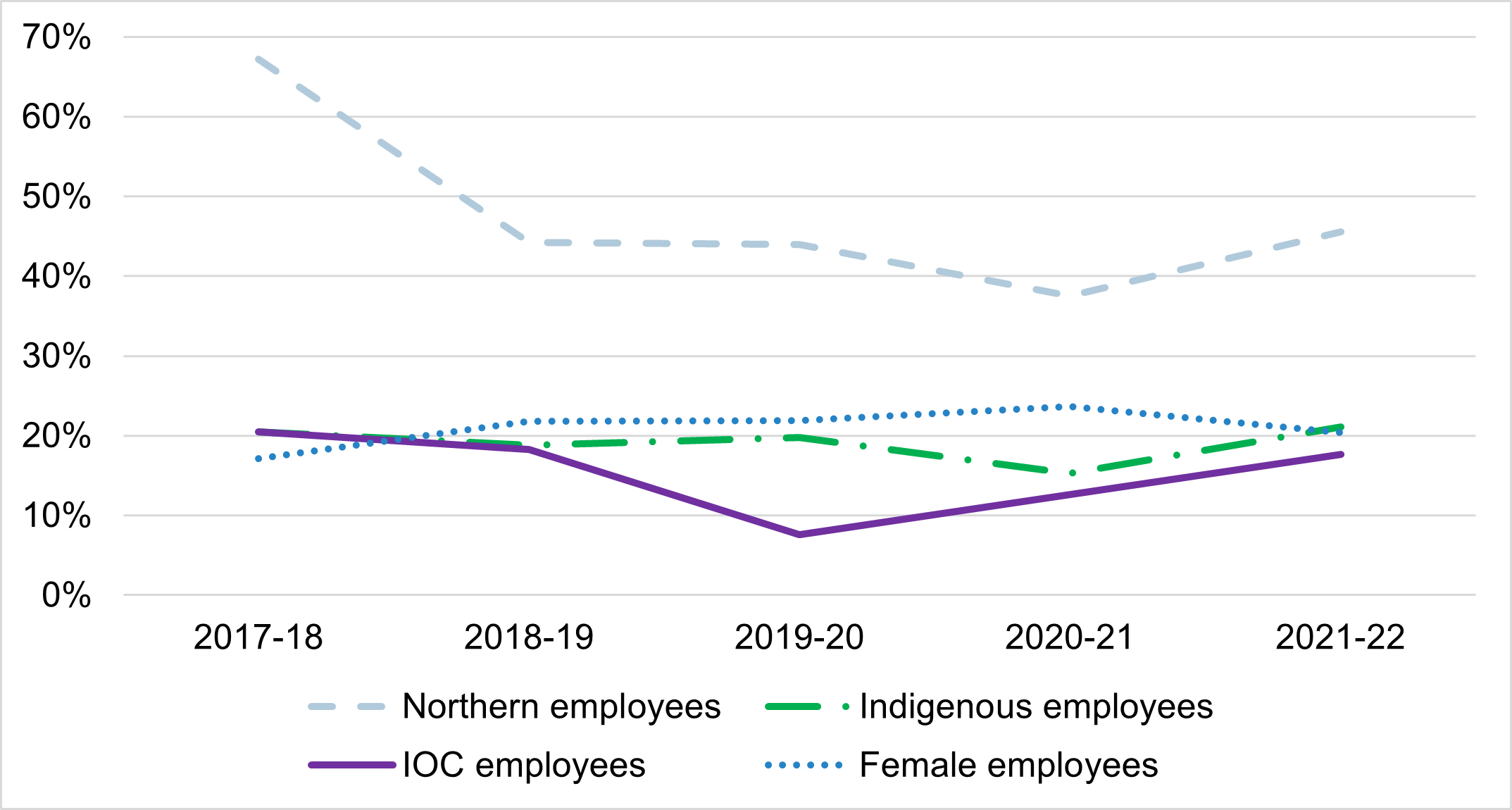
Text alternative for Figure 8: Percentage of person hours by category from 2017-18 to 2021-22
| 2017-18 | 2018-19 | 2019-20 | 2020-21 | 2021-22 | |
|---|---|---|---|---|---|
| Female employees | 17% | 22% | 22% | 24% | 20% |
| Northern employees | 67% | 44% | 44% | 38% | 46% |
| Indigenous employees | 20% | 19% | 20% | 15% | 21% |
| Indigenous Opportunities Considerations employees | 20% | 18% | 8% | 13% | 18% |
In 2021-22, the percentage of person-hours worked for Northern employment reached 46%. Although 2021-22 results represent a significant growth from last year, the results are still below the lower end of the target range (55% to 70%).
Indigenous employment also grew from 41,065 to 77,103 person-hours (87% increase). Indigenous employment accounted for 21% of the total person-hours worked in 2021-22, a 6% increase compared with 2020-21 results. Indigenous Opportunities Considerations employment increased from 13% to 18% relative to the total percentage, a continuous trend seen since 2019-20 when tracking data has been properly reported (13% in 2020-21, 8% in 2019-20). Northern Indigenous employees, included in Table 7 but not included in the above Figures (Figure 7 and 8), represented 20% of all employees (in person hours). Results are still below the lower end target set for Northern Indigenous employment (25%).
Female employment declined slightly from 24% in 2020-21 to 20% in 2021-22. Values are consistent with previous years (16-22% between 2016-17 and 2019-20). However, it is important to note that overall registered person-hours for female workers actually increased by 17%, from 63,525 in 2020-21 to 74,518 person-hours in 2021-22. The perceived decline is only a reflection of the total increase in person-hours worked in the project. Employment accounted by women is within the target range of 15 to 30%.
Table 8 presents the employment statistics for Parsons and its contractors for 2021-22 and Table 9 shows the employment statistics for CIRNAC and its contractors.
| Employee type | Total number persons (including contractors) | Total person-hours | Persons as percentage of all employees | Person-hours as percentage of all person-hours |
|---|---|---|---|---|
| Total | 638 | 258,829 | 100% | 100% |
| Northern employees | 335 | 158,750 | 53% | 61% |
| Indigenous employees (Northern and Southern) | 190 | 76,418 | 30% | 30% |
| Northern Indigenous | 186 | 73,394 | 29% | 28% |
| Indigenous Opportunities Consideration employees | 154 | 64,538 | 24% | 25% |
| Female employees | 126 | 39,315 | 20% | 15% |
| Employee type | Total number persons (including contractors) | Total person-hours | Persons as percentage of all employees | Person-hours as percentage of all person-hours |
|---|---|---|---|---|
| Total | 513 | 106,223 | 100% | 100% |
| Northern employees | 25 | 7,543 | 5% | 7% |
| Indigenous employees (Northern and Southern)Footnote 9 | 2 | 684 | 0% | 1% |
| Northern Indigenous | Not available | Not available | Not available | Not available |
| Indigenous Opportunities Consideration employees | 0 | 0 | 0% | 0% |
| Female employees | 209 | 35,203 | 41% | 33% |
Employment metrics are influenced by the type of contract and by the phase of the project. While Parsons and their contractors focus on operations and on-site work, CIRNAC contractors are largely off-site engineering design work. The Project anticipates that the Northern and Northern Indigenous employee statistics will continue to improve during the Implementation Phase of the project as the demand for on-site work will increase. The Project team is also committed to continue to work with its partners to identify and implement actions within the Implementation Plan to further increase employment of Northerners, Indigenous peoples, and women overall.
In the 2019-20 Annual Report, the Project began reporting data on the number of persons and person-hours associated with Indigenous employment and skill levels at the request of the Giant Mine Oversight Board and stakeholders. This information is still only available from Parsons and its sub-contractors, although the Project is hopeful that CIRNAC information will be available in the future.
Table 10 highlights employment statistics broken down by Northern sub-category, including Indigenous status (Indigenous and non-Indigenous) and whether they represent female or male employees. Figure 9 presents key trends for employment across Indigenous/non-Indigenous women and men working on the project for the past 3 years.
| Category | Metrics | 2021-22 Data | Percentage of Total |
|---|---|---|---|
| Total employment | Number of persons | 33 | 100% |
| Total employment | Person hours | 12,979 | 100% |
| Northern Indigenous women | Number of persons | 153 | 5% |
| Northern Indigenous women | Person hours | 60,415 | 5% |
| Northern non-Indigenous women | Number of persons | 30 | 23% |
| Northern non-Indigenous women | Person hours | 9,026 | 23% |
| Northern Indigenous men | Number of persons | 119 | 4% |
| Northern Indigenous men | Person hours | 76,330 | 3% |
| Northern non-Indigenous men | Number of persons | 33 | 18% |
| Northern non-Indigenous men | Person hours | 12,979 | 29% |

Text alternative for Figure 9: Percentage of employment by Northern sub-category (Parsons and its contractors), from 2019-20 to 2021-22.
| 2019-20 | 2020-21 | 2021-22 | |
|---|---|---|---|
| Northern non-Indigenous men | 34% | 39% | 29% |
| Northern Indigenous men | 21% | 23% | 23% |
| Northern Indigenous women | 5% | 7% | 5% |
| Northern non-Indigenous women | 3% | 2% | 3% |
NWT Residential status information is only available from Parsons and its contractors. In the previous year (2020-2021), there were 128 NWT resident employees and 121 non-NWT resident employees, in 2021-22, the number of NWT and non-NWT residents accounted for 319 individuals in each category (Table 11).
| Status | Total number of persons | Persons as percentage of all employees |
|---|---|---|
| NWT resident | 319 | 50% |
| Non-resident | 319 | 50% |
Table 12 highlights the employment statistics broken down by skill level for total employment, Northern Indigenous/non-Indigenous, Indigenous, and female employees for Parsons and its contractors only (that is, the percentages are the percentage of employment from the Parsons' totals, not the combined totals).
| Skill level | Total employment (percentage of total) | Northern | Indigenous (Northern and Southern) | Women |
|---|---|---|---|---|
| TOTAL Parsons | 638 (100%) | 335 (53%) | 190 (30%) | 126 (20%) |
| Entry-level | 58 (9%) | 54 (8%) | 50 (8%) | 7 (1%) |
| Semi-skilled | 149 (23%) | 115 (18%) | 82 (13%) | 53 (8%) |
| Skilled | 241 (38%) | 110 (17%) | 50 (8%) | 23 (4%) |
| Professional | 190 (30%) | 56 (9%) | 8 (1%) | 43 (7%) |
2021-2022 Procurement results and results compared to targets
7.2.2.1 Suppliers statistics
The Project tracks the total number of suppliers and the total value of contracts by 4 categories:
- Northern
- Southern
- Indigenous
- Indigenous Opportunities Considerations
It is important to note that these categories might overlap in some instances. For example, a single supplier may simultaneously be counted as Northern, Indigenous, and Indigenous Opportunities Considerations, or a combination thereof, and that category information was not available for all suppliers. For these reasons, the totals indicated in the top row of the table do not represent the sum of the proceeding rows. Table 13 shows the combined procurement statistics for Parsons and CIRNAC and compares the actual contract values (%) to the targets.
| Supplier type | Number of suppliers | Dollars spent | Percentage of total dollars spent | Target for procurement expenditures | Gap |
|---|---|---|---|---|---|
| Total | 635 | 73,683,859 | 100% | ||
| Northern suppliers | 273 | 43,158,636 | 59% | 65 to 75% | 6 to 16% |
| Southern suppliers | 362 | 30,525,222 | 41% | ||
| Indigenous suppliers | 41 | 30,564,330 | 41% | ||
| Indigenous Opportunities Considerations suppliers | 35 | 30,555,317 | 41% |
Figure 10 and Figure 11 summarize the total number of suppliers and percent of total value of contracts, by category, for 2017-18 to 2021-22. These results represent the combined data reported by both CIRNAC and the main construction manager.

Text alternative for Figure 10: Total Number of Suppliers from 2017-18 to 2021-22
| 2017-2018 | 2018-2019 | 2019-2020 | 2020-2021 | 2021-2022 | |
|---|---|---|---|---|---|
| Total | 474 | 799 | 427 | 352 | 635 |
| Northern suppliers | 208 | 337 | 173 | 182 | 273 |
| Southern suppliers | 266 | 453 | 254 | 170 | 362 |
| Indigenous suppliers | 19 | 44 | 38 | 18 | 41 |
| Indigenous Opportunities Considerations suppliers | 10 | 53 | 33 | 17 | 35 |

Text alternative for Figure 11: Percent of total dollar value spent from 2017-18 to 2021-22
| 2017-2018 | 2018-2019 | 2019-2020 | 2020-2021 | 2021-2022 | |
|---|---|---|---|---|---|
| Northern suppliers | 47% | 56% | 44% | 32% | 59% |
| Southern suppliers | 53% | 42% | 56% | 68% | 41% |
| Indigenous suppliers | 41% | 27% | 36% | 25% | 41% |
| Indigenous Opportunities Considerations suppliers | 35% | 29% | 35% | 24% | 41% |
In 2021-22, overall results demonstrated that the Project contracted fewer Southern suppliers and observed a significant increase in contracting Northern, Indigenous and Indigenous Opportunities Considerations suppliers, mostly by Parsons and its contractors. The proportion of expenditures with Northern suppliers reached 59% of all the project's expenses. The result is also higher than previous reported years (44% in 2019-20, 56% in 2018-2019, 47% in 2017-18). Despite the significant increase in procurement accounted by northerner suppliers observed in 2021-22, values for procurement accounted by Northerners are still 6% below the lower end of the target range.
The proportion spent with Indigenous suppliers increased to 41% in 2021-22, and expenditures increased to $30,564,330 in 2021-22 compared to $9,844,231 in 2020-21. The proportion spent with Indigenous Opportunities Considerations suppliers followed a similar trend, from 24% in the previous year to 41% in 2021-22, which is the highest result achieved compared to previous years (35% in 2019-20, 28% in 2018-19, and 35% in 2017-18). There are no targets set for expenditure with Indigenous Opportunities Considerations suppliers.
Table 14 and Table 15 provide separated statistics for Parsons and its contractors and CIRNAC contractors.
| Supplier type | Number of suppliers | Dollars spent | Percentage of total dollars spent |
|---|---|---|---|
| Total | 346 | $52,848,630.00 | 100% |
| Northern suppliers | 184 | $41,790,404.00 | 79% |
| Southern suppliers | 162 | $11,058,226.00 | 21% |
| Indigenous suppliers | 39 | $30,557,424.00 | 58% |
| Indigenous Opportunities Considerations suppliers | 35 | $30,555,317.00 | 58% |
| Supplier type | Number of suppliers | Dollars spent | Percentage of total dollars spent |
|---|---|---|---|
| Total | 289 | $20,835,228.65 | 100% |
| Northern suppliers | 89 | $1,368,232.30 | 7% |
| Southern suppliers | 200 | $19,466,996.35 | 93% |
| Indigenous suppliers | 2 | $6,906.00 | < 1% |
| Indigenous Opportunities Considerations suppliers | 0 | $0 | 0% |
As highlighted above under the Employment section, it is important to highlight the distinction between the results of Parsons and their contractors (that is, on-site work) and CIRNAC contractors (largely engineering design work) when considering these results. During 2021-22, work transitioned to more on-site work with early works implementation, which resulted in a higher percentage of Northern suppliers and a smaller percentage of Southern suppliers compared with 2020-21. The Project anticipates that the Northern and Northern Indigenous procurement statistics will continue to improve during the Implementation Phase of the Project because there will be more onsite work, however, it recognizes that there is more to be done to increase procurement of Northern and Indigenous suppliers and seeks to work with its partners to identify and implement actions within the Implementation Plan.
From 2005 to February 2022, under the Giant Mine Remediation Project, out of a total of approximately $614 million contract values awarded, $302 million (or 49%) went to Indigenous contractors.
7.2.2.2 Major procurements
The major procurements awarded between April 1, 2021 and March 31, 2022 are included in Table 16 below. Some of the values are contract extension amounts (that is, a contract had been awarded previous to the 2021-22 fiscal year, and it includes the value and duration of extension), while others are for single or multi-year contracts starting in 2021-22.
| Scope of work | Awarded to: | Value |
|---|---|---|
| Early Works Backfill:Table note 1 from July 31, 2021 to September 30, 2022 | Nahanni Construction Ltd. | $38,380,534 |
| Surface Care and Maintenance:Table note 1 from April 1, 2021 to March 31, 2023 | Det'on Cho Nuna Joint Venture | $12,657,022 |
| Non-hazardous Waste Landfill:Table note 1 from June 9, 2021 to October 31, 2021 | Forward Mining LP | $6,676,452 |
| AR1 Freeze Program:Table note 1 from August 4, 2021 to July 28, 2022 | DJRM First Nations Construction Corporation | $6,052,235 |
| Ambient Air Quality Monitoring: from April 1, 2021 to March 32, 2023 | SLR Consulting (Canada) Ltd. | $4,433,090 |
| Effluent Treatment Plant Operations: from May 17, 2021 to October 31, 2022 | BluMetric Environmental and Det'on Cho JV | $3,513,532 |
| Surface Water and Groundwater Monitoring: from April 1, 2021 to March 31, 2023 | BluMetric Environmental and True North Environmental JV | $1,408,646 |
| 3rd Party Independent Testing: from August 20, 2021 to March 31, 2022 | Det'on Cho Environmental | $783,219 |
| Aquatic Biological Services: from August 20, 2021 to March 31, 2022 | Det'on Cho Environmental | $586,704 |
| Domestic Waste Disposal: from June 23, 2021 to September 31, 2022 | Kavanaugh Bros | $329,706 |
| Site Wide Surveying: from January 1, 2022 to October 31, 2022 | Det'on Cho Challenger Geomatics | $309,500 |
| Tailings Dust Suppressant: from May 1, 2022 to March 31, 2022 | ALX Exploration Services | $273,529 |
| Road Dust Suppressant: from May 1, 2021 to March 31, 2022 | LandLoc Environmental | $223,370 |
| Bear Monitoring: from May 12, 2021 to October 1, 2021 | Ek'edia Services | $116,700 |
|
||
7.2.2.3 Additional procurement key performance indicators
Additional procurement key performance indicators include:
- procurement accounted for by:
- Northern Indigenous suppliers and amount spent (number, dollar value, percentage)
- Northern Non-Indigenous suppliers and amount spent (number, dollar value, percentage)
- modifications to procurement procedures to increase Indigenous participation (for example, advances communications of procurement, set asides) (description and number), the Project aims to report on this key performance indicator in the following fiscal year
- new joint ventures and partnerships established (number):
- there was one joint venture formed in 2021-22, Deton Cho and Challenger Geomatics formed Det'on Cho Challenger Geomatics, which won the Site Wide Surveying work package
- more formal tracking of these partnerships will occur in future reporting years
- new Northern Indigenous and Northern non-Indigenous contractors bidding (number), the Project aims to report on this key performance indicator in the following fiscal year
Table 17 highlights the procurement accounted for by Northern Indigenous and by Northern non-Indigenous suppliers for 2021-22.
| Supplier typeFootnote 10 | Number of suppliers | Dollars spent | Percentage of total dollars spent |
|---|---|---|---|
| Northern Indigenous suppliers | 40 | 30,562,966 | 41% |
| Northern non-Indigenous suppliers | 233 | 12,595,670 | 17% |
In addition, the Project has committed to report on the total Indigenous Opportunities Considerations bonuses issued for surpassing Indigenous Opportunities Considerations commitments and total Indigenous Opportunities Considerations deductions issued for not meeting Indigenous Opportunities Considerations commitments, as specified in contracts. 2021-22 is the first year of reporting. Results for the 2021-22 reporting year are:
- Total bonuses issued: $66,456.29
- Total deductions issued: $88,989.20
Overall, contractors paid a total of $22,532.91 in deductions (bonuses subtracted).
Next Steps: Employment and Procurement
The evergreen Socio-economic Implementation Plan has identified additional actions and deliverables for the Project to focus on in 2022-23, several of which are highlighted below:
- Employment:
- continue to create and maintain links between Project and other large infrastructure projects to identify opportunities to gain employees from project closures and to identify potential employment shortages
- assess labour demand for common services and project implementation activities (anticipated to be finalized by summer 2022)
- continue to enhance communication to increase employment desirability and support recruitment of potential hires (for example, attend the Yellowknives Dene First Nation job fair and provide information about employment opportunities and job supports)
- enhance apprenticeship and trainee uptake
- Procurement:
- implement modified procurement tools to support the procurement of local, Indigenous and Northern businesses, including the use of Indigenous Opportunities Considerations and the Procurement Strategy for Indigenous Businesses as well as identify other opportunities for improved procurement
- engage with Northern and Indigenous businesses ahead of formal procurement processes to improve their preparedness for upcoming contracts, including Industry Day in November 2022, and additional bidder's meetings and conferences in advance of procurement opportunities
7.2.3 Training and capacity building
In addition to the occupational health and safety training, Project contractors are required to ensure that employees are properly trained to perform their responsibilities. Contractors deliver workforce training, including site orientations. The inclusion of Indigenous Opportunities Considerations in contracts ensures Indigenous employment and capacity building is considered and implemented where possible by all Project contractors.
The table below summarizes the training activities from the Implementation Plan that the Project advanced and/or completed in 2021-22.
Key actions and deliverables advanced in 2021-22: training
Action:
Establish a group dedicated to training coordination.
Deliverable:
Participants at the February 2020 implementation planning meeting identified the need for a coordinated Training Hub in the North Slave region. The Project collaborated with the Government of the Northwest Territories' Department of Education, Culture and Employment to identify the purpose and format of the Hub, with input from the Socio-Economic Working Group. In 2021-22, the Government of the Northwest Territories continued to work with a third-party organization to establish a virtual platform. Once the platform is up and running, the Project will provide information to the coordinators and will stay engaged in the initiative.
Action:
Contribute towards strengthening local remediation capacity.
Deliverable:
Over the course of 2021-22, the Project worked with the Yellowknives Dene First Nation to develop a 5-year training plan for the Yellowknives Dene First Nation's Dechı̨ta Nàowo program; the Project team also continues to advance the development of respective plans with the North Slave Métis Alliance and Tłı̨chǫ.
Action:
Develop links between training providers, contractors, and the Project.
Deliverable:
Parsons meets regularly with training providers to receive updates on the training provided and recent graduates. Parsons includes in all Request for Proposals a list of local training institutions, the training they provide, and their contact information, as well, Parsons meets with contractors prior to and when issuing contracts to ensure they are aware of training providers and what is offered.
2021-22 Training results
The Project tracks its workforce training by number of people who have participated in training exercises, as well as the number of person hours. Based on statistics reported by both CIRNAC and the main construction manager, workforce training for 2021-22 is summarized in Table 18, organized by categories of:
- Northern
- Northern Indigenous
- Indigenous employees
- Indigenous Opportunities Considerations employees
- Women
- Total
It is important to note that the total presented in Table 18 does not reflect the sum of the other categories due to overlaps between the categories.
In 2021-22, the Project obtained the highest training numbers registered. The total number of people trained (335) is 47% greater than the previous year (average of 230 people since 2016-17 to 2020-21). Workforce training provided to Northern employees (250 people) was greater than values from previous years (average of 104 people trained since 2016-17 to 2020-21). Workforce training for Indigenous Opportunities Considerations employees increased from 32 individuals the previous year to 127 individuals in 2021-22. Workforce training for Indigenous employees more than doubled, growing from 68 in 2020-21 to 186 in 2021-22, this is more than the average increase observed from previous years. Female employees (74) remained unaltered from previous years. Figure 12 provides trending information on the percentage of people trained by sub-category since 2017-18. Northern, Indigenous and Indigenous Opportunities Considerations employees experienced an increase in overall training number. The percentage of female employees decreased as the number of female employees remained the same while the total number of people trained increased.
| Workforce training | Total number of persons | Total person-hours | Persons as percentage of all employees | Person-hours as percentage of all person-hours |
|---|---|---|---|---|
| Total | 335 | 39,407 | 100% | 100% |
| Northern employees | 250 | 34,531 | 75% | 88% |
| Indigenous employees | 186 | 32,705 | 56% | 83% |
| Northern Indigenous | 186 | 32,705 | 56% | 83% |
| Indigenous Opportunities Considerations employees | 127 | 21,278 | 38% | 54% |
| Female employees | 74 | 7,513 | 22% | 19% |

Text alternative for Figure 12: Percentage of People Trained by Employee Group from 2017-18 to 2021-22
| 2017-2018 | 2018-2019 | 2019-2020 | 2020-2021 | 2021-2022 | |
|---|---|---|---|---|---|
| Northern employees | 57% | 35% | 47% | 50% | 75% |
| Female employees | 17% | 23% | 27% | 32% | 22% |
| Indigenous employees | 18% | 14% | 24% | 30% | 56% |
| Indigenous Opportunities Considerations employees | 17% | 23% | 10% | 14% | 38% |
Figure 13 highlights the number of normalized person-hours of training by employee group from 2017-18 to 2021-22. The number of person-hours of training is normalized by person-hours worked to enable comparison across years, since the total number of training hours may significantly differ over the years. In the past, mandatory training (for example, first aid, Workplace Hazardous Materials Information System) were excluded from overall calculations of training statistics. To streamline the process, as of 2019-20, all training is now included in calculations of training statistics. In 2021-22, the total normalized number of persons hours trained (21,590) is significantly higher than the average recorded for previous years since 2016 (7,251). This upward trend in person-hours trained was observed across all employment categories. For non-normalized numbers, Northern employees achieved the highest numbers (34,531), followed by Indigenous employees (32,705), Indigenous Opportunities Considerations employees (21,278) and female employees (7,513), summing 39,407 person-hours in 2021-22. However, when numbers are normalized, Indigenous employees and Indigenous Opportunities Considerations employees obtained the highest numbers of training provided.
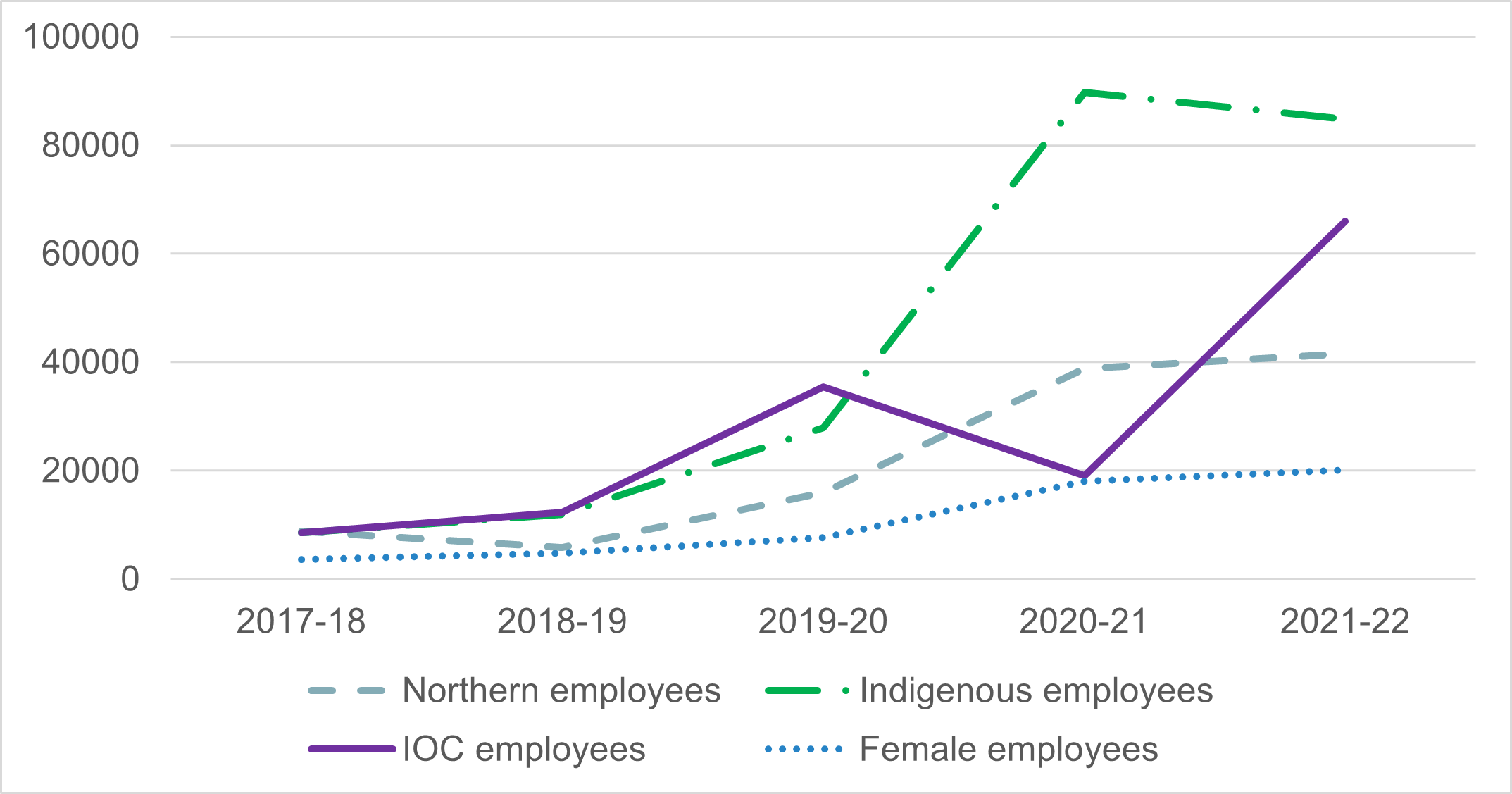
Text alternative for Figure 13: Number of person hours of training per 200,000 person-hours worked by employee group from 2017-18 to 2021-22
| 2017-2018 | 2018-2019 | 2019-2020 | 2020-2021 | 2021-2022 | |
|---|---|---|---|---|---|
| Northern employees | 8,846 | 5,820 | 15,985 | 38,769 | 41,531 |
| Female employees | 3,573 | 4,810 | 7,615 | 18,094 | 20,164 |
| Indigenous employees | 8,567 | 11,946 | 27,955 | 89,691 | 84,835 |
| Indigenous Opportunities Considerations employees | 8,570 | 12,342 | 35,464 | 19,051 | 65,939 |
7.2.3.1 Additional training key performance indicators
Additional training key performance indicators include:
- workforce training accounted for by (Table 19):
- Northern Indigenous women (number of persons, person hours, percentage)
- Northern Indigenous men (number of persons, person hours, percentage)
- Northern non-Indigenous women (number of persons, person hours, percentage)
- Northern non-Indigenous men (number of persons, person hours, percentage)
- trending information on percentage of person-hours accounted by Northern employees. Data was limited to 4 years of recording (Figure 14 )
- professional development scholarships funded (number of scholarships, dollar amount of each, and number filled by priority groups) will be reported on during the Implementation Phase
- Northern Indigenous and Northern Non-Indigenous apprentices supported (number, percentage out of total apprentices will be reported on during the Implementation Phase
| Employee type | Total number of persons (including contractors) | Total person-hours | Persons as percentage of all employees | Person-hours as percentage of all person-hours |
|---|---|---|---|---|
| Northern Indigenous women | 41 | 7,213 | 12% | 18% |
| Northern non-Indigenous women | 13 | 174 | 4% | 0.4% |
| Northern Indigenous men | 145 | 25,492 | 43% | 65% |
| Northern non-Indigenous men | 51 | 1,652 | 15% | 4% |

Text alternative for Figure 14: Non-normalized percentage of person-hours trained by Northern sub-category (Parsons and CIRNAC), 2018-19 to 2021-22.
| 2018-2019 | 2019-2020 | 2020-2021 | 2021-2022 | |
|---|---|---|---|---|
| Northern Indigenous men | 32% | 49% | 64% | 65% |
| Northern Indigenous women | 12% | 8% | 27% | 18% |
| Northern non-Indigenous men | 12% | 19% | 5% | 4% |
| Northern non-Indigenous women | 2% | 4% | 0% | 0% |
7.2.3.2 Dechita Nàowo
Through a Contribution Agreement, the Project funded the Yellowknives Dene First Nation Dechita Nàowo Training Program in 2021-22. The 2021-22 training programs and number of participants are summarized below:
- Activity 1 Building Environmental Aboriginal Human Resources Heavy Equipment Operator: 8 participants, 490 hours total
- Activity 2 Building Environmental Aboriginal Human Resources Core Environmental Monitoring: 14 participants, 1,645 hours total
- Activity 3 Industrial safety courses: 4 participants, 64 hours total
- Activity 4 On-the-job training: 9 participants from Heavy Equipment Operator program worked for Det'on Cho Landtran, 3,480 hours total
- Activity 5 Pre-Trades Preparation / Post-Secondary Preparation (focusing on pre-trades exam, studied Math, Science, and English): 9 participants, 2,961 hours total
Next steps: training
The implementation Plan has identified a set of training actions to advance, which include:
- support implementation of the Training Hub (North Slave Region Training Hub) by providing information on Project work packages, labour estimates and schedule
- contribute towards strengthening local remediation capacity (for example, continue supporting the development and implementation of 5-year training plans, better understand opportunities for higher-capacity positions and the training required)
7.2.4 Social and cross-cutting actions and deliverables
The Socio-Economic Strategy describes several common potential social impacts of large projects in Northern communities, noting that:
"Identifying the potential for negative impacts during the project planning stage and working to minimize and mitigate these, including through enabling and supporting programs that help alleviate unavoidable impacts, will be an important component of the Strategy."
The table below provides a summary of the actions and deliverables related to social / cross-cutting that were advanced or completed.
Action:
Further identification of opportunities to reduce social impacts.
Deliverable:
In November 2021, the Project team led a focused discussion with the Socio-Economic Working Group on social impact management, including additional opportunities to address gaps in management. The team continues to work with Parsons on identifying and implementing opportunities at site.
Action:
Strategic Partnerships Initiative participation
Deliverable:
CIRNA NWT Region led the development of an application to the Strategic Partnerships Initiative, a federal funding initiative to increase Indigenous participation in economic opportunities and to help fill funding and program gaps. The application was centred around building capacity through remediation opportunities in the NWT. The Project team and Parsons participated in interviews and the Advisory Committee to provide input and inform research.
Next steps: Social and cross-cutting actions and deliverables
The implementation Plan has identified a set of social actions to advance, which include:
- continue to build relationships and share labour demand with relevant social service providers
- continue to discuss with Parsons options for reducing social impacts on site
- continued participation in the Strategic Partnerships Initiative, as required
8. In Closing
In 2021-22, the Project reached a major milestone and began initial remediation work. While the ongoing safety requirements and restrictions related to COVID-19 presented some challenges to how the Project conducted work throughout the year, there was still significant progress made while adhering to the site's COVID-19 Virus Response Plan and procedures. The Project continued site operations (care and maintenance), immediate risk mitigation activities, and community engagement while progressing work on the review and resubmission of Management and Monitoring Plans and other requirements under the Water Licence.
- complete the remaining construction of the non-hazardous waste landfill
- complete early works underground stabilization
- complete construction of the AR1 freeze pad, including the placement of off-site borrow material for the "insulation layer" of the freeze pad
- ongoing operations and maintenance of the effluent treatment plant
- waste management, including detail design for contaminated soils
- continue sewage and greywater management
- finalize the Procurement Framework Agreement with the Yellowknives Dene First Nation
- secure project, expenditure, and contracting authority from Treasury Board for the implementation phase of the Project
- complete the Project Implementation Plan and update labour estimates
- continue to engage with Northern and Indigenous businesses ahead of formal procurement processes to improve their preparedness for upcoming contracts, including Industry Day in fall 2022, and additional bidder's meetings/conferences in advance of procurement opportunities
The Project will continue to prepare annual reports reports that describe the progress and performance of the Project. In the spirit of continual improvement, we welcome your comments on this report and how it can be enhanced in the future.
For more information or to provide comments on the Report, please contact:
Natalie Plato, Giant Mine Remediation Project Deputy Director
natalie.plato@rcaanc-cirnac.gc.ca
867-669-2838
References to all sources relied upon
- AECOM Canada Ltd. (2017). Akaitcho Deep Well Pump Station. Edmonton: Public Works and Government Services Canada.
- AECOM Canada Ltd. (2018). Climate Change Review. Edmonton: Public Services and Procurement Canada.
- AECOM Canada Ltd. (2019a). Giant Mine Coarse Grain Borrow Source Acid Rock Drainage / Metal Leaching Geochemical Assessment. Edmonton: Public Services and Procurement Canada.
- AECOM Canada Ltd. (2019b). Giant Mine Remediation Project: New Water Treatment Plant – Substantive Design and Cost Estimate Process Selection Report. Edmonton: Public Services and Procurement Canada.
- AECOM Canada Ltd. (2019c). Upgrade Options to Improve Mine Water Effluent Quality and Maintain Plant Reliability. Yellowknife: Public Services and Procurement Canada.
- AECOM Canada Ltd. (2019d). Water Treatment Plant Location, Discharge Line and Outfall Assessment Report. Edmonton: Public Services and Procurement Canada.
- AECOM Canada Ltd. (2020a). Downgradient of Dam 3 Pond Water Impacted Area Background and Remedial Options Analysis. Edmonton: Public Services and Procurement Canada.
- AECOM Canada Ltd. (2020b). Giant Mine Site-Wide Infrastructure Assessment. Yellowknife: Public Services and Procurement Canada.
- AECOM Canada Ltd. (2020c). Water Treatment Plant - Preliminary Design Report. Edmonton: Public Services and Procurement Canada.
- AECOM Canada Ltd. (2021). Giant Mine – Site-Wide Infrastructure Assessment. Edmonton: Public Services and Procurement Canada.
- AECOM Canada Ltd. (2022). Yellowknife Bay Fish Tissue. Edmonton: Public Services and Procurement Canada (PSPC).
- BlueMetric Environmental. (2022). Environment, Health & Safety Audit for the Giant Mine Remediation Project (GMRP) Underground Operations Call-up Under SOA #460002237. Gatineau; Yellowknife: CIRNAC.
- Canada North Environmental Services. (2018). Giant Mine Human Health and Ecological Risk Assessment. Markham, Ontario: Public Services and Procurement Canada.
- Chan, L., Rosol, R., Cheung, J., Parajuli, R., Hu, X., & Yumvihoze, E. (2019). Health Effects Monitoring Program in Ndilo, Dettah and Yellowknife: Progress Report: Results from the Phase I Baseline Study (2017-2018). Ottawa: Univerity of Ottawa.
- CIRNAC. (2019a, August 14). May/June 2019: What's Happening at Giant? Retrieved from Crown-Indigenous Relations and Northern Affairs Canada: https://www.rcaanc-cirnac.gc.ca/eng/1565725334962
- CIRNAC. (2019b, April 18). April 2019: What's Happening at Giant? Retrieved from Crown-Indigenous Relations and Northern Affairs Canada: https://www.rcaanc-cirnac.gc.ca/eng/1560957679224
- CIRNAC. (2019c). Giant QRA Plain Language Report. Crown-Indigenous Relations and Northern Affairs Canada.
- CIRNAC. (2021a). RE: Giant Mine Remediation Project MV2007L8-0031 Annual Review of Plans & Programs. Yellowknife, NT: Giant Mine Remediation Project.
- CIRNAC. (2021b, May 05). What's happening at Giant Mine? Retrieved from Crown-Indigenous Relations and Northern Affairs Canada: https://www.rcaanc-cirnac.gc.ca/eng/1612298764633/1617982723102
- CIRNAC, GNWT. (2022). 2021 Annual Water Licence Report. Yellowknife: Government of Canada, GNWT.
- Contango. (2019). Giant Pilot-Scale PTS Study Report. Edmonton: Golder Associates Ltd.
- Deloitte LLP. (2019). Development of Options for Consideration for Long Term Funding for Giant Mine. Crown-Indigenous Relations and Northern Affairs Canada.
- Environment Canada. (2012). Metal Mining Technical Guidance for Environmental Effects Monitoring. Ottawa, Ontario: National EEM Office, Environment Canada.
- Giant Mine Remediation Project. (2007). Giant Mine Remediation Plan. Yellowknife: Indian Affairs and Northern Development.
- Giant Mine Remediation Project. (2018a). Arsenic trioxide and underground issues at Giant Mine. Retrieved from Aboriginal Affairs and Northern Development Canada: https://www.rcaanc-cirnac.gc.ca/eng/1100100027413
- Giant Mine Remediation Project. (2018b). The 2017-2018 Annual Report of the Giant Mine Remediation Project: Moving Towards Remediation.
- Giant Mine Remediation Project. (2019a). Closure and Reclamation Plan. CIRNAC and GNWT.
- Giant Mine Remediation Project. (2019b). Engagement Log and Engagement Summaries 2016 - 2018. CIRNAC and GNWT.
- Giant Mine Remediation Project. (2019c). Tailings Management and Monitoring Plan.
- Giant Mine Remediation Project. (2020). Borrow Partial 3D Renderings - Engagement Slides. Giant Mine Remediation Project.
- Giant Mine Remediation Project. (2021a). Giant Mine Remediation Project MV2007L8-0031 – 2020 Annual Water Licence Report. Yellowknife, NT: Crown-Indigenous Relations and Northern Affairs Canada.
- Giant Mine Remediation Project. (2021b). 2020 Annual Water Licence Report. Submitted to the Mackenzie Valley Land and Water Board as per Part B, Condition 20 of Water Licence MV2007L8-0031.
- Giant Mine Remediation Project. (2021c). Wildlife and Wildlife Habitat Management and Monitoring Program. Submitted to the Mackenzie Valley Land and Water Board as per Land Use Permit MV2019X0007, Condition 53 and to satisfy the Board directives as specified.
- Giant Mine Remediation Project. (2022a). 2021 Annual Water Licence Report MV2007L8-0031. Yellowknife, NT: Crown-Indigenous Relations and Northern Affairs Canada.
- Giant Mine Remediation Project. (2022b). Aquatic Effects Monitoring Program Design Plan.
- Giant Mine Remediation Project. (2022c). Giant Mine Remediation Project – Dust Communications Strategy.
- Giant Mine Remediation Project. (2022d). NCSP Regional Project Risk Register. Excel Spreadsheet.
- GMOB. (2020). 2020 Annual Report.
- Golder Associates Ltd. (2018). Chamber 15 Arsenic Waste Updated Disposal Options. Edmonton.
- Golder Associates Ltd. (2019a). 2018 Contaminated Soil and Sediment Update. Edmonton: Public Services and Procurement Canada.
- Golder Associates Ltd. (2019b). 2019 ANNUAL GEOTECHNICAL INSPECTION – SITE VISIT SUMMARY [TECHNICAL MEMORANDUM]. Edmonton: Public Services and Procurement Canada.
- Golder Associates Ltd. (2019c). 2019 Giant Mine Bird Activity Survey [Technical Memorandum]. Prepared for Public Services and Procurement Canada (PSPC).
- Golder Associates Ltd. (2019d). Remedial Options / Scenarios for Deep Contaminated Materials, Giant Mine Remediation Project, NT. Edmonton: Public Services and Procurement Canada.
- Golder Associates Ltd. (2019e). BAKER CREEK AND YELLOWKNIFE BAY FISH AND FISH HABITAT ASSESSMENT – 2019 FIELD WORK SUMMARY. Edmonton: Public Services and Procurement Canada.
- Golder Associates Ltd. (2019f). GIANT MINE AQUATIC MONITORING - CURRENT REFERENCE AREAS – FINAL [Technical Memorandum]. Edmonton: Public Services and Procurement Canada.
- Golder Associates Ltd. (2019g). Giant Mine Remediation Project - General Design: Mine Water Intake Assessment Report. Edmonton: Public Services and Procurement Canada.
- Golder Associates Ltd. (2019h). Open Pit Closure Design - Design Basis Technical Memo. Public Services and Procurement Canada.
- Golder Associates Ltd. (2019i). Operation, Maintenance and Surveillance Manual for Giant Mine Dams. Crown-Indigenous Relations and Northern Affairs Canada.
- Golder Associates Ltd. (2020a). Fine Grained Borrow Characterization. Edmonton: Public Services and Procurement Services Canada.
- Golder Associates Ltd. (2020b). Giant Mine 2019 MDMER Annual Report. Edmonton: Public Services and Procurement Canada (PSPC).
- Golder Associates Ltd. (2020c). Giant Mine Openings to Surface: Site Investigation and Closure Design Options Report. Edmonton: Public Services and Procurement Canada.
- Golder Associates Ltd. (2020d). Monitoring Program Final Interpretative Report Phase 6 Environmental Effects. Submitted to AECOM Canada Ltd. Golder DCN: 18104954-065-R-Rev0-64000.
- Golder Associates Ltd. (2020e). Potential Fine Grained Borrow Geophysical Investigation 2018. Edmonton: Public Services and Procurement Canada.
- Golder Associates Ltd. (2020f). Small Mammal and Vegetation Sampling. Yellowknife: Public Works and Government Services Canada.
- Golder Associates Ltd. (2020g). Updated Hydrogeological Assessment – 3D Underground Model. Edmonton: Public Services and Procurement Canada.
- Golder Associates Ltd. (2021a). Giant Mine Remediation Project - Annual Water Monitoring Report 2020. Edmonton, AB: Public Services and Procurement Canada (PSPC).
- Golder Associates Ltd. (2021b). Giant Mine Remediation Project - Aquatic Effects Monitoring Program 2020 Annual Report. Golder Reference No. 18104954-094-R-Rev0-700.
- Golder Associates Ltd. (2021c). Phase 7 Environmental Effects Monitoring Program Study Program. Yellowknife: CIRNAC.
- Golder Associates Ltd. (2021d). 2021 Annual Geotechnical Inspection of Dams. Edmonton: Public Services and Procurement Canada.
- Golder Associates Ltd. (2021e). DAM 1 CLOSURE, SLOPE STABILITY ASSESSMENT. Saskatoon: Public Services and Procurement Canada.
- Golder Associates Ltd. (2022a). Public Service and Procurement Canada.
- Golder Associates Ltd. (2022b). SURFACE BOREHOLE CLOSURE – FINDINGS FROM 2021 FIELD INVESTIGATION – GIANT MINE. TECHNICAL MEMORANDUM Reference No. 1314260010-595-TM-Rev0-52000. Calgary.
- Golder Associates Ltd. (2022c). Giant Mine Remediation Project - Aquatic Effects Monitoring Program 2021 Annual Report. Calgar: Public Services and Procurement Canada.
- Government of Canada. (2002). Metal and Diamond Mining Effluent Regulations (SOR/2002-222). Retrieved from Metal and Diamond Mining Effluent Regulations: https://laws-lois.justice.gc.ca/eng/regulations/sor-2002-222/page-1.html
- Mackenzie Valley Review Board. (2013). Report of Environmental Assessment and Reasons for Decision: Giant Mine Remediation Project EA0809-001. Mackenzie Valley Environmental Impact Review Board. Retrieved from https://new.reviewboard.ca/sites/default/files/project_document/EA0809-001_Giant_Report_of_Environmental_Assessment_June_20_2013.PDF (PDF)
- Parsons Inc. (2020). Giant Mine Remediation Project: COVID-19 Update - December 10, 2020. Calgary, AB: Parsons.
- Parsons Inc. (2021a). COVID-19 New Preventive Measures Rollout. Calgary, AB: Parsons.
- Parsons Inc. (2021b). COVID-19 Update September 1, 2021. Calgary, AB: Parsons.
- Parsons Inc. (2021c). GMRP MCM Monthly Report_032021. Calgary, Alberta: Public Services and Procurement Canada (PSPC).
- Parsons Inc. (2021d). GMRP 2020-21 spills log.
- Parsons Inc. (2022a). COVID-19 Protocols. Calgary, AB: Parsons.
- Parsons Inc. (2022b). Monthly Reports March 2022: Giant Mine Remediation Project. Edmonton: Public Services and Procurement Canada.
- Parsons Inc. (2022c). Giant Mine Remediation Project – Standard Operating Procedure (Waste Management and Handling). Calgary, AB: Parsons.
- Shin Shiga Consulting. (2020). Summary of Traditional Land-Use by the Indigenous Métis People in the Yellowknife Bay Area.
- SLR Consulting (Canada) Ltd. (2021). GIANT MINE REMEDIATION PROJECT: Ambient Air Quality Monitoring Program Annual Report – 2020. Yellowknife, NT: Parsons Inc.
- SLR Consulting (Canada) Ltd. (2022). Ambient Air Quality Monitoring Program Annual Report – 2021. Yellowknife: PARSONS INC.
- SRK Consulting. (2020). Giant Mine 2019 Dam Safety Review Report. Project No: 1CI01.044. Prepared for: Northern Contaminated Sites Program Branch Crown-Indigenous Relations and Northern Affairs Canada.
- Williams, O. (2021, December 24). Giant Mine cleanup work scaled down after Covid-19 exposure. Retrieved from Cabin Radio: https://cabinradio.ca/82782/news/yellowknife/giant-mine-cleanup-work-scaled-down-after-covid-19-exposure/
- Yellowknives Dene First Nation & Trailmark Systems. (2019). YKDFN Knowledge of Giant Mine and Perspectives on the Giant Mine Remediation Project.
Appendices
- Appendix A: Environmental Agreement: Report Alignment
- Appendix B: List of 2021-22 Studies and Reports
- Appendix C: Project Risks
- Appendix D: Progress on Environmental Assessment Measures and Suggestions
- Appendix E: Additional Information on Monitoring Parameters
- Appendix F: Greenhouse Gas Emissions
- Appendix G: Plain Language Summary
Appendix A: Environmental Agreement: Report Alignment
A significant driver for the development of the Project Annual Report is the Environmental Agreement, the signing of which is a mandatory requirement per Measure 7 of The Report of Environmental Assessment and Reasons for Decision (Mackenzie Valley Review Board, 2013). This agreement establishes an independent oversight body (that is, the Giant Mine Oversight Board) for the Project, and was signed in June 2015 by Crown-Indigenous Relations and Northern Affairs Canada (CIRNAC, formerly Aboriginal Affairs and Northern Development Canada [AANDC]), the Government of the Northwest Territories, the City of Yellowknife, the Yellowknives Dene First Nation, Alternatives North and the North Slave Métis Alliance.
Article 5 of the Environmental Agreement stipulates that "the Co-Proponents shall prepare, provide to the Giant Mine Oversight Board and make available to the public an Annual Report on the Project each year," to be submitted to the Giant Mine Oversight Board "no later than October 1 in each year," starting October 1, 2016 (the report addressing the 2015-16 fiscal year).
The Environmental Agreement specifies what content must be included in each annual report. The table below outlines each requirement and where the content can be found in this 2021-22 Report.
Environmental Agreement requirement:
- A summary of the Project's key operational activities and associated expenditures.
Section of report:
- Operational summary
Environmental Agreement requirement:
- A summary of any other significant developments relating to the Project.
Section of report:
- Advancing design
- Environment
- Health and safety
- Community
Environmental Agreement requirement:
- A summary of the results or findings of all monitoring done for the environmental programs and plans and a description of actions taken or planned to implement adaptive management.
Section of report:
- Environment
- Health and safety
Environmental Agreement requirement:
- An assessment of the effectiveness of actions already taken to address the results or findings of all monitoring completed for the environmental programs and plans.
Section of report:
- Environment: Air
- Environment: Water
Environmental Agreement requirement:
- A summary of any environmental or engineering studies conducted by the co-proponents in relation to the Project.
Section of report:
- Advancing design
- Operational summary
- Environment: Water; Land
- Appendix B: Studies
Environmental Agreement requirement:
- A summary of any changes to, or plans for changes to, the environmental program and plans.
Section of report:
- Not applicable for this reporting year
Environmental Agreement requirement:
- A summary of the environmental audits of the Project, and the co-proponents' response to the audit.
Section of report:
- Operational summary
Environmental Agreement requirement:
- A summary of any reportable spills, accidents or significant malfunctions, and a summary of the co-proponents' responses.
Section of report:
- Operational summary
- Environment
Environmental Agreement requirement:
- A listing of regulatory inspections, reports or directions, and a summary of the co-proponents' response to any issues arising therefrom.
Section of report:
- Operational summary
Environmental Agreement requirement:
- An analysis of trends in environmental effects data over time.
Section of report:
- Environment
- Health and safety
- Community
Environmental Agreement requirement:
- A summary of significant public engagement activities, or matters raised as public concerns, and the co-proponents' responses.
Section of report:
- Community: Engagement
Environmental Agreement requirement:
- A summary of the Project's planned key operational activities for the coming year and associated planned expenditures, subject to the need to protect commercially sensitive financial information.
Section of report:
- Progress update and plans
- Operational summary
- In closing
Environmental Agreement requirement:
- A summary of the progress of the Project, including with respect to the Mackenzie Valley Resource Management Act measures, Mackenzie Valley Environmental Impact Review Board suggestions, and co-proponents' commitments.
Section of report:
- Progress on Environmental Assessment Commitments
- Appendix D
Environmental Agreement requirement:
- References to all sources relied on by the co-proponents in coming to conclusions in the Annual Report.
Section of report:
- References
Environmental Agreement requirement:
- A plain language summary of the Annual Report.
Section of report:
- Plain Language Summary
- Appendix G
Addressing Giant Mine Oversight Board recommendations
In the Giant Mine Oversight Board feedback on the 2020-21 Report, Giant Mine Oversight Board identified several questions and areas for improved clarity. The table below provides Giant Mine Oversight Board's report recommendations and the Project team's responses.
Giant Mine Oversight Board report recommendations:
GMOB has identified several opportunities for improving the clarity of the information in the summary table as follows:
- include a column on the left with numbers for tracking the activities
- the word "advanced" has several interpretations and may not provide insight into the status of the initiative; consider using "started", "continued", "partially completed" or other words that have a more definite interpretation
- "substantive" should be more clearly defined in the context of "substantive design"
- consider the use of colour coding such as in Table 1 on Page 20 to quickly provide information on the status of the activities
Note: there are several instances where these terms are used through the remainder of the report, and these phrases should be adjusted to be made more clear.
Project response:
The Project is appreciative of the suggestion to make this table clearer to readers and will look to make terminology changes in subsequent annual reports.
Giant Mine Oversight Board report recommendations:
The Giant Mine Oversight Board recommends the Project Overview include a description of the current management strategy for the arsenic trioxide dust.
Project response:
The Project is transitioning from a definition phase (chiefly care and maintenance, studies and design) to an implementation phase (see Figure 1). The Project is in the final stages of planning the work (Project Implementation Plan expected in April 2022) and will then implement the plan.
The Project Overview provides a very brief and high-level description of the Project, indicating it includes the ‘long-term containment and management of the arsenic trioxide waste' and also notes it ‘includes water management and treatment'. The section further lists the overall objectives of the Project, which are the same goals as those listed in the Closure and Reclamation Plan. Given the high- level nature of this section, the Project team believes the current description adequately captures the Project scope. Progress on the long-term containment (that is, freeze program) will continue to be included in the applicable sections of the report (Section 3.1 Waste Disposal).
Giant Mine Oversight Board report recommendations:
The Giant Mine Oversight Board recommends the success of the demolition waste recycling initiative be tracked in future reports.
Project response:
The referenced target value is from a design basis report and is not intended to be a recycling target for the Project. The Project tracks all waste generated on site, both legacy and operational, through to final disposal, which includes recycling where feasible. These waste values will continue to be reported annually in the Project Annual Water Licence Report.
Giant Mine Oversight Board report recommendations:
In the superscript, borrow is defined as "material that is used to infill a pit." The Giant Mine Oversight Board agrees that this is a use for borrow, but borrow more generally refers to material (for example, granular material) removed from a location for use in construction. The definition should be updated.
Project response:
The Project agrees with the Giant Mine Oversight Board's comment and will update superscript 2 in future versions of the report to state, "borrow material is material (such as granular rock or soil) removed from a location for use in another location".
Giant Mine Oversight Board report recommendations:
The second paragraph notes that "It was recommended that action be taken to stabilize the assembly with an engineered cap." It would be useful to identify who recommended the action, for example, geotechnical consultant, Independent Peer Review Panel, Other.
The Giant Mine Oversight Board recommends the report clarify who made the recommendation to undertake this action.
Project response:
The initial recommendation was made by John Brodie, special geotechnical advisor to CIRNAC at the time and supported by the Project's mining support services consultant, WSP Golder. WSP Golder was retained to review the details and design the solution. However, please note the Annual Report is a final document and therefore will not be updated with this additional information.
Giant Mine Oversight Board report recommendations:
The geotechnical inspection identified several dams as requiring immediate action, and the rest as "reasonably safe". The Giant Mine Oversight Board recommends that the descriptor "reasonably safe" be replaced with less subjective language.
Project response:
The Project agrees with GMOB's comment. The sentence could have been clearer with the following: Replace ‘reasonably safe' with: "the remaining dams present an acceptable level of safety compared against the Canadian Dam Association Guidelines but do require...". However, the Annual Report is a final document and therefore will not be updated, though future versions will include this clarity.
Giant Mine Oversight Board report recommendations:
The colours used in the bar graphs are fairly similar, particularly for 2016-17 and 2017-18. This is more of an issue for figures where data for a particular period is not present, for example, Figure 3 in Section 5.1. It is not immediately clear which year the small bar on the far-left side of the figure refers to. The Giant Mine Oversight Board understands that the Project is trying to maintain a colour scheme within the report, but using more contrasting colours would help with interpreting the figures.
Project response:
The Project will review and consider this suggestion for the next Annual Report.
Giant Mine Oversight Board report recommendations:
The end of the first paragraph notes that more water was pumped in 2020/21 than in previous years. This is thought to be due to increased pumping from the underground workings and relatively high runoff into the Northwest Pond.
The reason for needing to increase pumping from the underground should be indicated. This would help to highlight linkages in water management across the site.
The Giant Mine Oversight Board recommends the Project review the wording regarding sub-lethal effects of effluent in Baker Creek.
Project response:
The volume of minewater pumped to surface and seasonally treated and discharged varies each year. It is dependent on a number of factors including, but not limited to:
- available surface storage volumes
- managing minewater levels
- runoff
- precipitation events
In future reports, the Project can provide a brief statement outlining the above.
For a more detailed overview of the water balance at site, please refer to the Water Quantity Comparisons to Water Balance section of the Project Annual Water Licence Report.
Giant Mine Oversight Board report recommendations:
One of the activities identified on page 35 is "Further evaluate the hydraulic head increase and arsenic concentrations fluctuation at MW00-02," Is this discussed in more detail in another report? This question applies to the Giant Mine Oversight Board's overall understanding of the site, and is not limited to this report.
Project direct the Giant Mine Oversight Board to where this issue is described in more detail.
Project response:
MW00-02 is an operational monitoring program shallow groundwater well. As such, it is monitored internally to the Project. However, follow-up on this evaluation will be included in the 2021 report to the Giant Mine Oversight Board. The results from sampling at wells that are part of the Surveillance Network Program are included in the monthly Surveillance Network Program reports, with further analysis included in the Project Annual Water Licence Report submitted to the Mackenzie Valley Land and Water Board.
Giant Mine Oversight Board report recommendations:
The Giant Mine Oversight Board recommends the Project review the wording regarding sub-lethal effects of effluent in Baker Creek.
Project response:
Future reports will more accurately describe the sublethal effects of the treated effluent on P. subcapitata, L. minor and C. dubia.
Giant Mine Oversight Board report recommendations:
The Giant Mine Oversight Board recommends the Project confirm whether inorganic arsenic is included within the urinalysis program. If inorganic arsenic is not currently being monitored, then it should be added to the program.
Project response:
The Project can confirm that the medical monitoring urinalysis program includes analysis for inorganic arsenic.
The medical monitoring framework in place at the site was developed in 2013 by the Roaster demolition Project team (Parsons, AECOM, Golder, PSPC and CIRNAC) and accepted by the Workers' Safety and Compensation Commission. The analytical approach, the analytes and the action level (that is, the exposure limit) were documented in 7 memoranda prepared in 2013 by Senes & Arcadis. These memoranda were peer-reviewed in 2014 by Stantec.
Giant Mine Oversight Board report recommendations:
The Giant Mine Oversight Board recommends the Project develop methods for evaluating the effectiveness of engagement, in addition to tracking engagement actions.
Project response:
The Engagement team has developed a plan for evaluating engagement. This plan was brought to Working Group on February 10, 2022. Feedback was gathered and included in the plan, where possible. The plan was then sent to Working Group to be reviewed one last time before finalizing. The engagement evaluation has already begun with standard questions being asked at regular meetings. Additional activities will take place as outlined in the plan starting in 2022/23.
Giant Mine Oversight Board report recommendations:
The Giant Mine Oversight Board recommends the Project include line graphs for data presentations where year over year changes are discussed.
Project response:
Thank you for the feedback. The Project will consider using line graphs to present year-over-year progress in future reports.
Giant Mine Oversight Board report recommendations:
The Giant Mine Oversight Board recommends that data that are subsets of other data be more clearly indicated in the tables to improve clarity; for example, northern employees and southern employees are distinct data sets, however Indigenous, Indigenous Opportunities Considerations and female employees are subsets. Further, it is not clear whether the Indigenous and Indigenous Opportunities Considerations number are drawn from the total employment numbers (Northern plus Southern), or from Northern only. The tables could be reformatted including putting dividers between the source data and subset data, group subsets with source data.
The Giant Mine Oversight Board recommends the Project consolidate variables that report the same information, for example, hours worked and person-years provide essentially the same information. The Giant Mine Oversight Board recommends the Project use full time equivalents when reporting employment numbers.
Project response:
The employment indicators were selected through 2 means:
- Northern Contaminated Sites Program's standardized socio-economic reporting requirements, which GMRP has to abide to and report out on
- feedback from rights and stakeholders on locally valuable data to collect and report on
The Project will take this important feedback into consideration on how to better explain and present its data in future reports.
The Project will consider the use of Full Time Equivalency in its performance tracking and reporting. The standard practice since 2006 has been to report person hours and number of persons, which raises some concerns about consistency between future and previous annual reports, this will be taken into consideration when determining the use of Full Time Equivalency for tracking purposes.
Giant Mine Oversight Board report recommendations:
The Giant Mine Oversight Board recommends the Project consider reporting employment information and goals using alternative metrics such as:
- How many jobs is the Project predicted to create, in total, next year/each year?
- How many jobs will be created next/each year in each skill category?
- How many jobs within each category do Northern, Northern Indigenous, and female labour currently fill?
- Can these numbers be improved upon?
- Can we identify where the labour for these positions will come from?
Project response:
Between 2019 and 2020, extensive research and engagement went into determining what the targets would look like for the Project. Parties involved in this process involved federal, territorial, municipal and Indigenous governments. This research and engagement demonstrated that the Project is a unique project that does not fall into any of 3 distinct phases of a typical mine site (that is, construction, production and closure). Due to the fluctuations in estimated labour needs, targets established for the Project were set as a range instead of a single number. These targets were first reported against in the 2020 to 2021 fiscal year Annual Report and the Project team will continue to report on them annually. The Project team also committed to reviewing these targets to make sure they are aligned with the evolving socio-economic landscape in Yellowknife and surrounding communities.
Labour estimates for the remainder of the Project's Implementation phase are currently estimated to be complete in Fall of 2022. Once they are complete, the Project team will be sharing them with Rights holders and stakeholders.
Giant Mine Oversight Board report recommendations:
The Giant Mine Oversight Board recommends the information in Table 16 be expanded to include the entire project.
The Giant Mine Oversight Board recommends that the value of contracts to Northern and Northern Indigenous businesses be separated between goods and services.
Project response:
The Project tam is currently looking at an alternative way to present its statistics online for the entire project lifetime, in addition to reporting on them annually.
Thank you for the suggestion; the Project team will take the recommendation of organizing contracts by "goods and services" into consideration.
Giant Mine Oversight Board report recommendations:
The Giant Mine Oversight Board recommends the Project provide additional explanation regarding what information Table 15 is intended to convey.
Project response:
The lack of clarity in Table 15 is most likely due to an error in wording chosen to highlight what the table represents. Instead of the current title, which is "Total procurement accounted for by Northerners, 2020-21, compared to target ranges" it should say "Total procurement accounted for by Northern businesses, 2020-21, compared to target ranges". Table 15 is intended to report on performance against the following procurement target: Expenditures accounted by Northern (combination of Northern Indigenous and Northern Non-Indigenous) businesses: an initial target range of 65 to 75%.
Thank you for noticing this error and the Project apologizes for any confusion that this has caused.
Giant Mine Oversight Board report recommendations:
The Giant Mine Oversight Board recommends the Project work with their contractors to evaluate why Northern employment numbers are lower than target levels, and to assist with establishing appropriate targets.
Project response:
Parsons, the Main Construction Manager, regularly engages with contractors on their current and past performance and briefs the Project team on the findings. Here are some of the examples for lower employment numbers:
- the short-term nature of some of the Project's contracts which does not provide sufficient stability for long-term employment compared to active mine sites
- no desire to work on a contaminated site
- lack of expertise in the North requires contractors to fill in the gaps by bringing expertise from the South
The Project team will continue to work closely with Parsons to determine how on-site employment performance can be maximized.
Giant Mine Oversight Board report recommendations:
The Giant Mine Oversight Board recommends the Project provide additional discussion regarding how well the Indigenous Opportunities Consideration program is working.
Project response:
As part of its Socio-Economic Implementation Plan, the Project continues to review its procurement tools (that is, Indigenous Opportunities Considerations and the Procurement Strategy for Indigenous Businesses) to determine if they are fulfilling their roles. In the past, the Project observed that some contractors would provide low to very low Indigenous Opportunities Considerations commitments, when there is evidence that it is possible to achieve higher performance.
To mitigate this, the Project introduced minimum eligibility thresholds, which tell the contractor that they will need to surpass the Indigenous Opportunities Considerations threshold before they are eligible for a bonus. In addition, past Indigenous Opportunities Considerations performance for similar work goes into determining what the minimum eligibility threshold should be for future contracts that are related.
Giant Mine Oversight Board report recommendations:
The Giant Mine Oversight Board recommends that targets be included in the tables summarizing employment and procurement statistics.
Project response:
Responses to recommendations regarding metrics have been provided. In terms of including target performance in the same tables that summarize employment and procurement performance, this is already being done. Please see Tables 12 and 15 in the report.
Giant Mine Oversight Board report recommendations:
One of the procurement-specific next steps is to "Continue to modify/enhance procurement tools to support the procurement of local, Indigenous and Northern businesses, including the use of Indigenous Opportunities Considerations and the Procurement Strategy for Indigenous Businesses." There is no discussion providing the context for this activity.
It seems to be an important next step, so additional discussion should be provided to clarify the intent.
The Giant Mine Oversight Board recommends the Project include additional discussion providing context for modifying/enhancing procurement tools.
Project response:
Progress on key activities undertaken to advance socio-economic related actions are listed in Key actions and deliverables advanced in 2021-22: training. However, the Project agrees that further context for next steps is beneficial and strengthening the link between key actions already undertaken and next steps is important and will be taken into consideration when developing future annual reports.
Giant Mine Oversight Board report recommendations:
In section 7.2.3, the Project's report included the Sky Lennie as a successful case of training and capacity building brought with the project.
The Giant Mine Oversight Board recommends the Project consider how this case study could be incorporated more smoothly into the overall report.
Project response:
This good news story is intended to highlight a real-life example of efforts and results related to section 7.2.3 Training and capacity building. The Project agrees that there are better ways to present case studies and success stories as they are related to the larger topic. While this report is final and therefore will not be updated at this time, the Project will consider the feedback for future reports.
Giant Mine Oversight Board report recommendations:
Additional detail around the training results should be provided to give readers a better sense of the program. The data should be broken down by categories:
- standard mandatory certificates, for example:
- job site orientation
- first aid training
- operational safety
- Workplace Hazardous Materials Information System
- skills training, for example:
- forklift
- career training, for example:
- heavy equipment operation
- project management
- site management
The training stats in categories could be correlated with job retention and other measures.
Mandatory training is now included as part of the overall training statistics, but it is not clear that this type of training leads to the desired long term goals, for example, retention and career development.
Project response:
Performance tracking of training is broken down as follows:
- Environmental health and safety awareness: policy and procedures
- Environmental health and safety: health and safety
- Hazardous Waste Operations and Emergency Response
- Workplace Hazardous Materials Information System
- First Aid
- Wildlife Safety
- Water Safety
- Fire Response
- Other
- Environmental health and safety: environmental
- Spill Response
- Other
- General training (non-Environmental health and safety)
Thank you for the feedback. While this report is final and therefore will not be updated at this time, the Project will consider in the future how best to report on training performance and through which source (that is, Annual Report or website).
Giant Mine Oversight Board report recommendations:
The Dechita Nàowo program appears to be a successful vehicle for delivering training. The Giant Mine Oversight Board notes that the Training Orientation, Safety Meeting, Supervisor Training program had only 2 participants. This is a low number for what would seem to be a more career-oriented training stream. Are there plans in place that would help to increase the numbers in this stream?
Project response:
The Project provides annual funding to Dechita Nàowo to develop and provide training, such as the one that is reported in this Annual Report. For future plans related to Dechita Nàowo's activities, please inquire directly with Dechita Nàowo.
Giant Mine Oversight Board report recommendations:
The Giant Mine Oversight Board recommends that information on planned socio-economic initiatives should be included in the list of activities planned for 2021-22.
Project response:
Each section of the report, including 7.2 Socio-Economic, provides their own closing statements, in the case of socio-economics, they are listed as next steps throughout:
- "7.2.2 Employment and Procurement"
- "7.2.3 Training and Capacity Building"
- "7.2.4 Social and Cross-cutting Actions and Deliverables"
Giant Mine Oversight Board report recommendations:
There is very little specific information provided in this Appendix; there is reportedly more information available under a separate cover, but it is not clear that this is readily available to reviewers.
There appears to be a relatively small number of risks rated as high. A brief description of these risks, and how they are being managed would provide useful context for reviewers.
Project response:
The Project's risk register is an internal document used to identify and mitigate high risks on the site, many of which have been mitigated over the last number of years as a result of this process. As this document is intended to be a high level overview, the Project does not feel it is appropriate to go into further detail on the risk section. The risk profile in this report is meant to provide an overview and Project feels Figures 14 and 15 adequately present this.
Giant Mine Oversight Board report recommendations:
The education resource is identified as being "underway" [Appendix D, Giant Mine Environmental Assessment Suggestions Tracking Table (as of April 2022), Activity #3 - Education Resource].
The Giant Mine Oversight Board recommends the table include a progress update on the education resource.
Project response:
Along with a consultant, the Education Resource Committee consists of representatives from
- the Yellowknives Dene First Nation
- the North Slave Métis Alliance
- Alternatives North
- the Giant Mine Oversight Board
- CIRNAC
As the education resource is still in a fledgling development stage, the timeline is still being considered for what is feasible based on the committee's schedules and coordinating with communities for engagement. The Project team will include a progress update when available for future reports.
Giant Mine Oversight Board report recommendations:
The Annex A, Dam Inspections states that dams are used to "keep solids out of tailings". The Giant Mine Oversight Board assumes this is intended to mean something like "retain tailings solids", or "hold back tailings solids". The sentence should be reviewed and adjusted as necessary.
Project response:
The Project would like to note that the sentence could have been better worded as follows: "Dams are used to manage mine water, surface water, and tailings on site". The language will be considered if applicable for future reports.
Giant Mine Oversight Board report recommendations:
The Annex A, Socio-economic: Indigenous Opportunities Considerations Percentages states that Indigenous Opportunities Considerations employment increased compared to previous years. It would be more accurate to state that it increased from 2019-20, as data in the associated figure shows it as being lower than in 2017-18 and 2018-19 and possibly 2016-17.
Project response:
Indigenous Opportunities Considerations employment performance in 2020-21 was 12.62% which is higher than the 7.55% in 2019-20 and 11.83% in 2016-17.
During the transition period to the main construction manager in 2017-18 and 2018-19, there was a misunderstanding in how to track Indigenous Opportunities Considerations employees. All Northern Indigenous employees were counted as Indigenous Opportunities Considerations employees, which is not the case, so this resulted in inflated numbers for Indigenous Opportunities Considerations performance. This mistake was identified in later part of 2018-19 and correct tracking methods were used for 2019-20 and onwards. That is, the distinction between Indigenous Opportunities Considerations employees and Indigenous employees was properly applied based on the geographic location that Indigenous Opportunities Considerations is restricted to. This was noted in the 2019-20 Annual Report as a footnote on page 70.
Because the 2017-18 and 2018-19 Indigenous Opportunities Considerations employment performance numbers cannot be used when looking at trends, this statement correctly indicates that 2020-21 Indigenous Opportunities Considerations employment performance is higher compared to previous years. The only year that performance has been higher was 21.28% in 2015-16.
Appendix B: List of 2021-22 studies and reports
Studies Undertaken in 2021-22 lists environmental or engineering studies conducted in 2021-22 by the Project. It includes studies that were completed, as well as several that are still underway. Many of these studies are intended to provide information needed to inform closure design, while others are monitoring programs to ensure the safety of the surrounding communities during current site operations. Additional details on these studies can be found throughout the report.
Studies Undertaken in 2021-22
Theme
Design
Study/Report
- 2021 Annual Geotechnical Inspection of Dams
- Site-Wide Infrastructure Assessment 2021
- Dam 1 Closure, Slope Stability Assessment
- Giant Mine Dam 1 Quarterly Freeze Reports
- Monthly Dam 1 Temperature Data and Thermosyphon Status
- Dam 1 Freezing Status Report
Theme
Air
Study/Report
- Ambient Air Quality Monitoring Program Annual Report: 2021
Theme
Water
Study/Report
- Aquatic Effects Monitoring Program 2021 Annual Report
- AEMP Design Plan with Moderate and High Action Levels
- Annual Water Licence Report 2021
- Large-bodied Fish Tissues Sampling Program (Yellowknife Bay Fish Tissue) (included in the Aquatic Effects Monitoring Program 2021 Annual Report)
- Phase 7 Environmental Effects Monitoring Program Study Design
Theme
Health and safety
Study/Report
- CIRNAC and Main Construction Manager Incidents Reports
- Environment, Health and Safety Audit for the Giant Mine Remediation Project (Underground operations
- Surface Borehole Closure: Findings from 2021 Field Investigation
- Surface Monitoring - Monthly Review of Dams
- Health Effects Monitoring Program (Health Study ongoing)
Appendix C: Project risks and mitigation
Risk management has been an important and ongoing management activity for the Project since 2002-03. Risk is about uncertainties, or unknowns, and how these could impact the objectives of the Project, such as the objective to minimize impacts to the environment. Risk management involves identifying and understanding risks, ranking them (which ones are low or high), and taking steps to prevent risk events from happening or to reduce their impact if they do happen. Organizations with strong risk management processes are better prepared to anticipate, avoid or reduce the impact and/or likelihood of risk events, should they occur.
The Project has a risk management procedure and processFootnote 11 that it uses to reduce risks to acceptable levels (for example, legacy risks, see below) and to manage risks which may increase with increased project activity (for example, project activity risks, see below).
Examples of Project Risks
- Legacy Risks: risks related to the infrastructure (for example, dams) and environmental conditions (for example, underground chambers) left by the former mining operation that could have human health and environmental impacts. Examples include: the release of arsenic trioxide from the underground chambers, or the injury or death of a trespasser from falling into a mine opening.
- Activity Risks: risks related to the remediation project and the activities involved in reducing the legacy risks. These risks include risks to:
- scope
- budget
- schedule
- health and safety of workers and the surrounding environment
- Examples include:
- delays in advancing work (and associated cost impacts)
- health and safety impacts to workers while conducting remediation activities (for example, moving earth)
- air pollution due to dust from remediation work
There are many examples of how risk management has informed project decision-making. When the risk management process was first implemented in 2002-03, the identification of various public access risks led to the implementation of a range of site security measures to prevent unauthorized entry to the Site. More recently, the identification of significant risks related to the Roaster Complex, Baker Creek, and underground chamber instability led to the development of a Site Stabilization Plan, a set of remediation measures (including the demolition of the Roaster Complex) that were approved and implemented ahead of schedule to minimize impacts to human health and safety and the environment. An overview of current legacy and activity risks for the Project and associated risk treatment activities, is presented below.
Risk profile summary: 2021-22
This section provides a summary of the Project 2021-22 risk profile. The information is from the Project Risk Register (a large excel file) and summarizes the number of risks by status (that is, active, closed), number of risks by category (for example, dams), the distribution of risks across levels (for example, low, moderate), the distribution of risks across types (active versus legacy), the active risk drivers, and the historical profile since 2010.
A more detailed summary report is available under separate cover. The detailed summary report describes each active risk, its driver, level, and treatment (Giant Mine Remediation Project, 2022d).
Number of risks by status
Total active risks: 112
Total issues: 3
Nombre total de problèmes ou enjeux : 3

Text alternative for Figure 15: Project risk profile summary
This chart is a visual summary of the project risk profile.
Active risks are shown by category.
- 16 in dams
- 3 in tailings and sediments
- 0 in waste rock
- 3 in open pits
- 20 in underground
- 25 in buildings and structures
- 2 in fuel tanks
- 0 in waste, barrels and site debris
- 0 in contaminated soil
- 7 in diversions
- 4 in water treatment
- 14 in infrastructure
- 3 in general health and safety
- 0 in other: technical
- 2 in procurement
- 4 in human resources
- 2 in governance
- 2 in planning and controls
- 2 in engagement
- 2 in regulatory
- 1 in funding
- 0 in fraud
- 0 in other: management
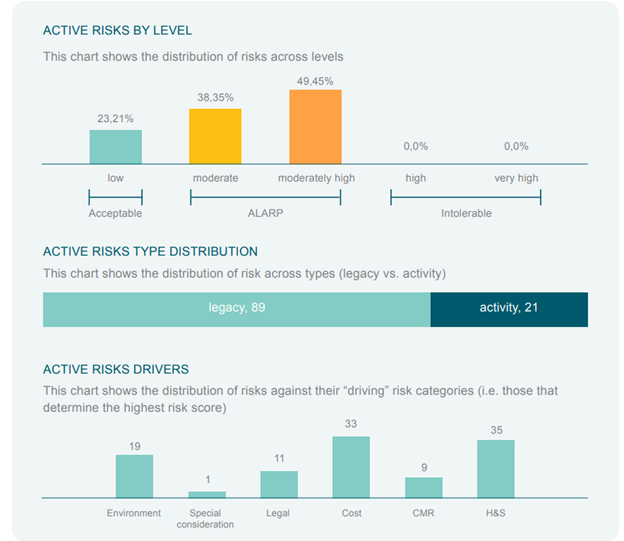
Text alternative for Figure 16: Active risks by level
Active risks by level are shown. 23, or 21%, are in the low or acceptable range. 38, or 35%, are moderate and 49, or 45%, are moderately high, which is in the as low as reasonably practicable range, and 0, or 0%, are high and 0, or 0%, are very high, and in the intolerable range.
Active risk type distribution shows that, of the risk on site, 89 are legacy risks while 21 are related to activity.
Active risk are also shown in a chart distributing them against their driving risk categories, that is, those that determine the highest risk scores.
19 risks are related to environment, 1 to special consideration, 11 are legal risks, 33 risks are related to cost, 9 are community, media, reputation, and 35 are health and safety related.

Text alternative for Figure 17: Historical Risk Profile
This chart graphs the historical risk numbers by level and type as entered on the Risk History Tab.
The risks are categorized as low, moderate, moderately high, high, and extreme. The number of active risks are on the y axis and the time or year is on the x axis. The total number of risks are also plotted and range from 120 in 2010 and varies over time to 2021 where it still sits at approximately 110. A dip in risks in 2013 reflects a change in how risks were capture in the risk categorization process.
| Year | Low | Moderate | Moderately High | High | Extreme | Total Risks |
|---|---|---|---|---|---|---|
| 2010 | 24 | 41 | 41 | 19 | 0 | 125 |
| 2011 | 25 | 63 | 37 | 12 | 1 | 138 |
| 2012 | 25 | 63 | 37 | 12 | 1 | 138 |
| 2013 | 5 | 14 | 27 | 13 | 1 | 60 |
| 2014 | 7 | 17 | 30 | 10 | 1 | 65 |
| 2015 | 20 | 55 | 48 | 7 | 0 | 130 |
| 2016 | 19 | 35 | 62 | 4 | 0 | 120 |
| 2018 | 17 | 36 | 58 | 3 | 0 | 114 |
| 2019 | 17 | 40 | 63 | 3 | 0 | 123 |
| 2020 | 22 | 36 | 43 | 4 | 0 | 105 |
| 2021 | 23 | 38 | 47 | 0 | 0 | 108 |
Appendix D: Progress on Environmental Assessment measures and suggestions: detailed tables
This appendix provides supplemental details about progress toward achieving the Measures stipulated via the Report of Environmental Assessment and Reasons for Decision (Mackenzie Valley Review Board, 2013), and plans for 2021-22. Throughout these tables, "the Project" refers to the Giant Mine Remediation Project. The language in the measures is drawn directly from the Report of Environmental Assessment and Reasons for Decision (Mackenzie Valley Review Board, 2013).
Giant Mine Environmental Assessment measures tracking table (as of March 31, 2022)
Measure: 1
Status: No action required
To prevent the significant adverse impacts on environment and the significant public concern from the proposed perpetual timeframe, the Project will proceed only as an interim solution, for a maximum of 100 years.
Project comment on status
The closure period is 100 years as outlined in the Closure and Reclamation Plan.
Measure: 2
Status: Further action required
Every 20 years after the beginning of Project implementation, the Developer will commission an independent review of the Project to evaluate its effectiveness to date, and to decide if a better approach can be identified. This will:
- consider results of the ongoing research
- be participatory in nature
- follow the requirements of procedural fairness and be transparent in nature
If the periodic review identifies a better approach that is feasible and cost-effective, the Developer will further study it, and make the study and its results of the study public.
Project comment on status
Article 8 of the June 9, 2015 Environmental Agreement further formalized the process through which the future Independent Project Review will be conducted. The Agreement ensures the independent review of the Project is conducted in a manner that considers ongoing research results, is participatory and transparent in nature and follows the requirements of procedural fairness.
Measure: 3
Status: Complete
To facilitate active research in emerging technologies towards finding a permanent solution for dealing with arsenic at the Giant Mine site, the Developer will fund research activity as advised by stakeholders and potentially affected Parties through the Giant Mine Oversight Board. The ongoing funding for this research activity, and additional resources required to manage its coordination, will be negotiated and included as part of the Environmental Agreement specified in Measure 7 and will make best use of existing research institutions and programs. The Giant Mine Oversight Board will ensure through the research activity that, on a periodic basis:
- reports on relevant emerging technologies are produced
- research priorities are identified
- research funding is administered
- results of research are made public
- results of each cycle are applied to the next cycle of these steps
Project comment on status
Articles 7 and 11 of the June 9, 2015 Environmental Agreement provide a commitment of funding for the Oversight Body (which will be known publicly as the Giant Mine Oversight Board) to manage a research program as required by Measure 3. Initial funding flowed for this Measure in 2016-17 and will be ongoing.
Measure: 4
Status: Complete
The Giant Mine Oversight Board will provide the results of the research funded by the Developer to the periodic reviews of the Project described in Measure 2. If better technological options are identified through the funded research in-between these periodic 20-year reviews, these will be reported publicly by the Giant Mine Oversight Board to the Parties, the Developer and the Canadian public. The Developer will consider these technologies and make decisions regarding their feasibility. The Developer will make any such decisions public.
Project comment on status
The Giant Mine Oversight Board hosted a research workshop in March 2018 and negotiated a Memorandum of Understanding with the University of Waterloo for TERRE-NET researchers to establish a formal research relationship with respect to alternate technological options for the permanent remediation solution for the arsenic trioxide dust stored at the Giant Mine site. Currently, the research focus is on stabilization of the dust; the safe extraction of the dust will be a future focus.
Measure: 5
Status: Complete
In order to mitigate significant adverse impacts that are otherwise likely, the Developer will commission an independent Quantitative Risk Assessment to be completed before the Project receives regulatory approvals. This will include:
- explicit acceptability thresholds, determined in consultation with potentially affected communities
- an examination of risks from a holistic perspective, integrating the combined environmental, social, health and financial consequences
- possible events of a worst-case/low frequency high consequence nature
- additional considerations specified in Appendix D of the Report of Environmental Assessment
From this, the Developer will identify any appropriate Project improvements and identify management responses to avoid or reduce the severity of predicted unacceptable risks.
Project comment on status
An independent consultant (Wood) was retained in 2018 to complete the Quantitative Risk Assessment. A separate consultant was retained to develop the engagement component (Stratos). The report and findings will be presented during engagement sessions in Spring / Summer 2020. The completed report was submitted to the Mackenzie Valley Land and Water Board in June 2020.
Results will continue to be carried forward in Project documentation as applicable, such as Design Plans.
Measure: 6
Status: Complete
The Developer will:
- investigate long-term funding options for the ongoing maintenance of this Project and for contingencies, including a trust fund with multi-year up front funding
- involve stakeholders and the public in discussions on funding options
- make public a detailed report within three years that describes its consideration of funding options, providing stakeholders with the opportunity to comment on the report
Project comment on status
The Measure 6 report on long term funding options for Giant Mine was finalized in July 2019 (Deloitte LLP, 2019).
Measure: 7
Status: Complete
The Developer will negotiate a legally-binding environmental agreement with, at a minimum, the members of the Oversight Working Group, and other appropriate representative organizations, to create an independent Oversight Body (the Giant Mine Oversight Body) for the Project. These negotiations will build on the existing discussion paper and draft environmental agreement of the Giant Oversight Working group. This Giant Mine Oversight Body will exist for the life of the Project unless otherwise agreed by the Parties to the Environmental Agreement. Every effort will be made to have the Giant Mine Oversight Body in place as early as possible. The negotiations will make significant progress within 6 months of the Ministers' Environmental Assessment decision or proceed to mediation. The Developer will cover any mediation costs. The environmental agreement will include a dispute resolution mechanism to ensure compliance with the agreement and a stable funding mechanism for the Giant Might Oversight Body.
Project comment on status
Through negotiations with the 6 affected parties (GNWT, CIRNAC, Alternatives North, the North Slave Métis Alliance, the Yellowknives Dene First Nation, the City of Yellowknife) an Environmental Agreement was signed in June 2015. This Agreement established the mandate for the Giant Mine Oversight Board. Details of the Board's mandate are included in the Giant Mine Environmental Agreement and Society's by-laws found on the Giant Mine Oversight Board 's website.
Measure: 8
Status: Complete
The activities of the oversight body will include:
- keeping track of monitoring activities by the Developer and the results of those activities, including
- water quality and aquatic effects monitoring
- health monitoring
- other monitoring
- considering the adequacy of funding for the Project and ongoing research
- providing advice to the Developer, regulators and government on ongoing improvements in monitoring and Project management to prevent risks and mitigate any potential impacts
- sharing the oversight body's conclusions with the general public and potentially affected communities in a culturally appropriate manner
Project comment on status
The Environmental Agreement provides for the creation of the Oversight Board and funding to fulfill these obligations going forward. Article 3 of the Environmental Agreement outlines the mandate of the Giant Mine Oversight Board. The Project continues engaging with Giant Mine Oversight Board staff and directors through various engagement initiatives and venues, further described in the Engagement Plan.
Measure: 9
Status: Underway
The Developer will work with other federal and territorial departments as necessary to design and implement a broad health effects monitoring program in Ndilǫ, Dettah and Yellowknife focusing on arsenic and any other contaminants in people which might result from this Project. This will include studies of baseline health effects of these contaminants and ongoing periodic monitoring. This will be designed with input from:
- Health Canada, GNWT Health and Social Services and the Yellowknife medical community
- the Yellowknives Dene and other potentially affected communities
The organization conducting the monitoring will provide regular plain language explanations of the monitoring results in terms that are understandable to lay people, and communicate this to potentially affected communities in a culturally appropriate manner.
Project comment on status
The Health Effects Monitoring Program was established in 2017. The Program is carried out by University of Ottawa's Dr. Laurie Chan and his team. It is a long-term monitoring program to establish levels of arsenic and other contaminants of concern in residents of Ndilǫ, Dettah and Yellowknife. The results of baseline data collection phase (2 waves in 2018 and 2019) indicated: that overall arsenic levels in urine are similar between the overall Yellowknife population and the Canadian Health Measures Survey levels, which represent the general Canadian population.
Measure: 10
Status: Underway
The Developer will commission a comprehensive quantitative human health risk assessment by an independent, qualified human health risk assessor selected in collaboration with:
- Health Canada
- the Yellowknives Dene
- the City of Yellowknife
- the Developer
This human health risk assessment will be completed before the Project receives regulatory approvals. It will:
- include a critical review of the 2006 Tier II human health risk assessment and the previous screening reports
- consider additional exposures and thresholds (as specified in Appendix F of the Report of Environmental Assessment)
- decide whether a Tier III risk assessment is appropriate
- provide a plain language explanation of the results in terms that are understandable to the general public, and communicate this to potentially affected communities in a culturally appropriate manner
- provide interpretation of results and related guidance
- inform the broad health effects monitoring program (described in Measure 9 above)
The Developer may conduct the human health risk assessment concurrently with the Quantitative Risk Assessment described in Measure 5. Based on the results of this human health risk assessment, and on any existing results of the health effects monitoring program (described in Measure 9 above), the Developer will, if necessary in response to this information, identify, design and implement appropriate design improvements and identify appropriate management responses to avoid or reduce the severity of any predicted unacceptable health risks.
Also, footnote number 133 in the Report of Environmental Assessment (Appendix D) is revised to read, in its entirety, "Including inference of causality and pathologies deducted from any available health studies."
Project comment on status
The Human Health Ecological Risk Assessment was completed by Canada North Environmental Services. The Human Health Ecological Risk Assessment was carried out with significant input from stakeholders, community members and traditional knowledge holders. This input included both the scope of the assessment and the implementation to better assess risks considering differences in traditional land use, food consumption, and lifestyles for residents living in Yellowknife, Ndılǫ and Dettah. The final report was released in January 2018. Additional considerations for communications are underway to ensure residents understand the outcomes which have informed public health advisories through the GNWT Department of Health and Social Services.
The Project developed the Hoèła Weteèts'eèdeè study (formerly called the Stress Study) via an independent research team through the University of Wilfred Laurier. Wilfred Laurier were the principal investigators of the study which has been co-designed with the Yellowknives Dene First Nation. The requirement of this study was identified in Appendix F to the Report of Environmental Assessment noting the requirement to "evaluate indirect effects of potential exposures to arsenic on wellness, including stress effects. At the time of writing this report the study has been put on hold indefinitely, pending advice of the Advisory Committee.
Measure: 11
Status: Complete
The Developer, with meaningful participation from the Oversight Body and other parties, will thoroughly assess options for, and the environmental impacts of, diversion of Baker Creek to a north diversion route previously considered by the Developer or another route that avoids the mine site and is determined appropriate by the Developer. Within 1 year of the project receiving its Water Licence, a report outlining a comparison of options including the current on-site realignment will be provided to the appropriate regulatory authorities, the Oversight Body and the public.
Once informed by the advice of the Oversight Body and regulatory authorities, the Developer will determine and implement the preferred option. In doing so, the Developer will consider the advice of the Oversight Body, regulatory authorities, and the public, and will ensure that the primary considerations in selecting an option are to:
- minimize the likelihood of Baker Creek flooding and entering the arsenic chambers, stopes and underground workings
- minimize the exposure of fish in Baker Creek to arsenic from existing contaminated sediments on the mine site, surface drainage from the mine site or tailings runoff. If off-site diversion is selected, the Developer will seek required regulatory approvals to implement the diversion within five years of receiving its water license
Project comment on status
A comprehensive evaluation of diversion alternatives was undertaken and documented in the Baker Creek Diversion Alternatives Evaluation Report. The assessment included an evaluation of alignment options based on environment, society and feasibility. The Draft Report was engaged on with the Giant Mine Oversight Board, the Project Working Group, and the Yellowknives Dene First Nation Giant Mine Advisory Committee. Engagement details are documented in the engagement log. Overall support for the recommendations provided for alignment option.
The Final report was provided as Appendix 5.5A to the Closure and Reclamation Plan in the Water Licence Package.
Actions taken as part of the Baker Creek design to address a) include:
- providing Baker Creek with geomorphic channel including floodplain conveyance
- designing closure channel and floodplain conveyance for floods up to and including the Probable Maximum Flood, sealing underground mine openings to surface to mitigate potential for inundation and uncontrolled flow to the underground mine during extreme events and placing pit fills in a manner to provide additional flood protection
Actions taken as part of the Baker Creek design to further address b) include: removing tailings, where present from Baker Creek and removing fine sediments, where present, from Baker Creek.
Measure: 12
Status: Complete
To prevent significant adverse impacts on Great Slave Lake from contaminated surface waters in the existing or former channel of Baker Creek, should it be re-routed to avoid the mine site, the Developer will ensure that water quality at the outlet of Baker Creek channel will meet site-specific water quality objectives based on the Canadian Council of Ministers of the Environment Guidance on the Site-Specific Application of Water Quality Guidelines in Canada.
Project comment on status
Project comments on status: Water quality objectives specific to and protective of Yellowknife Bay were developed based on Canadian Council of Minister of the Environment guidance and are presented in the Effluent Quality Criteria report. Extensive modelling including a site model in GoldSim, a near field model of the mixing zone (CORMIX) and a 3D Model of Yellowknife Bay (GEMSS) were developed to support the development of effluent quality criteria and demonstrate the Project's ability to meet water quality objectives. Modelling documentation is included in the Effluent Quality Criteria Report along with prediction of future water quality in Yellowknife Bay. The water quality objectives will be met upon completion of the Project active remediation phase and will be met in the vicinity of the outlet of Baker Creek (see Measure 13), at the edge of a 200 metre mixing zone (see Measure 15) that includes the Project's new Water Treatment Plant outfall and the influence of Baker Creek.
Site specific water quality objectives were presented as part of pre-engagement and submitted in the Effluent Quality Criteria Report to the Mackenzie Valley Land and Water Board for approval in April 2019. These were discussed at the first technical session in July 2019, hosted by the Mackenzie Valley Land and Water Board, in support of the Water Licence application process and approved by the Mackenzie Valley Land and Water Board in July 2020. Final effluent quality criteria were determined by the Mackenzie Valley Land and Water Board and included in the Project Water Licence MV2007L8-0031 issued September 18, 2020.
Measure: 13
Status: Complete
The Developer will design and, with the applicable regulators, manage the Project to ensure that, with respect to arsenic and any other contaminants of potential concern, the following water quality objectives are achieved in the vicinity of the outlet of the existing or former channel of Baker Creek, should it be re-routed to avoid the mine, excluding Reach 0:
- Water quality changes due to discharge from the former channel of Baker Creek will not reduce benthic invertebrate and plankton abundance or diversity
- Water quality changes due to discharge from the former channel of Baker Creek will not harm fish health, abundance or diversity
- Water quality changes due to discharge from the former channel of Baker Creek will not adversely affect areas used as drinking water sources
- Water quality changes due to discharge from the former channel of Baker Creek will not adversely affect any traditional or recreational users
- There is no increase in arsenic levels in Great Slave Lake due to discharge from the former channel of Baker Creek beyond the parameters described in Measure 12
Project comment on status
Measure 13 a) through d) are satisfied by selecting Water Quality Objectives for Yellowknife Bay that are protective of aquatic life and drinking water. Arsenic concentrations in Great Slave Lake, beyond the edge of the mixing zone (200 metres from breakwater), will not increase from present-day concentrations as demonstrated in the Effluent Quality Criteria Report and supporting documentation (see Measure 12).
Measure: 14
Status: Complete
The Developer will add an ion exchange process to its proposed water treatment process to produce Water Treatment Plant effluent that at least meets Health Canada drinking water standards (containing no more than 10µg/L of arsenic), to be released using a near shore outfall immediately offshore of the Giant mine site instead of through the proposed diffuser. The Developer will achieve this concentration without adding lake water to dilute effluent in the treatment plant.
Project comment on status
The new Water Treatment Plant will include ion-exchange technology as part of the treatment process and will discharge effluent meeting the criteria of 10 ug/L of Arsenic. The outfall location was identified through stakeholder engagement and options analysis and will be located nearshore of the Giant site in the vicinity of Baker Creek. No diffuser is proposed. Final Effluent Quality Criteria were determined by the Mackenzie Valley Land and Water Board and included in the Project Water Licence MV2007L8-0031 issued September 18, 2020.
Measure: 15
Status: Complete
The Developer and regulators will design and manage the Project so that, with respect to arsenic and any other contaminants of potential concern:
- water quality at the outfall will meet the Health Canada Guidelines for Canadian Drinking Water Quality
- the following water quality objectives in the receiving environment are met:
- water quality changes due to effluent discharge will not reduce benthic invertebrate and plankton abundance or diversity at 200 metres from the outfall
- water quality changes due to effluent discharge will not harm fish health, abundance or diversity
- water quality changes due to effluent discharge will not adversely affect areas used as drinking water sources
- there is no increase in arsenic levels in Yellowknife Bay water at 200 metres from the outfall
- there is no increase in arsenic levels in Yellowknife Bay sediments at 500 metres from the outfall
Project comment on status
All parameters of potential concern will meet relevant Canadian Drinking Water Guidelines at the edge of the mixing zone. Water Quality Objectives specific to Yellowknife Bay have been developed to be protective of aquatic life and drinking water and all Water Quality Objectives will be met at the edge of the mixing zone. Arsenic concentrations in Great Slave Lake, beyond the edge of the mixing zone will not increase from present-day concentrations due to effluent discharge. See Measure 12 for more details on Water Quality Objectives and supporting evidence. Final Effluent Quality Criteria were determined by the Mackenzie Valley Land and Water Board and included in the Project Water Licence MV2007L8-0031 issued September 18, 2020.
Measure: 16
Status: Underway
Before construction, the Developer will model re-suspension of arsenic from sediments and resulting bioavailability in the vicinity of the outfall. If the modeling results indicate that the outfall may re-suspend arsenic from sediments, the Developer will modify the outfall design until operation does not cause resuspension of arsenic from sediment.
Project comment on status
The Project is taking a more protective approach and mitigating the potential of sediment resuspension through design of a sediment cover, rather than modelling. The design criteria for the outfall will include the requirement to avoid resuspension of arsenic from sediments.
Measure: 17
Status: Underway
Before operating the outfall, the Developer will design and implement a comprehensive aquatic effects monitoring program that is sufficient to determine if the water quality objectives listed in Measure 15 are being met. This program will:
- at a minimum, be able to identify any accumulation of arsenic over time in the water, sediment or fish in the receiving environment
- include appropriate monitoring locations near Ndılǫ, in Back Bay and in Yellowknife Bay, with a focus on areas in the vicinity of the outfall and areas used by people
- include the establishment of a baseline for aquatic effects in Back Bay before beginning Project construction and installation of the outfall
- be developed according to AANDC Guidelines for Designing and Implementing Aquatic Effects Monitoring Programs for Development Projects in the Northwest Territories, June 2009, with corresponding action levels and management response framework
Project comment on status
The Aquatic Environment Monitoring Program Design Plan focussing on the period up to 2026 (current discharge location) was submitted to the Mackenzie Valley Land and Water Board in April 2019 and interim approved by the Mackenzie Valley Land and Water Board in August 2020. Details including Water Licence conditions were discussed in Technical Session 1 in July 2019, Technical Session 2 in September 2019 and the Public Hearings in January 2020. The Plan was resubmitted in December 2020 for conformity check and approval. A baseline field monitoring program began in 2018-19 to develop baselines for aquatic effects in Back Bay and further afield, and is ongoing. The Aquatic Environment Monitoring Program Design Plan will be updated prior to the Water Treatment Plant, as required by the Water Licence.
Measure: 18
Status: Complete
Prior to preparing chambers and stopes for freezing, the Developer will conduct a comprehensive Quantitative Risk Assessment evaluating both wet and dry methods for the initial freezing design, with respect to current risks and implications for future removal. This will include an evaluation of potential effects of the proposed freezing and wetting method on the thawing or frozen excavations, and potential impacts of ongoing design changes prior to implementing the Project. The Developer will release a plain language report to the public describing its considerations and the resulting design.
Project comment on status
The Freeze Design Basis Report was finalized in 2016 and included an evaluation of wet versus dry methods, resulting in the selection of the dry method. The plain language report was finalized and distributed to the Giant Mine Working Group, the Yellowknives Dene First Nation Giant Mine Advisory Committee, and email distribution list (June 2019).
Measure: 19
Status: Complete
Considering the results of the risk assessment described in Measure 18, the Developer will not adopt any method of freezing that significantly reduces opportunities for future arsenic removal or other remediation by future technologies.
Project comment on status
The Freeze Design Basis Report was finalized in 2016 and included an evaluation of wet versus dry. The Project is proceeding with the dry method, which combined with a passive freezing approach will allow for reversibility if needed. Closure Objective F2 and associated closure criteria address reversibility in the Closure and Reclamation Plan.
Measure: 20
Status: Underway
The Developer will conduct all major demolition and construction activities with the potential to release large amounts of dust or contaminants into the air when wind directions will minimize the chances of dust and contaminants blowing into the City of Yellowknife, Dettah and Ndılǫ.
Project comment on status
The Dust Management and Monitoring Plan defines wind levels for carrying out site activities as well as requirements for timing of activities including demolition to be carried out during times of forecasted low winds and in a direction to minimize potential impacts to local communities. As well, the site wide Air Quality Monitoring Plan is an existing and ongoing program that was designed to adapt to changing activities on site, and will incorporate all suitable measures and activities to mitigate the risks of exposure to contaminated dust throughout the life of the Project. The Air Quality Monitoring Plan is an appendix to the Dust Management and Monitoring Plan.
Measure: 21
Status: Future action required
The Developer will collect dust and contaminant level data from soil and vegetation in the vicinity of major reclamation activities before and after major demolition or construction activities to serve as a baseline for any related adaptive management activities that may follow.
Project comment on status
Activity specific monitoring such as dust and contaminant level data from soil and vegetation in the vicinity of major reclamation activities will be identified in future versions of the Dust Management and Monitoring Plan closer to the time when major demolition activities are planned. The details of dust monitoring will take into consideration the timing of demolition relative to each building, the contaminants of potential concern, the size of the building and the amount of dust expected.
Measure: 22
Status: Complete
The Developer will conduct a study to determine appropriate depth of the tailings cap and B1 pit cover, in consultation with Environment Canada and responsible regulators, to verify that the depth proposed will ensure the tailings cap and B1 pit cover are not compromised by vegetation growth. The Developer will provide a report of this study to the Mackenzie Valley Land and Water Board before it issues a water license for the Project.
Project comment on status
During Surface Design Engagement some affected parties preferred the selection of a non-vegetated tailings cover. The selection of a rock cover as outlined in the Closure and Reclamation Plan addresses the concern of the cover being compromised by vegetation growth. As a result of input received during engagement and the selection of a rock cover, this measure has been addressed.
Measure: 23
Status: Underway
The Developer will work cooperatively with responsible regulatory authorities and interested Parties in the development and submission of a Tailings Management and Monitoring Plan prior to receiving regulatory approvals. This plan will not only identify potential issues for the management of tailings but will also identify mitigation measures to prevent problems related to the tailings cap failure, and will include consideration of the B1 pit cover as applicable.
Project comment on status
A Tailings Management and Monitoring Plan (Version 1.0) was developed as part of the Water Licence application and approved (for Phase 1).
A revised version of the Tailings Management and Monitoring Plan is anticipated to be submitted by summer 2022.
Measure: 24
Status: Future action required
The Developer will physically prevent all-terrain vehicle access to the tailings cap and B1 pit cover to prevent the surface from being eroded or otherwise compromised. The Developer will monitor the effectiveness of this prevention, and will take any additional management measures as necessary to prevent all-terrain vehicle access.
Project comment on status
The selection of a coarse rock cover will prevent the surface from being eroded or comprised through all-terrain vehicle access. Closure objective T6 addresses this in the Closure and Reclamation Plan.
Measure: 25
Status: Underway
The Developer will work cooperatively with responsible regulatory authorities and interested Parties in the development and submission of an Air Quality Management Plan which incorporates an ongoing air quality monitoring program. This ongoing monitoring program will include all previously identified on-site air quality monitoring stations and one off-site air quality monitoring station near Niven Lake. At a minimum, ambient concentrations of NO2 and PM2.5 will be monitored at the Niven lake site. Total suspended particulate and metal concentrations will be monitoring at the on-site locations. This Air Quality Management Plan will identify action levels and trigger additional management and mitigation activities, if required.
Project comment on status
The Air Quality Monitoring Program comprises eight site perimeter stations and three community stations. PM2.5 is measured at the community stations, with the Niven community station also measuring NO2. The Air Quality Monitoring Plan, in conjunction with the Dust Management and Monitoring Plan, identifies action levels which trigger additional management and mitigation measures as required.
Measure: 26
Status: Underway
In conjunction with Measure 10 above, the Developer will consider the results of the comprehensive human health risk assessment, and consult with the Yellowknives Dene First Nation and City of Yellowknife when determining suitable end uses of the site, to ensure that those proposed uses do not pose a health risk to people, including toddlers.
Project comment on status
The Human Health Ecological Risk Assessment was completed in 2018 and results were presented to the Yellowknives Dene First Nation, the City of Yellowknife and other affected parties. The constraints to end land use are presented in the Closure and Reclamation Plan. The Engagement Plan outlines the extensive number of engagement activities that have taken place on the Human Health Ecological Risk Assessment and the Closure and Reclamation Plan. The Project team will continue to work with its municipal, territorial and federal counterparts to communicate site risks and end land use constraints.
Giant Mine Environmental Assessment Suggestions Tracking Table (as of April 2022)
Suggestion: 1
Status: Underway
The Developer should consult with surrounding communities, including Dettah, Ndılǫ and the City of Yellowknife, prior to finalizing its Project design, so that design improvements may be incorporated to address any remaining concerns.
Project comment on status
The extensive engagement completed since the Environmental Assessment is documented in the Closure and Reclamation Plan, Engagement Plan and the Engagement Log. This includes the Surface Design Engagement process and regular ongoing engagement through the Giant Mine Working Group, the Yellowknives Dene First Nation Giant Mine Oversight Committee and other engagement venues.
Suggestion: 2
Status: Underway
The Developer should create a monument as a memorial to the impacts of past contamination from Giant Mine on Indigenous communities and the environment.
Project comment on status
The Project has committed to a monument as this was widely supported by affected parties during Surface Design Engagement, however the details of exactly what and where the monument would go were not discussed during Surface Design Engagement The Project will engage on this with affected parties prior to finalizing the details of the monument and communicate this decision to the public.
Suggestion: 3
Status: Underway
To encourage widespread learning from and remembering of the experiences of the Giant Mine, the Developer, in conjunction with the Government of the Northwest Territories Department of Education, Culture and Employment, should:
- develop an education resource unit on the impacts of Giant Mine on the land and on people, including impacts on Indigenous peoples
- distribute this resource unit for use within the school curriculum across Canada
Project comment on status
The Project is working with the Yellowknives Dene First Nation, North Slave Métis Alliance, Giant Mine Oversight Board, and Government of the Northwest Territories Education, Culture and Employment to develop a Giant Mine education resource for the Grade 10 Northern Studies curriculum.
Suggestion: 4
Status: Underway
The Federal Contaminated Sites Action Program should develop a policy framework and guidance for the perpetual care and management of remediated contaminated sites
Project comment on status
A Perpetual Care Plan is a requirement under the Environmental Agreement. A Perpetual Care Task Force (the Task Force) has been established to assist in the development of the Perpetual Care Plan. The Task Force is made up of representatives from each signatory to the Project's Environmental Agreement. Under the Agreement, a draft was to be available to the Giant Mine Oversight Board by June however, the Project requested a formal extension from the Giant Mine Oversight Board until November 2020 to account for incorporating the results of the Quantitative Risk Assessment. A draft Perpetual Care Plan framework was submitted to the Giant Mine Working Group in August 2020 for feedback prior to the Giant Mine Oversight Board submission. The Project began engagement in 2019-20.
Suggestion: 5
Status: Outside of the Project scope
To ensure long-term funding throughout the life of the Project, the Developer should create an independently managed self-sustaining trust fund with multi-year up-front funding for the ongoing maintenance of this Project and for contingencies. A third-party expert should independently manage this trust fund. Annual reports on the condition of the fund should be provided to stakeholders and the public.
Project comment on status
This suggestion is linked to the outcome of Measure 6. A final report as required under Measure 6 was completed in 2019/20. A response to this suggestion is outside the be mandate of the Project, however the Project team will ensure the report is provided to the relevant department(s) in the Government of Canada and continue to work with our counterparts in the federal system to ensure funding is in place throughout the life of the Project.
Suggestion: 6
Status: Outside of the Project scope
To reduce public concern about the multiple roles of Aboriginal Affairs and Northern Development Canada in this Project and to increase public confidence, Aboriginal Affairs and Northern Development Canada should produce guidelines to clarify reporting structures to ensure that Project inspectors, advisors and managers employed by the federal government can perform their duties objectively and without undue pressure from within the federal government. These should be made available to the public within 6 months of Ministerial acceptance of this Report of Environmental Assessment.
Project comment on status
A response to this suggestion is outside the mandate of the GMRP, however the existing Treasury Board Values and Ethics Code for the Public Sector is available to the public.
Suggestion: 7
Status: Outside of the Project scope
Based on the results of the health risk assessment described in Measure 10, the appropriate government authorities should remediate garden and playground soils where arsenic concentrations exceed current guidelines for urban soils in Canada.
Project comment on status
The remediation of garden and playground soils is out of scope of the Project. The Project continues to cooperate with relevant federal and territorial agencies to share information.
Suggestion: 8
Status: Complete
The Developer should consider the Trail Human and Environmental Health Committee as a model for the development of the health program.
Project comment on status
The Health Effects Monitoring Program has incorporated lessons learned and similar concepts from that of the Trail BC Monitoring Program.
Suggestion: 9
Status: Underway
During its review of the diversion of Baker Creek, the Department of Fisheries and Oceans should consider the habitat loss of the existing Baker Creek and decide on any habitat design requirements for the diversion to the extent it deems appropriate. Any resulting habitat compensation requirements should be applied on the new diversion.
Project comment on status
The Project is working with the Department of Fisheries with respect to habitat loss and compensation. Discussions began in 2018 and continued in 2019 and 2020. The Project is committed to engaging with the Working Group, Giant Mine Advisory Committee, and the affected parties to determine the appropriate habitat design requirements are incorporated into the final design of Baker Creek. Fisheries and Oceans Canada will determine the final habitat design requirements through the Fisheries Act Authorization process.
Suggestion: 10
Status: Underway
The Developer should investigate the potential advantages and disadvantages of adding an engineered wetland to the Project to reduce arsenic in surface drainage. This investigation should include possible locations in the channel that formerly contained Baker Creek and in the Baker Creek diversion. On completion, the Developer should make a public report of the results of this investigation and of any resulting changes to Project design. This should be completed before a water license is issued for the Project.
Project comment on status
A Research and Reclamation Plan entitled Passive and Semi Passive Treatment systems is an Appendix to the Closure and Reclamation Plan. This plan outlines research undertaken to date on engineered wetlands and the proposed further steps to investigate the feasibility and potential effectiveness of applying passive and semi-passive treatment systems on the Giant site.
Suggestion: 11
Status: Underway
To manage the risks of airborne exposure of contaminated dust from deconstruction of buildings or other structures on site, the Developer should:
- prepare a dispersion model of dust plume given typical wind direction and speed
- define the meteorological window of opportunity to describe acceptable wind conditions to eliminate the potential for a dust cloud release and transport of surrounding communities
- consult a meteorologist to develop a sound model of weather conditions, to indicate when winds are steady and not gusting, blowing to the north
- stop if winds change or any dust controlling equipment fails
Project comment on status
The Air Quality Monitoring Program is an existing and ongoing program that was designed to adapt to changing activities on site, and will incorporate all suitable measures and activities to mitigate the risks of exposure to contaminated dust throughout the life of the Project. The Dust Management and Monitoring Plan includes Action Levels which include a number of potential mitigations and contingencies, up to and including work stoppage.
Suggestion: 12
Status: Underway
To prevent impacts on people from potentially harmful contaminant releases from deconstruction of buildings or other structures on site at the Giant Mine site, the Land and Water Board should specify allowable wind directions and wind speeds in degrees, to ensure that contaminated structures are not demolished during blustery multi-directional winds at ground level.
Project comment on status
The Air Quality Monitoring Plan is an existing and ongoing program that was designed to adapt to changing activities on site, and will incorporate all suitable measures and activities to mitigate the risks of exposure to contaminated dust throughout the life of the Project. The Dust Management and Monitoring Plan includes Action Levels which include a number of potential mitigations and contingencies, up to and including work stoppage.
Suggestion: 13
Status: Complete
The Developer should investigate options for filling in the pits, in consultation with the City of Yellowknife and the Yellowknives Dene First Nation.
Project comment on status
The option to fill pits was investigated and outlined in the Open Pits Options Assessment Report. Pit filling options were evaluated and engaged on during the Surface Design Engagement, where there was support from most affected parties to fill pits. As outlined in the Closure and Reclamation Plan, the pits will be filled or partially filled.
Suggestion: 14
Status: Underway
The Developer should consider the baseline conditions for existing fish habitat in Back Bay (including a fish habitat assessment in the area of the foreshore tailings and the aquatic effects baseline required in Measure 17) and develop a foreshore tailings cover design and foreshore tailings monitoring and mitigation plan for review by the Department of Fisheries and Oceans pursuant to habitat provisions of the Fisheries Act.
Project comment on status
Fish Habitat surveys of the foreshore tailing areas, the near shore contaminated sediments and the outfall area in Yellowknife Bay began in 2018 and continued in 2020/21. This work will inform and be presented in the Project's application for Department of Fisheries and Oceans Canada Authorization. Yellowknife Bay baseline condition surveys began in 2018 and will inform a future Aquatic Environment Monitoring Program Design Plan focused on Yellowknife Bay.
Suggestion: 15
Status: Underway
The Developer should consult with the City of Yellowknife in the design of any landfill on the Giant Mine site.
Project comment on status
Engagement sessions occurred with the City of Yellowknife through the Giant Mine Working Group and in the City-Project monthly meetings to present the proposed locations and other details of the on-site landfill, resulting in support of the proposed location in the Closure Reclamation Plan. The Non-Hazardous Waste Landfill Design Plan was submitted to the Mackenzie Valley Land and Water Board in March 2021.
Suggestion: 16
Status: Underway
The Developer should consult with Indigenous groups with respect to reduced traditional use cumulatively resulting from the proposed Project in combination with contamination from Giant Mine. This should occur prior to finalizing Project design, so that design improvements may be used to address any remaining concerns
Project comment on status
The extensive engagement completed by the Project is documented in the Closure and Reclamation Plan, Engagement Plan and Engagement Log. The Project has supported Traditional Knowledge studies and continues to incorporate community and Traditional Knowledge across programs and plans, as available.
Appendix E: Additional Information on Monitoring Parameters
E.1 Air Quality Monitoring Program
The Project team is committed to maintaining air quality parameters below the protective thresholds set by the Air Quality Monitoring Plan and listed below.
| Analyte | SourceFootnote 12 | Averaging period | Guideline / standard concentration (µg / cubic meters unless otherwise specified) |
|---|---|---|---|
| Total suspended particulates | [3] | 24 hour | 120 |
| Total suspended particulates | [3] | Annual | 60 |
| Particular matter less than 10µm (PM10) | [1] | 24 hour | 50 |
| Particular matter less than 2.5µm (PM2.5) | [2] | 24 hour | 28 |
| Particular matter less than 2.5µm (PM2.5) | [2] | Annual | 10 |
| Nitrogen dioxide | [3] | 1 hour | 213 (parts per billion) |
| Nitrogen dioxide | [3] | 24 hour | 106 (parts per billion) |
| Arsenic (As) | [1] | 24 hour | 0.3 |
| Arsenic (As) | [4] | Annual | 0.011 |
| Iron (Fe) | [1] | 24 hour | 4 |
| Lead (Pb) | [1] | 24 hour | 0.5 |
| Nickel (Ni) | [1] | 24 hour | 0.2 |
| Antimony (Sb) | [1] | 24 hour | 25 |
| Asbestos as fibre greater than 5µm in length | [1] | 24 hour | 0.04 fibres/cubic centimeters |
| Fence line: Total suspended particulates Risk Based Action LevelTable note 1 | [4] | 15-minute | 333 |
| Fence line: PM10 Risk Based Action LevelTable note 1 | [4] | 15-minute | 159 |
|
|||
E.2 Water quality monitoring
The Project team undertakes effluent and water quality monitoring in and around the Giant Mine site via different programs in order to report on surface water, groundwater and underground minewater. These programs track parameters such as:
- the volume of water pumped or discharged
- water quality
- the performance of the Effluent Treatment Plant
Parameters tested at all stations include:
- standard general parameters, for example
- temperature
- pH
- conductivity
- Hardness
- major ions
- nutrients
- total and dissolved metals and metalloids
There are also specific station requirements for other tests such as cyanide, sulphide, hydrocarbons and radium-226. Samples collected at Surveillance Network Program location 43-1 must meet federal requirements under Metal and Diamond Mining Effluent Regulations as well as the discharge criteria defined in the Project Water Licence MV2007L8-0031.
The figures below highlight the locations of surface water quality monitoring stations as well as groundwater monitoring wells and well status.

Text alternative for Figure 18: Surface water quality monitoring stations
An aerial photo of the Giant Mine site showing the location of different surface water quality monitoring stations. Shown are:
- 2 environmental effects monitoring stations
- 5 operational monitoring program stations
- 1 operational monitoring program minewater station where water is sampled from the surface
- 11 surveillance network program stations
- 3 surveillance network program stations where water is sampled from the surface
- 4 toxicity sample stations
The aerial photo also delineates where Baker Creek flows through the site and identifies areas of road, highway, the water course, industrial water, pit boundaries and the project site boundary.

Text alternative for Figure 19: Groundwater monitoring wells and well status
An area photo showing the Giant Mine site's groundwater monitoring wells and the well status.
The map shows active wells and inactive wells in 2019.
It identifies well material type:
- 19 are bedrock
- 25 are overburden
- 7 are tailings
It delineates the different well monitoring groupings. Groupings include:
- Calcine pond
- eastern portion of the site
- foreshore tailings
- Mill Pond
- North, Central and South Pond
- Northwest Pond
- western portion of the site
The aerial photo also delineates where Baker Creek flows through the site and identifies areas of road, highway, the water course, Dam 1, fault lines, pit boundaries and the project site boundary.
Appendix F: Greenhouse gas emissions
Table 26 below provides the summary of monthly consumption on site (Parsons Inc., 2021c; Parsons Inc., 2022b).
Table 21: Summary of monthly consumption for 2021/2022 fiscal year
Indirect emissions: monthly usage (kWh)
| April | May | June | July | August | September | October | November | December | January | February | March | Annual | |
|---|---|---|---|---|---|---|---|---|---|---|---|---|---|
| Purchased electricity | 490,000 kWh | 675,000 kWh | 454,500 kWh | 571,500 kWh | 445,500 kWh | 396,000 kWh | 445,500 kWh | 513,000 kWh | 558,000 kWh | 625,250 kWh | 639,000 kWh | 675,000 kWh | 6,488,750 kWh |
Direct emissions: Fuel consumption
Fuel combustion (for heating or otherwise)
| April | May | June | July | August | September | October | November | December | January | February | March | Annual | |
|---|---|---|---|---|---|---|---|---|---|---|---|---|---|
| Natural gas | 0cubic meters | 0cubic meters | 0cubic meters | 0cubic meters | 0cubic meters | 0cubic meters | 0cubic meters | 0cubic meters | 0cubic meters | 0cubic meters | 0cubic meters | 0cubic meters | 0cubic meters |
| Propane | 65,536L | 8,236L | 0L | 0L | 0L | 0L | 36,225L | 53,396L | 151,040L | 56,620L | 111,541L | 130,028L | 611,623L |
| Diesel fuel | 29,311L | 20,071L | 0L | 0L | 6,000L | 18,037L | 45,550L | 40,131L | 72,263L | 60,572L | 64,214L | 73,458L | 429,608L |
| Gasoline | 0L | 0L | 0L | 0L | 0L | 0L | 0L | 0L | 0L | 0L | 0L | 0L | 0L |
Direct emissions: Mobile transportation
Light duty vehicle (excluding trucks, sport utility vehicles and minivans) by fuel type
| April | May | June | July | August | September | October | November | December | January | February | March | Annual | |
|---|---|---|---|---|---|---|---|---|---|---|---|---|---|
| Gasoline | 0L | 0L | 0L | 0L | 0L | 0L | 0L | 0L | 0L | 0L | 0L | 0L | 0L |
| Diesel | 0L | 0L | 0L | 0L | 0L | 0L | 0L | 0L | 0L | 0L | 0L | 0L | 0L |
| Propane | 0L | 0L | 0L | 0L | 0L | 0L | 0L | 0L | 0L | 0L | 0L | 0L | 0L |
| Natural gas | 0kg | 0kg | 0kg | 0kg | 0kg | 0kg | 0kg | 0kg | 0kg | 0kg | 0kg | 0kg | 0kg |
Light duty truck (less than 3,900 kg gross vehicle weight rating, including sport utility vehicles and minivans) by fuel type
| April | May | June | July | August | September | October | November | December | January | February | March | Annual | |
|---|---|---|---|---|---|---|---|---|---|---|---|---|---|
| Gasoline | 0L | 0L | 0L | 0L | 0L | 0L | 0L | 0L | 0L | 0L | 0L | 0L | 0L |
| Diesel | 6,930L | 5,722L | 6,952L | 8,500L | 5,692L | 4,907L | 6,016L | 4,999L | 5,183L | 5,357L | 3,511L | 9,268L | 73,039L |
| Propane | 0L | 0L | 0L | 0L | 0L | 0L | 0L | 0L | 0L | 0L | 0L | 0L | 0L |
| Natural gas | 0kg | 0kg | 0kg | 0kg | 0kg | 0kg | 0kg | 0kg | 0kg | 0kg | 0kg | 0kg | 0kg |
Heavy duty truck (greater than 3,900 kg gross vehicle weight rating)
| April | May | June | July | August | September | October | November | December | January | February | March | Annual | |
|---|---|---|---|---|---|---|---|---|---|---|---|---|---|
| Gasoline | 0L | 0L | 0L | 0L | 0L | 0L | 0L | 0L | 0L | 0L | 0L | 0L | 0L |
| Diesel | 0L | 0L | 0L | 0L | 0L | 0L | 0L | 0L | 0L | 0L | 0L | 0L | 0L |
Off-road vehicle/construction equipment (including all terrain vehicles and snowmobiles)
| April | May | June | July | August | September | October | November | December | January | February | March | Annual | |
|---|---|---|---|---|---|---|---|---|---|---|---|---|---|
| Gasoline | 88.49L | 374.0L | 60L | 0L | 0L | 0L | 0L | 100L | 181.2L | 0L | 0L | 0L | 803L |
| Diesel | 3,139L | 6,749L | 4,857L | 10,025L | 7,361L | 7,260L | 12,149L | 13,167L | 16,994L | 12,315L | 19,733L | 7,059L | 120,811L |
Mobile air conditioning
Vehicles (Including haul trucks and construction equipment)
| April | May | June | July | August | September | October | November | December | January | February | March | Annual | |
|---|---|---|---|---|---|---|---|---|---|---|---|---|---|
| Number in fleet | 17 | 17 | 17 | 17 | 17 | 17 | 17 | 17 | 17 | 17 | 17 | 17 | 17 |
Comments:
- Mobile air conditioning vehicles include light‐duty vehicles.
- Propane consumption is the actual propane received on‐site rather than used as there are no flow meters installed on them.
Table 22: Greenhouse gas emission summary for 2021/2022 fiscal year
Total Emissions (kg Carbon dioxide equivalent)
Indirect emissions
| April | May | June | July | August | September | October | November | December | January | February | March | Annual | |
|---|---|---|---|---|---|---|---|---|---|---|---|---|---|
| Purchased electricity | 166,691 kg Carbon dioxide equivalent | 229,392 kg Carbon dioxide equivalent | 154,457 kg Carbon dioxide equivalent | 194,218 kg Carbon dioxide equivalent | 151,398 kg Carbon dioxide equivalent | 134,576 kg Carbon dioxide equivalent | 151,398 kg Carbon dioxide equivalent | 17,433 kg Carbon dioxide equivalent | 0 kg Carbon dioxide equivalent | 212,485 kg Carbon dioxide equivalent | 217,157.8 kg Carbon dioxide equivalent | 229,392 kg Carbon dioxide equivalent | 2,205,137 kg Carbon dioxide equivalent |
Direct emissions
Stationary fuel combustion by fuel type
| April | May | June | July | August | September | October | November | December | January | February | March | Annual | |
|---|---|---|---|---|---|---|---|---|---|---|---|---|---|
| Natural gas | 0 kg Carbon dioxide equivalent | 0 kg Carbon dioxide equivalent | 0 kg Carbon dioxide equivalent | 0 kg Carbon dioxide equivalent | 0 kg Carbon dioxide equivalent | 0 kg Carbon dioxide equivalent | 0 kg Carbon dioxide equivalent | 0 kg Carbon dioxide equivalent | 0 kg Carbon dioxide equivalent | 0 kg Carbon dioxide equivalent | 0 kg Carbon dioxide equivalent | 0 kg Carbon dioxide equivalent | 0 kg Carbon dioxide equivalent |
| Propane | 101,450 kg Carbon dioxide equivalent | 12,750 kg Carbon dioxide equivalent | 0 kg Carbon dioxide equivalent | 0 kg Carbon dioxide equivalent | 16,230 kg Carbon dioxide equivalent | 48,790 kg Carbon dioxide equivalent | 56,076 kg Carbon dioxide equivalent | 182,657 kg Carbon dioxide equivalent | 233,809 kg Carbon dioxide equivalent | 86,099 kg Carbon dioxide equivalent | 172,665 kg Carbon dioxide equivalent | 201,283 kg Carbon dioxide equivalent | 946,792 kg Carbon dioxide equivalent |
| Diesel fuel | 79,288 kg Carbon dioxide equivalent | 54,292 kg Carbon dioxide equivalent | 0 kg Carbon dioxide equivalent | 0 kg Carbon dioxide equivalent | 16,230 kg Carbon dioxide equivalent | 48,790 kg Carbon dioxide equivalent | 123,212 kg Carbon dioxide equivalent | 108,554 kg Carbon dioxide equivalent | 195,471 kg Carbon dioxide equivalent | 163,848 kg Carbon dioxide equivalent | 173,698 kg Carbon dioxide equivalent | 198,703 kg Carbon dioxide equivalent | 1,162,090 kg Carbon dioxide equivalent |
| Gasoline | 0 kg Carbon dioxide equivalent | 0 kg Carbon dioxide equivalent | 0 kg Carbon dioxide equivalent | 0 kg Carbon dioxide equivalent | 0 kg Carbon dioxide equivalent | 0 kg Carbon dioxide equivalent | 0 kg Carbon dioxide equivalent | 0 kg Carbon dioxide equivalent | 0 kg Carbon dioxide equivalent | 0 kg Carbon dioxide equivalent | 0 kg Carbon dioxide equivalent | 0 kg Carbon dioxide equivalent | 0 kg Carbon dioxide equivalent |
Mobile transportation by vehicle type
| April | May | June | July | August | September | October | November | December | January | February | March | Annual | |
|---|---|---|---|---|---|---|---|---|---|---|---|---|---|
| Light duty vehicle (excluding trucks, sport utility vehicles and minivans) | 0 kg Carbon dioxide equivalent | 0 kg Carbon dioxide equivalent | 0 kg Carbon dioxide equivalent | 0 kg Carbon dioxide equivalent | 0 kg Carbon dioxide equivalent | 0 kg Carbon dioxide equivalent | 0 kg Carbon dioxide equivalent | 0 kg Carbon dioxide equivalent | 0 kg Carbon dioxide equivalent | 0 kg Carbon dioxide equivalent | 0 kg Carbon dioxide equivalent | 0 kg Carbon dioxide equivalent | 0 kg Carbon dioxide equivalent |
| Light duty truck (less than 3,900 kg gross vehicle weight rating) | 19,107 kg Carbon dioxide equivalent | 15,777 kg Carbon dioxide equivalent | 19,167 kg Carbon dioxide equivalent | 23,435 kg Carbon dioxide equivalent | 15,693 kg Carbon dioxide equivalent | 13,530 kg Carbon dioxide equivalent | 16,587 kg Carbon dioxide equivalent | 13,782 kg Carbon dioxide equivalent | 14,290 kg Carbon dioxide equivalent | 14,770 kg Carbon dioxide equivalent | 9,678 kg Carbon dioxide equivalent | 25,551 kg Carbon dioxide equivalent | 201,427 kg Carbon dioxide equivalent |
| Heavy duty truck (greater than 3,900 kg gross vehicle weight rating) | 0 kg Carbon dioxide equivalent | 0 kg Carbon dioxide equivalent | 0 kg Carbon dioxide equivalent | 0 kg Carbon dioxide equivalent | 0 kg Carbon dioxide equivalent | 0 kg Carbon dioxide equivalent | 0 kg Carbon dioxide equivalent | 0 kg Carbon dioxide equivalent | 0 kg Carbon dioxide equivalent | 0 kg Carbon dioxide equivalent | 0 kg Carbon dioxide equivalent | 0 kg Carbon dioxide equivalent | 0 kg Carbon dioxide equivalent |
| Off-road vehicle/construction equipment (including all terrain vehicles and snowmobiles) | 9,607 kg Carbon dioxide equivalent | 21,092 kg Carbon dioxide equivalent | 14,676 kg Carbon dioxide equivalent | 29,995 kg Carbon dioxide equivalent | 22,024 kg Carbon dioxide equivalent | 21,722 kg Carbon dioxide equivalent | 36,350 kg Carbon dioxide equivalent | 39,635 kg Carbon dioxide equivalent | 51,283 kg Carbon dioxide equivalent | 36,849 kg Carbon dioxide equivalent | 59,042 kg Carbon dioxide equivalent | 21,121 kg Carbon dioxide equivalent | 21,121 kg Carbon dioxide equivalent |
Mobile air conditioning
| April | May | June | July | August | September | October | November | December | January | February | March | Annual |
|---|---|---|---|---|---|---|---|---|---|---|---|---|
| 608 kg Carbon dioxide equivalent | 608 kg Carbon dioxide equivalent | 608 kg Carbon dioxide equivalent | 608 kg Carbon dioxide equivalent | 608 kg Carbon dioxide equivalent | 608 kg Carbon dioxide equivalent | 608 kg Carbon dioxide equivalent | 608 kg Carbon dioxide equivalent | 608 kg Carbon dioxide equivalent | 608 kg Carbon dioxide equivalent | 608 kg Carbon dioxide equivalent | 608 kg Carbon dioxide equivalent | 608 kg Carbon dioxide equivalent |
Appendix G: Plain language summary
Introduction to the Giant Mine Remediation Project
The Giant Mine is a former gold mine located within Yellowknife, Northwest Territories city limits. It is about 5 km north of city centre. The site lies within the asserted traditional territory of Indigenous communities and groups.
- The site is within the Yellowknives Dene First Nation's traditional territory. As part of the Akaitcho Territory Dene First Nations, they are negotiating a land, resource, and governance agreement with the governments of the Northwest Territories and Canada
- The Tłı̨chǫ have a recognized area of traditional land use known as Monfwı̀ Gogha Dè Nı̨htł'è. In this area, members exercise rights set out in the Tłı̨chǫ Agreement. The Giant Mine site falls within this area's boundaries
- The North Slave Métis Alliance represents Métis in Yellowknife. Members assert Indigenous rights in the area that includes the Giant Mine site
- The Northwest Territories Métis Nation represents the Métis from the Northwest Territories' South Slave region. The Giant Mine site is next to Great Slave Lake, which is within the boundaries of the Land and Resources Final Agreement they are negotiating with the governments of Canada and the Northwest Territories
The Giant Mine operated from 1948 to 2004. When the owners went bankrupt, Canada became responsible for the site and the contamination left behind. This includes 13.5 million tonnes of tailings and 237,000 tonnes of arsenic trioxide waste. The Giant Mine Remediation Project (the Project) is jointly managed by:
- the Government of Canada, represented by Crown-Indigenous Relations and Northern Affairs Canada
- the Government of the Northwest Territories represented by the Environment and Natural Resources department
Together, they manage the site to protect human health and the environment while they plan how they will clean up the site.
About the annual report
The Project team is committed to informing interested parties about Project progress, activities, and plans. The team engages and shares information in several ways. One way is through submitting an annual report to the Giant Mine Oversight Board.
The report describes what has happened on the site and the activities in support of planning the clean up that took place over one federal fiscal year. A fiscal year is the budget year of the federal government, from April 1 to March 31.
In the annual report, the team provides a detailed explanation of its activities, important findings, and future plans. This is so interested parties can keep track of the Project's progress.
The Project team needs to prepare an annual report as part of the terms of the Giant Mine Remediation Project Environmental Agreement. The agreement guides what information the Project must include in the report. The Giant Mine Oversight Board reviews and comments on the report each year. This process will continue to shape the report's format and content.
This document is a plain language version of the full annual report, which provides more details about progress in 2021-22. This annual report is Giant Mine Remediation Project's seventh. It covers the period from April 1, 2021 to March 31, 2022. Activities and updates related to the Project after March 31 will be covered in next year's report.
Impact of COVID-19 on the Project
In response to the COVID-19 pandemic, the Main Construction Manager (Parsons) continued to update and implement their response plan and procedures based on government guidelines. It applied to all people at the Giant Mine site. This included scaling down site efforts to essential activities in response to possible COVID-19 exposure on-site both in October and December 2021. Overall, the biggest impacts of COVID-19 on the project were delays to engagement activities as well as some delays to operations, though the work was still completed within 2021.
Project status
In 2007, the Giant Mine Remediation Project team submitted a Water Licence application to the Mackenzie Valley Land and Water Board. The application included a remediation plan for all aspects of underground and surface clean-up. The City of Yellowknife referred this plan to Environmental Assessment. The assessment was completed in 2014. It included a Report of Environment Assessment with 26 measures the Project team must complete. The measures included developing a new clean-up plan, called a CRP. The CRP is the result of extensive engagement and design work done by the Project team since the Report of Environmental Assessment.
In April 2019, the Project team submitted the new plan and supporting documents to the Mackenzie Valley Land and Water Board. The board approved the Project's Land Use Permit in August 2020 and the Water Licence in September 2020. These can be found on the board's public registry.
In July 2021, the Giant Mine Remediation Project moved from Phase 1, which focused on care and maintenance, into Phase 2, which focuses on active remediation and adaptive management.
Progress on Environmental Assessment measures
The Report of Environmental Assessment included 26 measures. The team's immediate focus was measures with set timelines and those with the biggest impact on project scope. Since the Report of Environmental Assessment, the Project has completed and advanced many measures. The table below includes their status, as well as the status of suggestions included in the Report of Environmental Assessment.
| Status | Measures | Suggestions |
|---|---|---|
| Completed | 3, 4, 5, 6, 7, 8, 11, 12, 13, 14, 15, 18, 19, 22 | 8, 13 |
| Underway | 9, 10, 16, 17, 20, 23, 25, 26 | 1, 2, 3, 4, 9, 10, 11, 12, 14, 15, 16 |
| Future Action Required | 2, 21, 24 | |
| No Action Required / Outside Scope of Project | 1 | 5, 6, 7 |
In 2021-22, the Project focused on the Tailings Monitoring and Management Plan (Measure 23), they advanced the plan internally and sent a draft to the Giant Mine Remediation Project Working Group for comments. At the time of writing this report Measure 10 (Hoèła Weteèts'eèdeè: Understanding Community Wellbeing Around Giant Mine) has been put on hold indefinitely, pending advice of the Advisory Committee.
Advancement of remediation designs and activities
In 2021-22, the Project advanced remediation designs and activities for several project items. These included:
- waste disposal and management (non-hazardous waste landfill and contaminated soil and sediment)
- freeze designs
- water treatment projects (new water treatment plant, pumping system, and passive treatment system)
- tailings containment areas
- open pit closure
Ongoing site management
Ongoing management at the Giant Mine site is critical to ensuring it stays stable and safe for staff, area communities and the environment during remediation. This includes:
- maintaining the site
- managing risks
- conducting inspections
- monitoring the environment
- keeping dust levels down
- treating water
- health and safety activities
Key activities in 2021-22 included:
Care and maintenance
Ongoing care and maintenance at Giant Mine is essential to manage current risks and prevent harm to staff, area communities, and the environment. In 2021-22 the Project continued care and maintenance activities. These included:
- air quality monitoring and sampling
- undertaking dust management activities, including applying SoilTac to tailings containment areas
- preparing for the spring freshet (that is, spring thaw)
- monitoring and sampling water and effluent
- discharging treated effluent
- maintaining site infrastructure and roads
- monitoring of the dams
- conducting underground care and maintenance, including stabilization work, enhancing safe working conditions, and improving the communications system
- providing full time on-site emergency medical services
- undertaking site security activities, including putting up new signs and upgrading security fences
- conducting weekly inspections of the Material Storage Area
Infrastructure review
Every few years the Project examines buildings to see if they are putting people on site at risk. If they need to be addressed before cleanup takes place the Project team takes action. In 2021-22, the Project team completed an assessment of all remaining buildings and established that a review of all buildings on site is not required, since all buildings are scheduled to be demolished in the short term, and any buildings that required any further inspections will be conducted on a case-by-case basis. The demolition of townsite buildings is scheduled to start in 2022-23.
Northwest Deep Well Pumping Station upgrade
The Northwest Deep Well Pumping Station pumps water out of the underground at Giant Mine so water stays well below where the arsenic trioxide is stored. After operating for 4 years, the pump system was working at a slower rate and the Project developed a plan to upgrade the station, including the addition of new pumps and an electrical building to power them. One pump stopped working in August 2019, after a power brown-out. The Project Team re-installed the pump 2021-22, which then worked as designed.
Dam inspections
Dams are used to manage mine, surface water and tailings on site. Every year, the dams are inspected for safety and to assess water levels. In 2021-22, the inspection concluded that the dams had not worsened since the previous inspection and were performing satisfactorily.
Regulatory inspections
In 2021, external regulators conducted 13 external inspections. The regulators decide how many inspections per year are needed, based on what work is being done at the site. There were no non-compliances identified, however the Project team identified and completed corrective actions to improve dust and waste management, with the covering of the old non-hazardous landfill area within the Northwest Pond and the implementation of the operational Waste Transfer Station.
The Main Construction Manager and their subcontractors also conduct regular internal inspections. This includes daily site inspections by care and maintenance staff and regular engineering inspections of major structures and equipment. These inspections identified minor issues only, and these were quickly address and corrected.
In 2021-22, the Project team completed an Environmental Health and Safety underground audit that found 8 non-compliances, 2 non-conformances, and 27 areas for improvement. The Project team has taken corrective actions for several of these findings and will continue to make progress.
Environment
The Project has an Environmental Management Plan that guides how each major component of the site is managed. Currently, the Project has several active monitoring programs in place for key environmental issues. The Project's Long-Term Monitoring Program combines all current monitoring activities and those that will be required. This includes monitoring of the environment and structures/technology.
Environmental
- Surveillance Network Program
- Metal and Diamond Mine Effluent Regulations, including Environmental Effects Monitoring Program
- Operational Monitoring Program (Effluent Treatment Plant, underground, annual site-wide bird survey)
- Aquatic Effects Monitoring Program
- Wildlife and Wildlife Habitat management and Monitoring Plan
- Air quality: fenceline and community
- Noise
Structural
- Freeze
- Dams and seeps
- Landfill
- Pit stability
- Tailings covers
- Underground Structures
- Baker Creek (icing)
The Long-term Monitoring Program is used to:
- determine baseline conditions,
- monitor current conditions and performance of management programs, and
- inform the design process for remediation activities.
Air
The Project monitors air quality on a regular basis. In 2021-22, monitoring showed that the air quality where the Project's air emissions are located is similar to regional and local air quality. The Project also kept dust down so residents are not exposed to contaminants from activities occurring at the site. In addition, the Project is taking steps to actively reduce greenhouse gasses now and during remediation.
Water
The Project continues to treat effluent (that is, liquid waste) at the site's effluent treatment plant. It is treated to meet the criteria in the former mine's Water Licence and criteria that meets relevant regulations. In 2021-22, 589,700 cubic meters of treated effluent was released into the environment. Tests showed the treated effluent met requirements before release. The Project conducted environmental effects monitoring to see if the treated effluent caused negative effects on aquatic life. Results were similar to previous years' results: there were no significant concerns.
In 2021-22, other key Project activities included:
- submitting the revision for the Aquatic Effects Monitoring Plan to the Mackenzie Valley Land and Water Board
- advancing the Fisheries Act Authorization application
- continuing to engage with Fisheries and Oceans Canada
- completing the Large-Bodied Fish Sampling Program
Land
The Project monitors and manages arsenic-impacted waste on site, as well as other hazardous and non-hazardous waste. Monitoring and reducing impacts on wildlife are other important activities on site. In 2021-22, key activities included:
- setting up a Waste Transfer Station for operational waste created on site
- reviewing the Wildlife and Wildlife Habitat Management and Monitoring Plan
- logging and reporting wildlife sightings and interactions
Health and safety: occupational and public
Occupational health and safety
Health and safety on site are very important to the Project team. The Project keeps track of how many incidents and near misses happen each month and reports this information to the Project Director. Workers discuss incidents and near misses in daily safety meetings so workers can review lessons learned, identify causes, and prevent future incidents.
The table below shows the incidents and near misses in 2021-22.
| Incidents and Near Misses | 2021-22 Total |
|---|---|
| Major Incident: An incident resulting from activities performed at the site that results in a severe and irreversible disability, impairment, injury, illness or fatality to an individual or individuals. | 0 |
| Moderate Incident: An incident resulting from activities performed at the site that results in a reversible disability, impairment, injury or illness that temporarily alters the lives of an individual or individuals. | 3 |
| Minor Incident: An incident resulting from activities performed at the site that results in injury or illness that inconveniences an individual or individuals. | 9 |
| Near Misses: An unplanned incident resulting from activities performed at the site that did not result in any disability, impairment, injury, illness or fatality, but had the potential to do so. | 71 |
The number of moderate and minor incidents have changed each year. The Project looks at the number of incidents compared to the number of hours worked. Moderate incidents slightly decreased in 2021-22, to 3 incidents. Minor incidents have increased (9). The number of reported near misses in 2021-22 (71) are higher than 2010-21 (56) but lower than numbers recorded between 2016-17 and 2018-19.
The Project also tracks arsenic levels in workers on site. In 2021-22, there were 25 urine samples that were above the accepted level, out of 1305 samples taken (1.92%). This percentage is higher than the previous year (1.24%), but lower than levels recorded in 2018-19 (3.25%) and 2019-20 (2.20%). When a worker's sample is above the accepted level, the Project takes immediate action. This includes taking steps to reduce the worker's exposure, which may mean changing the type of work they do until their levels return to below the accepted level. The Project also investigates the cause of the exposure.
The care and maintenance contractor also ensures employees and subcontractors receive relevant health and safety training. This includes first aid, wildlife safety, water safety and fire response, as required by applicable regulations.
Health Effects Monitoring Program and Hoèła Weteèts'eèdeè
The Health Effects Monitoring Program will establish current levels of arsenic and other contaminants of concern in people's bodies. This means the study had to take place before the cleanup starts. During remediation, the participants will provide samples again. These new results will be compared to the current levels. This study will help make sure the remediation activities do not negatively impact people's health.
The monitoring program completed its baseline sample collection in 2018. Public engagement was held in May 2019 to report back on the initial results of the study. The results from the 2 waves of sampling are similar to Canada's population in general. In 2021-22, the Advisory Council continued to provide information to the public and prepare for sampling that will take place in 2022-23. A study with children will start in 2022 and with both children and adults in 2027, when the remediation is happening.
Hoèła Weteèts'eèdeè: Understanding Community Wellbeing Around Giant Mine (formerly called a stress study) was discontinued at the request of the Yellowknives Dene First Nation.
Key engagement
Engagement is an important and valued part of the Giant Mine remediation process. In 2021-22, the Project team continued its regular engagement with key affected parties through avenues such as:
- the Giant Mine Oversight Board
- the Giant Mine Advisory Committee
- the Giant Mine Working Group
- the annual public forum
Specific engagement sessions were also held to focus on:
- the Quantitative Risk Assessment
- the Perpetual Care Plan
- Socio-economic Strategy implementation
- management and monitoring plans
- aquatics, such as
- Baker Creek design
- Monitoring
- fishing authorization requirements
- future conditions of Yellowknife Bay
In 2022-23, engagement will focus on:
- outreach to communities and businesses on procurement and contracting opportunities
- the Socio-Economic Strategy
- closure criteria for site components
- minewater elevation action levels
- the Perpetual Care Plan
- aquatic effects monitoring program
- community outreach for the health effects and monitoring studies
- the Project Implementation Plan for remediation of the site
- remediation work
Socio-economic
The Giant Mine Remediation Project works to deliver social and economic benefits to Indigenous and Northern communities while protecting the environment and people's health. Parsons, the Main Construction Manager, uses several tools to help the Project team achieve their socio-economic goals. This includes subcontracting to Indigenous and Northern businesses and incorporating criteria into all tenders that encourage employment, training, and apprenticeships for Indigenous workers.
The Project tracks total employment and employment by certain categories. This includes:
- Northern workers
- Indigenous workers
- how Indigenous Opportunities ConsiderationsFootnote 13 commitments are met during procurement
- female workers
The overall hours worked increased across employment categories. Northern employment increased from 38% to 46% in 2021-22. Indigenous employment increased from 15% to 21%, and Indigenous Opportunities Considerations employment continued to increase compared to previous years, from 13% to 18%. Overall, the number of hours worked by female employees increased in 2021-22, however, when compared to the total hours worked in the project, percentage of hours worked decreased slightly from the previous year, from 24% to 20%.
Text alternative for Percentage of person hours by category from 2017-18 to 2021-22
| 2017-18 | 2018-19 | 2019-20 | 2020-21 | 2021-22 | |
|---|---|---|---|---|---|
| Female employees | 17% | 22% | 22% | 24% | 20% |
| Northern employees | 67% | 44% | 44% | 38% | 46% |
| Indigenous employees | 20% | 19% | 20% | 15% | 21% |
| Indigenous Opportunities Considerations employees | 20% | 18% | 8% | 13% | 18% |
In 2019-20, the Project worked with the Socio-Economic Working Group and the Socio-Economic Advisory Body to set employment targets for the Project's implementation. In 2021-22, employment accounted by women was within the target range despite the slight decline in the overall percentage compared to total numbers. Employment accounted by Northerners and Northern Indigenous employees continue to be below the lower end of the target range but experienced a slight improvement from previous years. The table below shows total employment accounted for by Northerners, Northern Indigenous, and Women in 2021-22 compared to the target ranges.
| Key Performance Indicator | Number of person hours | Person-hours as percentage of all person-hours | Target ranges for the implementation phase | Gap |
|---|---|---|---|---|
| Employment accounted by Northerners | 166,293 | 31% | 55-70% | 9-24% |
| Employment accounted by Northern Indigenous | 73,394 | 20% | 25-35% | 5-15% |
| Employment accounted by women | 74,518 | 20% | 15-30% | Within target range |
The Project anticipates that the Northern and Northern Indigenous employee statistics will continue to improve during the Implementation Phase of the project as the demand for on-site work will increase. The Project will continue to work with its partners to identify next steps in improving these employment figures.
The Project also tracks suppliers by type, specifically Northern, Indigenous and Indigenous Opportunities Considerations. In 2021-22, procurement among Northern and Indigenous suppliers observed a significant increase from previous years. The proportion of money spent on contracts for Northern reached 59% of the total expenditure (approximately $43 million). The proportion spent with Indigenous suppliers and Indigenous Opportunities Considerations suppliers increased to 41% ($30 million for each sub-category). Procurement from southern suppliers decreased to 41% ($30 million).
Text alternative for Percent of total dollar value spent from 2017-18 to 2021-22
| 2017-2018 | 2018-2019 | 2019-2020 | 2020-2021 | 2021-2022 | |
|---|---|---|---|---|---|
| Northern suppliers | 47% | 56% | 44% | 32% | 59% |
| Southern suppliers | 53% | 42% | 56% | 68% | 41% |
| Indigenous suppliers | 41% | 27% | 36% | 25% | 41% |
| Indigenous Opportunities Considerations suppliers | 35% | 29% | 35% | 24% | 41% |
In addition to the occupational health and safety training, Project contractors deliver workforce training, including site orientations. In 2021-22, the Project registered the highest training numbers since recording; the total number of people trained (335) increased by 47% from 2020-21. Workforce training provided to Northern, Indigenous, and Indigenous Opportunities Consideration employees all increased compared to previous years.
Text alternative for Percentage of People Trained by Employee Group from 2017-18 to 2021-22
| 2017-2018 | 2018-2019 | 2019-2020 | 2020-2021 | 2021-2022 | |
|---|---|---|---|---|---|
| Northern employees | 57% | 35% | 47% | 50% | 75% |
| Female employees | 17% | 23% | 27% | 32% | 22% |
| Indigenous employees | 18% | 14% | 24% | 30% | 56% |
| Indigenous Opportunities Considerations employees | 17% | 23% | 10% | 14% | 38% |
In closing
In 2021-22, the Project began initial remediation work despite challenges related to COVID-19 pandemic. The Project continued care and maintenance, immediate risk mitigation, community engagement activities, and progressing the review and resubmission of its management and monitoring plans.
The Project will continue to prepare annual reports about its progress and performance, and to develop a plain language summary of its annual reports.
For more information or to provide comments, please contact:
Natalie Plato, Deputy Director
natalie.plato@rcaanc-cirnac.gc.ca
867-669-2838